Coveo's Case for Anglera Stops at the Visit
Coveo's release on buying Anglera rests on an Anglera-reported 30-day test of about 300 apparel SKU variants that counted visits and gave no base or sales, short of the standard Anglera's own founders had published. The price the release withheld sits in Coveo's same-day MD&A: US$7.2 million in cash, net of cash and debt, plus a possible payment tied to performance targets.
Sir John Crabstone
Coveo, a Montreal search firm, bought Anglera on 29 October; its release offers one apparel test as evidence that AI shopping assistants reward richer product data. Anglera, a Y Combinator start-up, uses agents to pull attributes from spec sheets, PDFs and images, keeping a source reference for each. The test was reported by Anglera, covers “approximately 300 SKU variants” and stops at the visit.
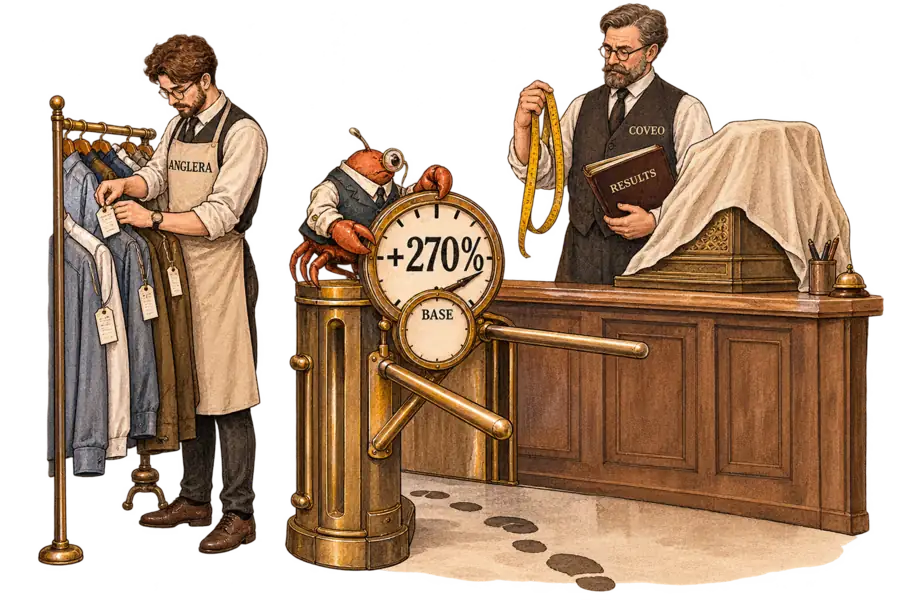
Over 30 days, says footnote 2, enriched pages saw “a 120% increase in organic landing-page traffic and a 270% increase in AI-referred visits” against a control group. It names no retailer and gives neither base counts nor sales. A 270% rise turns ten visits into 37. The footnote, which ends “Results may vary”, does not say whether there were ten.
A percentage without its base is an adjective.
Anglera’s founders had published a stricter standard. In June, Amay Aggarwal wrote that apparel is where product-data ROI is “easiest to prove and hardest to fake”. Of organic and AI-referred traffic he added: “none of them should be treated as the headline”. The release made them its only proof.
His recipe asks for 200 to 500 SKUs and an untouched control. The enriched arm roughly matched the range; the release does not size the control. Its final instruction reads “Translate to dollars last”, meaning conversion revenue and returns avoided. The release never gets to the dollars.
Ray Iyer, his co-founder, was blunter in May. His post was about analytics undercounting AI clicks, but the warning carries. There is no clean number for AI traffic, he wrote, adding: “Anyone who tells you otherwise is rounding off a lot of uncertainty.” Five months later, the release offered a percentage with no base.
The release’s other figure, a discoverability loss of “up to 30%” from missing attributes, comes from an August 2025 NielsenIQ post. “Our data shows,” it says, and gives neither sample nor method; the figure links to a 2021 NIQ article. Its examples include allergens and pack sizes; it ends by selling NIQ Brandbank’s content service. Both suppliers of the release’s figures sell product content.
VTEX’s newsroom reported the test next day without its footnote. It called the gap “the clearest evidence yet” that catalogue completeness “now directly shapes whether a product shows up in an AI assistant’s answer”. Clear evidence usually arrives with its base.
Unite.AI kept the footnote. It also repeated the release’s line on price: “Terms of the transaction were not disclosed.”
The price, at least, appeared the same day in Coveo’s quarterly MD&A: US$7.2 million in cash, net of cash and debt. A further cash payment, “if any”, depends on “specified performance targets”. The targets are specified, though not in the MD&A.
The release sketches a next step. Unsuccessful searches on Coveo could flag gaps for Anglera to fill, “while Coveo measures the impact on discovery and conversion”. Conversion makes it into the plan, if not yet into the proof.
Coveo already sells Discovery for Agentic Channels, which runs a retailer’s Coveo ranking inside ChatGPT, capturing every “query, click, and conversion”. For customers who buy both, one firm could write the product data, rank it and grade it. Whether or not the enrichment paid, the retailer would hear from the firm that sold it.