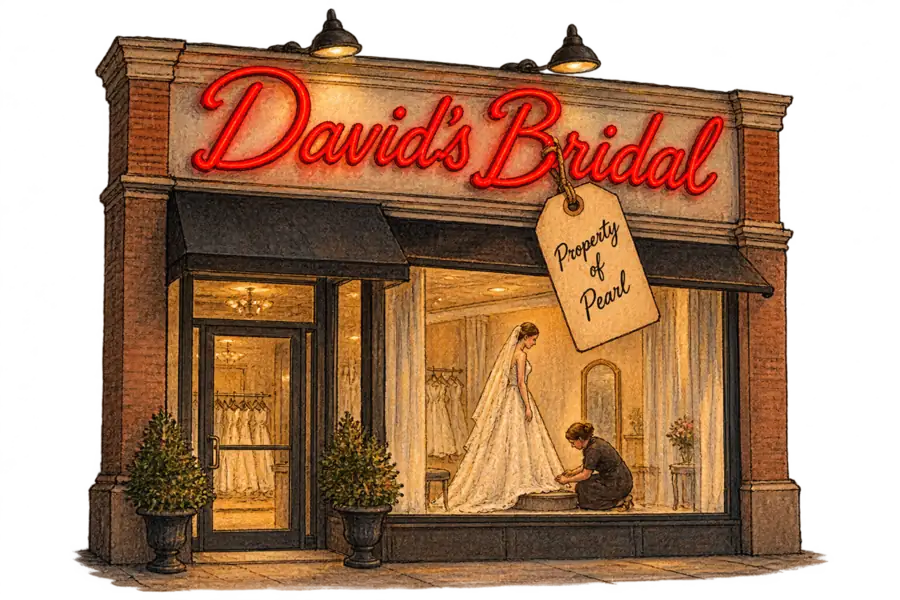
David's Bridal Shops Found the Brides. Pearl Would Own the Name.
A letter of intent would move David's Bridal's brand and intellectual property into Pearl, its AI planning and media arm, with the name licensed back to the shops. The deck says 96% of new Pearl accounts arrive from in-store appointments, but it gives no split of Pearl's projected 2027 EBITDA between the shops and everyone else.
Sir John Crabstone
David’s Bridal proposes to separate its AI planning and media arm and send the family name with it. On 22 October the chain and K&F Growth Acquisition Corp. II, a SPAC, announced a non-binding letter of intent to take Pearl public. The announcement says the separation would result “in Pearl owning David’s Bridal’s brand and intellectual property”. The shops would stay in the retail business, trading under a name they no longer owned.
The announcement’s first footnote says Pearl “currently operates under Pearl by David’s and/or Pearl by David’s Bridal”, so Pearl leans on the name too; after the split, only the shops would need a licence for it.
CNBC called Pearl an “AI platform” that would own the intellectual property “and license it back to the chain”. “Most AI companies have to find a customer,” said Kelly Cook, who runs David’s Bridal and would run Pearl. “We already have her …” She is right about the customer; the open question is who “we” will be after the split.
On Pearl’s own figures, the shops do the finding. The investor presentation says 96% of new Pearl accounts “arrive pre-built from an in-store appointment”, and 65% of booked bridal appointments became Pearl users. On that evidence the fitting room is Pearl’s acquisition channel, and the release leaves the stores with the retail business.
The deck’s boldest number has a footnote, and the footnote is about dresses. Pearl says 90% of American brides engage with its “ecosystem”; the footnote describes an estimate based on unique cookies, new cookies and three or more product-listing-page loads “in the bridal gown category”. Since launch, Pearl Planner has reached 7.3% of the roughly 2 million US brides a year.
At 9.3 times projected 2027 EBITDA, the $350m enterprise value implies EBITDA of $38m-39m, on revenue of $85m-95m. The release expects Pearl and the shops to sign “long-term, commercial agreements”; the deck gives no split of that EBITDA between the shops and everyone else.
The deck’s risk factors mention “brand and intellectual property license arrangements” with David’s Bridal, without terms. They concede that the agreements “were not negotiated on a purely arm’s-length basis”, and that Pearl may have received “better terms from unaffiliated third parties”. The chain, controlled by CION Investment Corporation, would take up to $99m in cash and keep a stake; with CION, it would hold 25% at zero redemptions. Pearl could license the name to strangers; the shops could license it from no one else.
A spokesperson confirmed the licence-back to Retail Dive, and said David’s Bridal expects a new chief executive before the split. The name would take Cook with it, though she would stay on David’s Bridal’s board.
No definitive agreement has been signed. K&F’s shareholders vote on 3 November on extending its deadline to 7 February 2028, and closing is pencilled in for the first half of 2027. The announcement promises “no disruption”. The sign over the door would read as it always has, and belong to someone else.