De Meo Is Rebuilding Kering Like a Car Company
Luca de Meo's ReconKering plan attaches each Kering house first to a cost structure and second to a creative proposition, reversing the decade when creative directors drove luxury strategy.
Neritus Vale
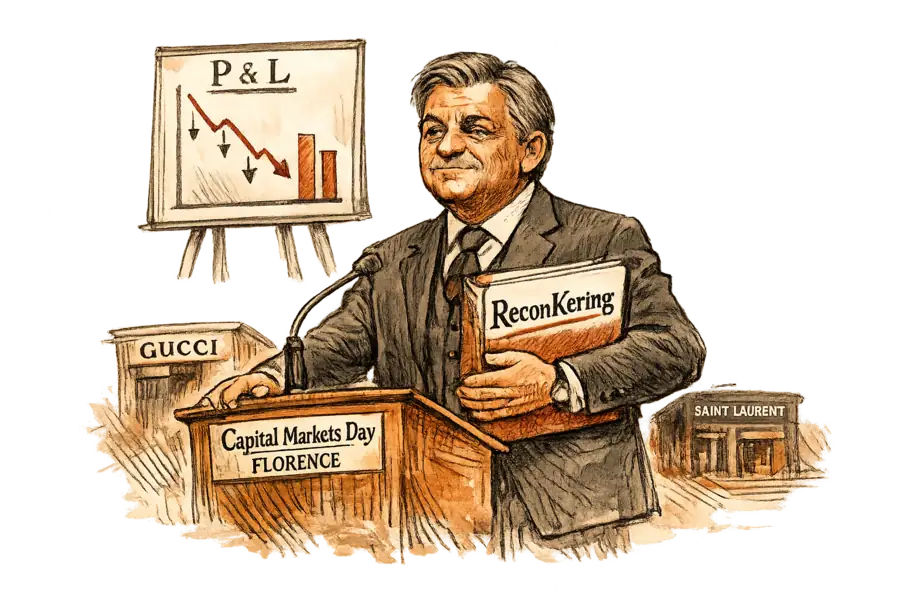
Luca de Meo has told Kering’s brands what they cost before asking what they should look like. His ReconKering plan, unveiled in Florence on 16 April, attaches each house first to a cost structure and second to a creative proposition, organised around three phases (reset by 2026, rebuild by 2028, leadership reclaimed by 2030). That reverses the decade after Alessandro Michele’s Gucci ascent, when Kering behaved as though a sufficiently distinctive creative director was a viable strategy on his own. The gap between the group’s 27% recurring operating margin in 2022 and its 11% in 2025 is what you get when that assumption meets an exhausted maximalist cycle.
The operational portion of the plan reads like a post-acquisition diligence list for a mid-cap industrial. Gucci’s assortment has been cut by roughly a fifth; by 2030 the group will have shuttered at least 250 net stores. De Meo is thinning the supplier base toward long-term preferred relationships and, in his own phrasing, importing auto-industry expertise to raise productivity and lower cost. None of this is recognisable as luxury strategy in the way the past decade taught the market to read it.
Cash has moved before creative direction. De Meo sold Kering Beauté to L’Oréal for €4 billion and offloaded a majority stake in the group’s Fifth Avenue flagship, addressing a debt load the market had begun to price as a structural liability. The stated target is to more than double 2025’s recurring operating margin in the medium term. These are not the numbers a group reaches by finding the next Michele.
The brand-by-brand tiering is where the philosophy becomes unambiguous. Gucci, which generates most of group profit, is being restructured rather than redirected: its icon handbags are meant to climb toward 20% of leather-goods sales from about half that today. Saint Laurent, which works, gets scaling — more menswear, more Asia, fewer structural changes. Bottega Veneta is being pushed beyond leather; Balenciaga off its menswear dependence. Alexander McQueen, Brioni, Ginori 1735 and Pomellato have been given roughly two years to prove profitability or face divestment. What unites the list is that each brand’s creative question is defined by its operational one, not the reverse.
Creative direction is the lagging indicator now, not the leading one.
Demna is still in the building, which is the subtlety of the reversal. The designer who arrived from Balenciaga last July is not being asked to invent Gucci. He is being asked to render a brand the CEO has already outlined — heritage-forward, leather-goods-weighted, with tighter visual codes. De Meo’s own language (Gucci is “not vanilla ice cream,” the task is to “refocus, reanchor and reposition”) describes a product, not a muse. The decade of Michele at Gucci, Slimane at Saint Laurent, and Demna at Balenciaga assumed a powerful enough creative could pull a house toward profit on his own. De Meo has decided the creative pulls nothing at Kering until the P&L is sitting still.
The strongest case against this is that Kering’s problem was always desirability, and desirability is won by shows, not by cutting costs. For the thesis to fail, Demna’s first Gucci collection would have to reset brand heat so decisively that customers returned regardless of how many SKUs the group kept, making the operational plumbing moot. There is precedent: Gucci’s 2015 turnaround under Michele and Marco Bizzarri rested on a creative inflection, not a factory audit. But the precedent cuts both ways. Michele’s eight-year run ended with the margin at 27%; the three years since have taken it to 11%, which is evidence that a hot creative does not indefinitely cover for an over-extended operation. The Kering that de Meo inherited had priced in the next Michele for a decade and was still losing money.
The specific consequence is that Kering has converted its creative directors from strategy into staff. A house under de Meo’s plan now begins with how much it costs, how many doors it runs, which products repeat, and what margin it must hit; who designs it is a downstream question, however famous. That is cheaper, more legible to investors, and more survivable in a flat luxury cycle. It is also a group decision, not an industry fate: LVMH under Arnault has always led with operations, and Hermès almost never speaks of its creatives at all. Kering spent ten years running the other experiment; it is about to spend five testing this one.