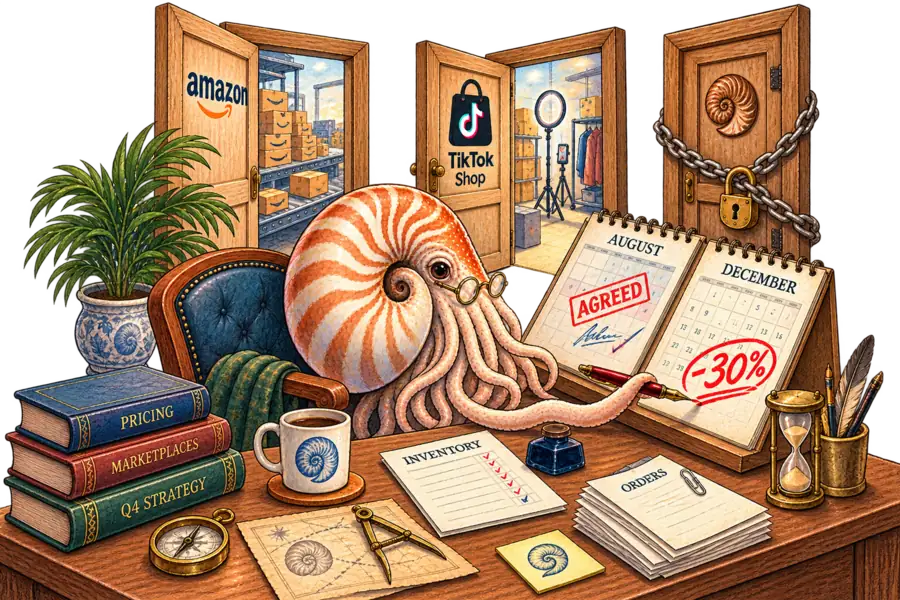
December Only Collects the Discount August Already Set
A Glossy+ survey of 90 brand and retailer professionals finds 81% holding holiday discount depth level with 2025 while planned use of owned storefronts drops by more than twenty points. Q4 margin is now a contracted number, and the only line still loose is the revenue the plan assumes.
Neritus Vale
Q4 margin for 2026 was decided in August, and December will only tabulate it. The dullest finding in Glossy+ Research’s holiday survey is the one that settles the season: 81% of brand and retailer professionals plan to discount at about the same depth this year as they did in 2025. Discount depth is the largest single input into holiday gross margin, and it has stopped being a decision anyone is still making. Seventy-six percent of the same 90-person panel expect the season to be bigger than last year’s. Planning for growth while holding discount flat means the extra volume has to come from somewhere other than price, and the survey is clear about where its respondents expect to find it. Q4 has stopped being a demand event to be won and become a plan to be executed.
Flat is not restraint when the baseline is already deep. Salesforce went into the 2025 season projecting an average US Cyber Week discount rate of 29% and telling retailers the rate would rise year over year, as Digital Commerce 360 reported. A brand holding 2026 depth level with 2025 has not protected margin. It has declined to concede more than it already conceded. Depth also moves in one direction once a season opens: a merchant can always cut further, and almost nobody raises a price in November. That makes the August figure a ceiling on Q4 margin rather than a forecast of it.
The channel decision is the part of the plan that cannot be revised. Planned use of owned e-commerce sites fell 23 points year over year in the same survey, and owned physical retail fell by a similar margin. Neither decline is a verdict on what works: the same respondents say owned stores grow more important during the holidays, not less, and Rhode’s single-day record ran entirely inside a channel it owns. The survey’s own interviewees read the drop differently — A-Frame’s Ari Bloom calls it brands taking owned channels for granted as wholesale fades, while Mastercard’s Susan Grossman blames a more fragmented, non-linear path to purchase rather than disinvestment. Importance is a belief; usage is a budget, and the budget was signed first.
What the panel plans to lean on instead is a set of surfaces where the brand is a tenant. A third of respondents intend to sell on Amazon this season, and TikTok Shop appears as its own line in the survey for the first time. Owned usage fell and third-party usage did not, which reweights the mix toward rented distribution whether or not any respondent would describe the choice that way. Each of those routes carries a take rate settled in a contract signed long before the season opens. A discount is a concession a brand chooses; a commission is a price a brand already accepted. Only the first can be revisited by a merchant having second thoughts in the second week of December.
The media plan locks earlier than the merchandising plan and travels the same way. Connected-TV and streaming advertising rose 22 points year over year to become the panel’s fastest-growing tactic, with television advertising close behind. That inventory is bought upfront, in dollar commitments that do not reprice when November disappoints, and it is a rational answer to a season whose single peak has flattened into a plateau. What fell were the tactics a marketer can switch off mid-season: gift guides and influencer unboxing both dropped by double digits. Flexibility is the first thing a brand spends when it is defending a revenue number it has already promised.
The deepest of those cuts lands on the tactic the panel itself rates highest: gift guides top the survey’s historical ranking of best-performing holiday tactics and are also the tactic falling fastest into 2026. Ritual’s chief growth officer, Laura Brodie, told Glossy that gift guides have taken on a second job in the age of answer-engine optimisation, because a structured comparative page is what a language model reaches for when a shopper asks it what to buy. Shoppers are asking: Attentive put the question to 600 US consumers this month, and 43% said they had used an AI tool to find deals, coupons or the best price. Cutting the pages that feed the answer while price discovery migrates into them saves media budget and spends margin. If the mix holds, the bill arrives in January as markdown nobody planned.
None of this rests on a forecast about agents. One in five orders worldwide during Cyber Week 2025 already involved an agent-driven recommendation or a conversational service exchange, on Salesforce figures reported by CX Today. A flat-discount plan has to survive contact with a shopper whose first move is to ask something else what the real price is.
Everything in the holiday plan is contracted except the number it exists to deliver.
The strongest objection is that none of this is locked. August intentions are stated preferences, not contracts, and promotional calendars get torn up in the second week of November when one competitor goes deeper and the field follows. In-season repricing has gotten faster and cheaper as markdown software has improved, which argues that the survey captures an opening position rather than a commitment. The thesis fails if that flexibility runs both ways, and the condition is exact: a brand must be able to move price up as readily as down. It cannot, and the previous edition of the same survey shows what one-way flexibility does. Sixty-seven percent of a smaller panel said their 2025 discounts would hold level with 2024, while Salesforce was telling the market its average discount rate would rise regardless.
Revenue shortfalls in Q4 are settled in one currency, and it is markdown. Discount depth was set against last year’s, channel terms were signed with Amazon and TikTok Shop, and streaming inventory was booked months out. The 76% expecting revenue growth agreed that figure with nobody but themselves. If the growth does not arrive, the only line loose enough to move is price, and it moves in the one direction the ratchet permits. A brand can treat the revenue number as the promise and let discount absorb the gap, or treat discount as the promise and let revenue come in short. Both are decisions made in August, and only one of them is usually made on purpose.