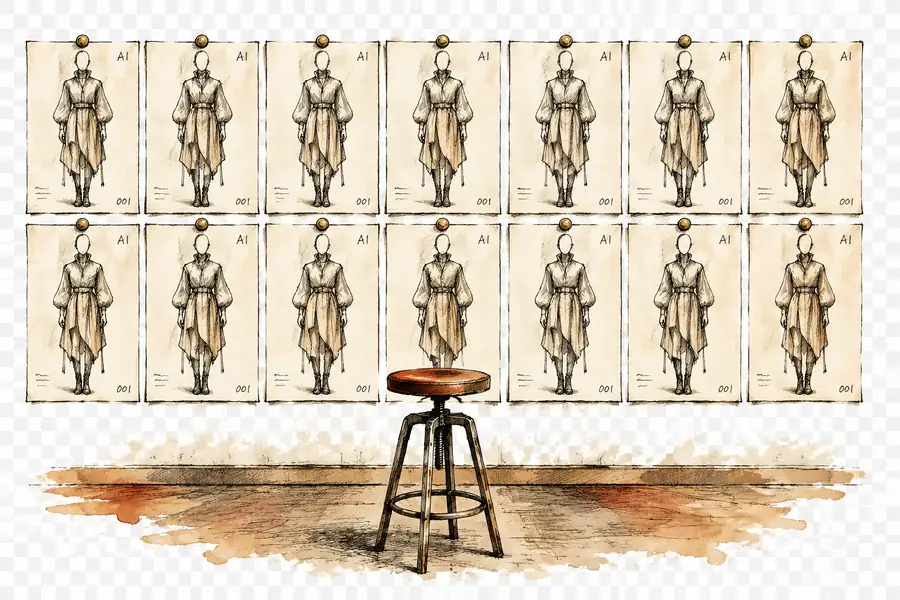
Design Schools Taught The Tool. The Judgment Didn't Follow.
Parsons, Central Saint Martins and FIT folded generative AI into the studio over the past two years, and their educators now report graduates fluent in prompting and thin on critique. The research on why says the judgment gap is real, and closing it is a choice about how studio time is spent, not a property of the tool.
Neritus Vale
A graduate who can generate fifty colourways before lunch and cannot say which one is any good is what design schools did not mean to make. Fashion programmes at Parsons, Central Saint Martins and the Fashion Institute of Technology have folded generative AI into the studio over the past two years, and the people teaching it report the same defect: fluency in prompting, thinness in critique. The tool arrived faster than the judgment meant to govern it, and judgment is the part the industry was counting on these graduates to supply.
Educators describe the erosion in plainer language than the vendors use. AK Brown, a former professor now working in fashion media, told Glossy that AI in the classroom is “a blessing and a curse, and often at the same time,” and that students “leaned on AI in ways that quietly eroded critical thinking.” Jason Schupbach, who runs FIT, is rebuilding the school around the deficit, pitching it as a “creative career lab” whose faculty “teach the students soft skills, critical thinking.” FIT now sorts its courses into three tiers, from AI-encouraged to AI-forbidden, an admission that the tool and the judgment cannot share every hour on the timetable.
The mechanism behind the deficit is documented outside the studio, which is why it should trouble the people inside it. A Microsoft Research survey of 319 knowledge workers, published in 2025, found that “higher confidence in GenAI is associated with less critical thinking, while higher self-confidence is associated with more critical thinking.” The study examined office workers rather than designers, but the finding transfers without strain: the more a person trusts the output, the less they interrogate it, and interrogation is what a crit is.
A second experiment points to what the offloading costs the person doing it. MIT’s Media Lab wired 54 people to EEG headsets while they wrote essays with ChatGPT, with a search engine, or with no help at all. The ChatGPT group showed the weakest, least connected brain activity, reported the lowest sense of owning their work, and could not reliably quote their own essays. The ChatGPT output also converged: narrower language patterns and topic distributions than the other two groups, the studio’s homogenisation problem expressed in the language of cognitive science. The paper studied writing rather than design, and its small, not-yet-peer-reviewed sample proves less than the headlines claimed. It still names something a studio recognises: a maker who cannot account for a choice cannot defend it, and the defence of a choice is the whole content of a crit.
Prompting is a skill of acquisition and critique a skill of refusal, and only one of them is reliably practised.
The strongest objection is that this is the calculator panic in new clothing. Every tool that absorbed a manual skill, from the pocket calculator to CAD to Photoshop’s content-aware fill, drew the same warning that students would stop learning the fundamentals. Each time, judgment migrated upward to the level the tool could not reach rather than vanishing. Business of Fashion has reported that many design students remain distrusting of generative AI, which suggests the next cohort is supplying its own scepticism without being taught it. The thesis fails if schools rebuild critique at the new altitude (judging, directing and rejecting AI output) faster than the tool erodes it at the old one.
That condition is where the analogy breaks. Arithmetic was never the judgment that mattered in mathematics; it was the substrate beneath it, so handing it to a chip cost nothing that mattered. Critique is not the substrate of design; it is the work itself, the act a creative director is paid to perform. A 2025 study of 33 student design teams in an HCI design course found they do exercise judgment over AI, sorting its output for reliability, fit and quality. But the recorded judgments amount to this: checking outputs and cutting padding, the reflexes of noticing rather than the trained discernment that can name what is wrong and prescribe the fix. Noticing that an image is off is the start of critique; saying why, and what to do instead, is what takes a studio years to build and a prompt box seconds to discourage.
The price of the gap will not be paid by the graduates who carry it. It will be paid by the brands that hire them and then cannot work out why the AI-assisted line looks like everyone else’s. The tools converge on a narrow default, down to the faces they will and will not render, and a room of fluent prompters with no trained eye cannot see the convergence, let alone overrule it. Schools that keep the crit at the centre of the studio will graduate designers who can direct the machine; those that let prompting crowd it out will graduate operators who can only feed it. Which they produce is a choice about how studio time is spent, not a property of the software, and it is being made now.