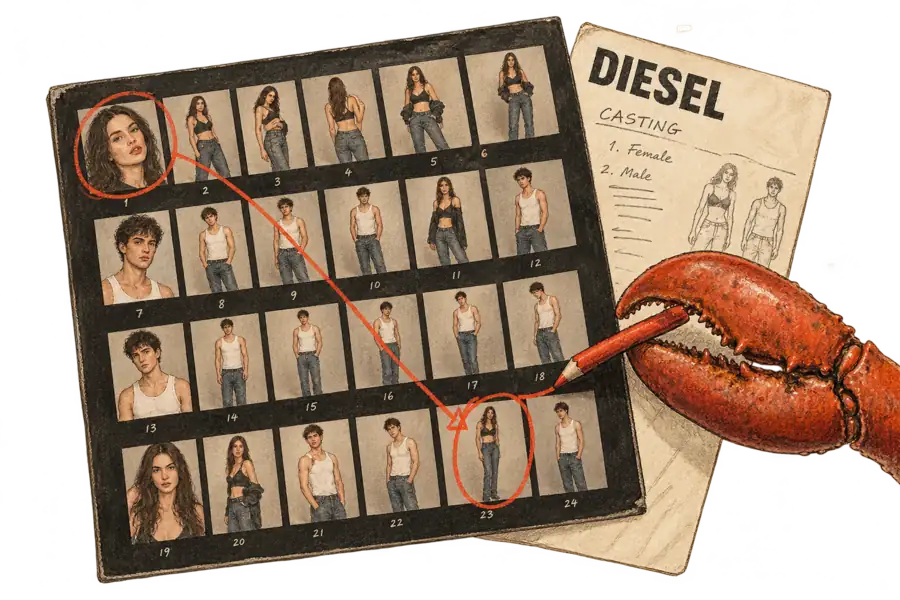
Diesel's Casting Sheet Asked Models to Agree to Face Swaps
Photo-shoot contracts reviewed by Reuters show Diesel, Reale Actives, Calvin Klein and L'Oréal asking models for AI rights, from face swaps between models to training tools on images with the face left out. Signed, such terms would let a campaign show a person who never stood in front of the camera.
Parallax Pincer
In the picture Diesel’s paperwork would allow, one model’s face sits on another model’s body. A casting sheet seen by Reuters asked models to agree to “swapping of faces among the participating models” and “superimposition of the Participant’s face onto another person’s body.” Signed, those terms would let a campaign show someone who never stood before the camera, and the picture would stop being a record of the shoot. The sheet also covered “alteration or reconstruction of facial features and body proportions.”
Reuters’ Helen Reid interviewed 15 model-agency directors and reviewed more than a dozen confidential photo-shoot contracts. OTB, Diesel’s parent, said the document was drafted for one campaign and isn’t typical of its agreements, and that it doesn’t systematically modify models with AI. Patrick Staal, owner of Uniko Models in Barcelona, says some brands “ask to modify faces, bodies, skin, age or expressions after shoots using AI.”
Alix Earle’s skincare brand, Reale Actives, uses the tagline “Reale you is perfect you.” A contract Reuters reviewed asked for the right to make AI replicas of models and to “own” and use them for a year without further compensation. The brand said it uses real models, hasn’t replicated anyone with AI, and got the wording from a production partner it declined to name.
A Calvin Klein draft asked the model to accept, for no extra pay, that the brand “may use reasonably unrecognizable images of Model.” The stated purpose was to “train and fine tune AI tools for learning general model attributes.” A parenthesis excludes “identifying features such as Model’s face, scars, tattoos or otherwise.” Calvin Klein said it is “testing and learning in this fast-moving space,” guided by regulation, industry standards and respect for models’ rights.
L’Oréal’s contract sought the right to use AI, “including for the purpose of modifying, enhancing, or adapting the appearance of cosmetic products, packaging, or shades, as well as for retouching purposes.” Reuters reports that lawyers use words such as “including” and “not limited to” to claim rights a contract does not spell out, and Melanie Howard of Loeb & Loeb calls such language “dangerous in its ambiguity.” Without addressing that wording, L’Oréal told Reuters it uses standard AI tools in post-production and editing that don’t affect the model’s image.
Reuters describes the contracts it reviewed as unsigned, so each clause is an ask, not a record of use.
The composite body has a retail history. In 2011, Adweek reported that H&M’s online lingerie and swimwear pictures pasted real models’ heads on computer-generated bodies, one virtual body “rendered in different skin tones to match the faces.” H&M told ABC News “It’s not a real body; it is completely virtual,” and that it was “regrettable if we have led anyone to believe that the virtual mannequins should be real bodies.” Diesel’s sheet proposes a composite of its own, with a second body that can belong to another hired model.
Reuters cites falling bookings and studio closures. About You is launching Scayle Studios, which makes imagery with AI-generated models, and a spokesperson said Scayle has 130 brand clients and generated 190,000 outfits in the month before Reuters’ 27 October report. If the face-swap clauses were signed, a real shoot could be edited as freely as a generated one.
Every safeguard Reuters cites runs on consent, which is what a casting sheet requests. Since June 2025, New York’s Fashion Workers Act has required clients to get a model’s “clear written approval” before creating or using her digital replica. That approval “must detail the scope, purpose, rate of pay, and length of time the replica will be used”.
Reuters’ account of Reale’s clause gives a year and no further pay. It does not report the scope or purpose, or whether New York law applies to the contract. The Act’s definition excludes “minor retouching,” a line our Lightroom piece raised for generated eyes; a swapped face is hard to call minor.
The British Fashion Model Agents Association’s statement of a model’s rights covers a “digital scan of the Model,” meaning digital versions and avatars, not face swaps in photographs. It is written in the first person and leans on trust: a model who cannot own her digital version will “trust all parties” to transfer ownership to her “at the end of the usage term.” The association’s head, John Horner, told Reuters that without binding rules in Britain or Europe, models remain exposed to less scrupulous agents.
On our reading, a composite of two hired models would carry no label in New York, whose synthetic-performer law is limited to a performer “not recognizable as any identifiable natural performer.” The face in the picture is real, and so is the body; they were never one person. Staal’s warning is about time: “Signing away AI rights at 20 years old could still affect someone ten years later.”