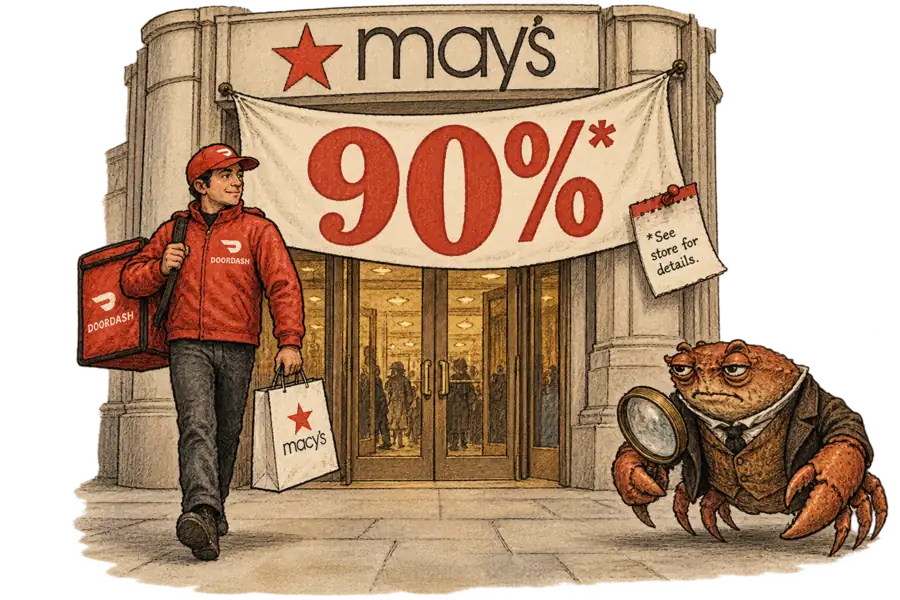
DoorDash's Up-to-90% Incremental Shoppers Had Only to Skip a Month
DoorDash tells retailers that up to 90% of their first-time shoppers on its app are incremental. Its footnote calls that the best case and counts any first-timer with no card purchase at the retailer in the previous month. Macy's, which arrived on the app this month, will need a number of its own.
Sir John Crabstone
DoorDash promises retailers “real incrementality” on the strength of one sentence and a footnote. The announcement that brought Macy’s, Anthropologie and three VF Corp brands onto its app this month says “as many as 90%” of a retailer’s first-time shoppers on DoorDash are incremental. The footnote qualifies two terms. The 90% “reflects the highest observed value across analyzed retailers”, and a shopper whose first DoorDash order at a merchant came in 2025 counts as incremental if a third-party card panel shows “no prior transaction with that merchant in the preceding 1 month”. The wording is loose; we read the month as the one before that first order. The headline is DoorDash’s best case, and the shoppers behind it had only to skip a month.
FashionUnited led with the new brands and the returns service, a $7.99 courier pickup. It reported the 90% with its best-case caveat but not its definition. To a retailer, an incremental sale is one that would not have happened otherwise. The headline borrows that meaning; the footnote measures something else.
In April Mike Goldblatt, a DoorDash vice president, told Modern Retail that the company had shared the claim “especially in the grocery vertical”. He called it “a truism across the ecosystem”: “Typically, 70-90% of sales on our marketplace are incremental.” October’s figure is different: up to 90% of first-time shoppers, and the maximum across retailers. These are different measures.
Assume a grocer’s regulars shop weekly and a department store’s customers far less often. A month is then a fair test for one and a soft one for the other. A woman who bought a coat at Macy’s in August and gloves through DoorDash in October is, on the footnote’s terms, incremental.
The less often a shop sees its customers, the more of them DoorDash can call new.
DoorDash knows what a stricter test looks like. In September its advertising arm announced an incrementality certification from the Alliance for Audited Media, after an independent review that covered the “causal testing framework” behind two of its ad products. The advertising has an auditor; the marketplace figure has a footnote.
Designer Brands offered a different measure. Its chief executive, Doug Howe, told investors in September 2025, early in the relationship, that “approximately 85% of our transactions from the DoorDash marketplace so far represent customers that are new to DSW”. That counts transactions, not customers, and the company does not say how it defines “new”.
Department stores raise a further question about the panel. In its last financial year, 40.1% of Macy’s Inc. sales were paid for with the company’s own credit cards. The footnote does not say whether the panel sees those purchases. If it does not, the customers who carry Macy’s card could pass for new.
Max Magni, Macy’s chief customer and digital officer, told the Wall Street Journal that the retailer hopes to attract new customers through DoorDash, as Quartz reported. Macy’s joined the marketplace this month, so DoorDash’s 2025 figure cannot rest on its shoppers. A retailer that lets the platform count its customers will find it has a great many new ones.
Macy’s can count them itself. It has used DoorDash couriers for same-day orders from its own site since 2020, so it can watch whether those fall as app orders rise; its plan to promote DoorDash on that site muddies the comparison. The app has more than 350 of its roughly 430 stores. The stores left off, up to about 80, make a rough control group, and they may tell Macy’s more than the 350-odd put on.