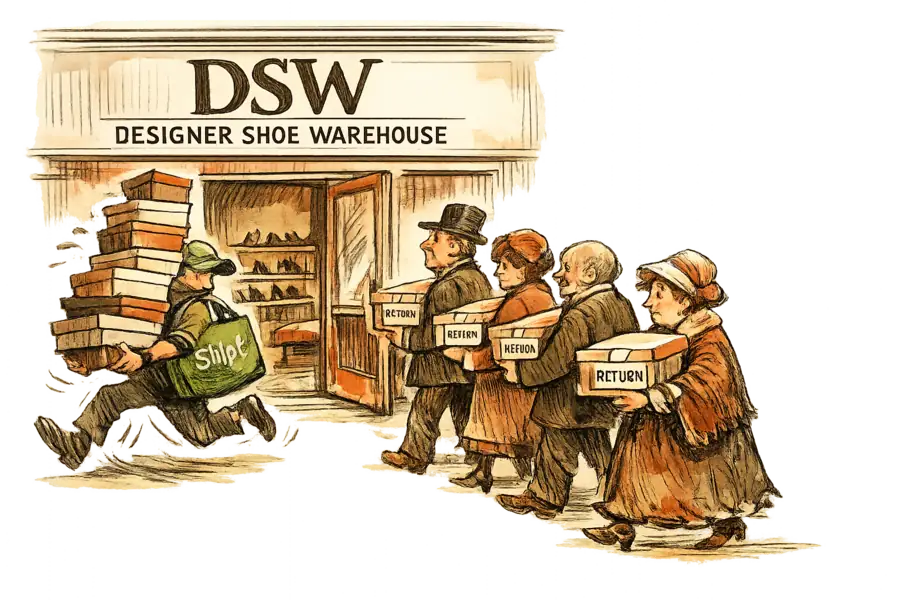
DSW Rents Two Delivery Networks and Owns Every Return
DSW has rented two same-day delivery networks since last summer, less than a year after telling investors that filling online orders from stores was the expensive way to do it. Footwear is the category where the fitting room did the returns work for free.
Sir John Crabstone
DSW has rented two last-mile networks since last summer. Shipt began picking from 452 DSW stores on 28 July, putting nearly 75 million American households within a same-day window of a shoe box. Each arrangement buys speed the chain does not own and imports a cost it does. Footwear bought without a try-on comes back.
Supply Chain Dive reported last September that Designer Brands was pulling digital orders out of its shops and into its logistics centre. Warehouse fulfilment, said chief executive Doug Howe, is “operationally more efficient than fulfilling from stores”. Shipt works the other way by design. Its shopper walks into the store, takes the box off the rack and drives it out.
The case for the deal is customer acquisition, and it is a good one. On the September earnings call, Howe said roughly 85% of transactions from the DoorDash marketplace “represent customers that are new to DSW”. A chain short of traffic will pay for a new name at almost any margin. That figure is counted when the order is placed; the one that matters is counted when it comes back.
Chief financial officer Jared Poff undercut the case on the same call. DSW is “very deliberately pulling back the marketing we spend to chase” what he called “empty calorie sales,” because too much of that growth is “very difficult to make actual money on.” The company renting the networks does not fully believe in them.
Every account of the deal has led with back-to-school convenience, which is fair enough. Footwear News reports that DSW is Shipt’s first full footwear partner, and quotes its growth chief saying demand for shoes came through “loud and clear”. Customers asked for delivery. Nobody asked them whether they wanted to guess their size.
Statista’s consumer panel ranks shoes second only to clothing among goods Americans send back after buying them online: 17% of respondents against clothing’s 25%. The shopper who needs shoes tonight is the shopper least able to say whether they fit.
Fit is what makes footwear costly to post. Coresight Research and Alvanon, reported in Sourcing Journal, price the US online apparel and footwear market at $201.1 billion for 2025, with a 23.4% return rate worth $47.1 billion. Size and fit sit behind roughly 70% of online apparel returns. Those figures group shoes with clothing, so read the footwear share as an estimate. The mechanism needs no such caution: nobody knows their size in a brand they have never worn.
A fitting room is a returns desk that settles in thirty seconds and bills nobody.
Same-day delivery moves that desk outside the building. The rejected pair no longer returns to the rack in a minute; it travels, and it may not fetch full price when it lands. Comparable sales fell 1.1% last quarter while gross margin rose to 45.3%: the profile of a company earning on cost rather than traffic. Most of it still comes back through the door it left by. That is the one leg of the journey nobody has thought to rent.