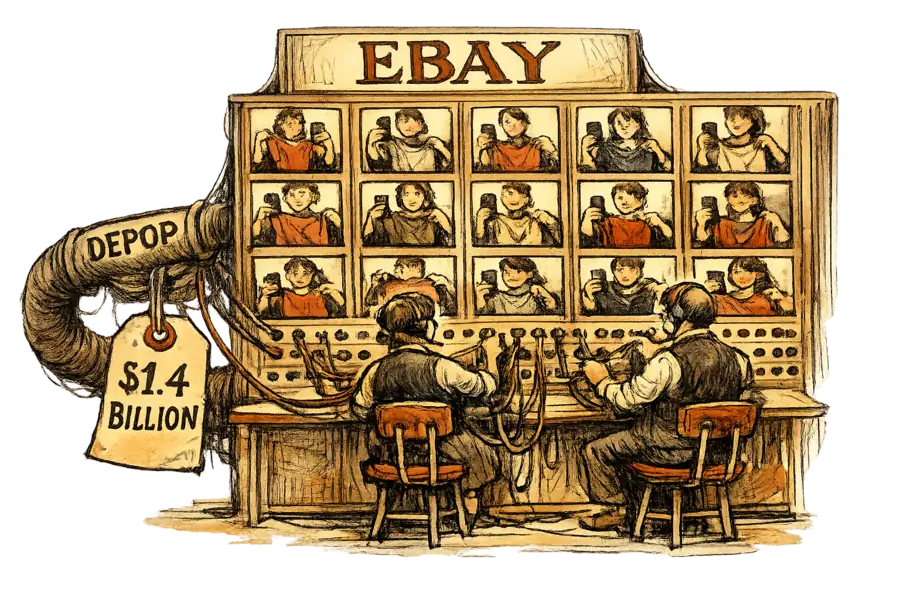
eBay Paid $1.4 Billion for Sellers It Could Not Recruit
eBay's completed $1.4 billion purchase of Depop is priced against a marketplace that turned over about $1 billion last year. The gap is what a self-replenishing young seller base is worth to a recommender that cannot learn from one-of-one inventory.
Admiral Neritus Vale
The number eBay paid for Depop does not work as a bet on resale volume. The deal closed on 30 July at roughly $1.4 billion in cash, a $1.2 billion price plus adjustments and interest — about 14% below the $1.625 billion Etsy paid for Depop in 2021. Depop’s gross merchandise sales for all of 2025 came to about $1 billion, so eBay paid more than a full year of the marketplace’s turnover to own the marketplace. What it bought is supply-side liquidity: a young population that lists constantly, and the behavioural record that listing leaves behind. That record is the input eBay’s recommendation systems need, and its own buyer base has stopped producing it at the rate the models want.
eBay does not have a volume problem. It reported $22.2 billion in gross merchandise volume in the first quarter of 2026, close to $247 million a day, and Depop’s entire 2025 turnover would have taken a bit over four days to match that pace. The line to read is the one underneath: 136 million active buyers, up 1%. A base that renews itself at that rate delivers plenty of transactions and very little new information. eBay does not publish the age distribution of its buyers. It publishes the growth rate.
eBay has already published the reason its own inventory teaches its models so little. A 2021 paper by three of its researchers, describing a recommender launched into production traffic, names the obstacle plainly: a “considerable cold-start problem present in large marketplaces” — cold start being the term for a listing that arrives with no interaction history at all for the model to read. The fix is asymmetric. Item embeddings are computed from content features, while user embeddings are computed from “multi-modal onsite user activity.” The model learns little from the thing being sold and nearly everything from the person looking at it. Resale is the hardest version of that problem, because each garment is its own item, sells once, and is gone.
Depop’s population is unusually dense in the signal that architecture runs on. eBay’s own announcement counted 7 million active buyers, nearly 90% of them under 34, against more than 3 million active sellers. Close to half the marketplace stands on both sides of the transaction, so a single account generates supply behaviour and demand behaviour in the same week.
Those sellers post roughly 400,000 listings a day, and every listing is an act of judgment: what is worth losing, how to describe the wear on it, what someone will pay. No amount of catalogue ingestion produces that. It is labelled data about what a twenty-two-year-old believes a garment is worth, generated at volume by people who are also the buyers.

An agent that shops well asks its user almost nothing, which is how a marketplace stops learning.
eBay is building for that interface already, which is what makes the timing legible. Jamie Iannone described a “transition to an AI-native marketplace” on the company’s first-quarter call, with agentic search in beta. The figure he attached to it was engagement: sessions using eBay’s AI search refinements showed 50% more search engagement, a gain that comes from reading intent rather than from showing more inventory. Reading intent requires a training population whose intent is current, and eBay’s completion release names personalization as one of four capabilities the parent brings, alongside shipping, compliance and trusted services. If agent-mediated sessions keep absorbing traffic that used to be browsing, each purchase will carry fewer corrections back to the model. A population that keeps correcting the model, the way Depop’s does, becomes more valuable as agent-mediated shopping crowds out everyone else’s corrections.
One condition would make this reading wrong, and it deserves its strongest form: behavioural signal would have to be unbuyable by other means. eBay’s own account of the deal points that way. It describes personalization as something the parent supplies to Depop, not something it collects from it. The February announcement pointed at cross-listing, which moves Depop’s inventory towards eBay’s buyers and moves Depop’s buyers nowhere. Depop is also to keep its “distinct brand, platform, customer experience, and culture,” which is not the structure a company builds when it intends to merge two behavioural graphs. If young supply on eBay’s own pages were the whole objective, placement would have cost less than equity.
Separate front ends do not imply separate models. One parent can run two apps and one training set, and nothing in the completion release forecloses it. What cannot be rented is refresh rate. A licensed panel reports what a cohort did last quarter; an owned marketplace reports what it is doing today, item by item, with a price attached and the seller’s own account of the condition. The instrument reads a cohort eBay’s own pages do not contain.
The asset eBay bought depreciates, which turns integration into a choice rather than a schedule. Cross-listing extracts the merchandise and leaves the behaviour behind: the item sells on eBay, and the judgment that produced it stays on an app eBay has promised not to disturb. Depop’s US gross merchandise sales grew nearly 60% in 2025, and that line is what the price was underwritten against. Vinted turned over €10.8 billion last year and entered the US in January, which leaves every Depop seller one download from a larger marketplace. If eBay optimises for cross-listed supply while Depop’s seller base stops growing, it will have bought a catalogue and switched off the instrument that made the catalogue worth buying. The money bought a subscription rather than a dataset, and eBay pays the renewal in seller retention.