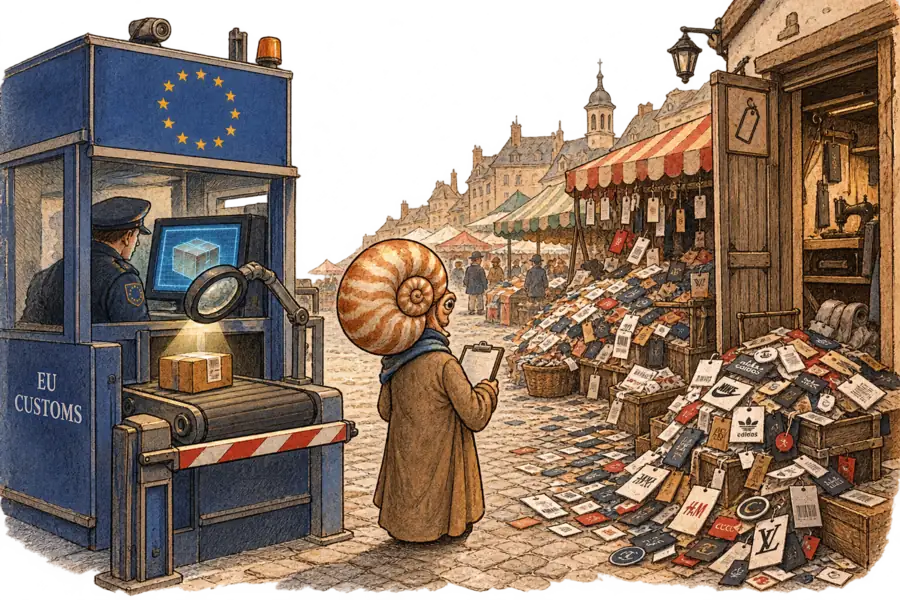
Nine in Ten of the EU's Record Fakes Were Seized Inland. Its AI Answer Reads Border Data.
Of the 196m counterfeit items detained in the EU in 2025, more than 175m were seized inside the single market, most of them by Italian authorities, and Germany and Austria supply no inland data. The Commission's release pairs the record with an AI-powered customs data hub built on the import and export data traders submit, at a border where parcels make up four in five cases but carry about an eighth of the goods.
Neritus Vale
The EU’s record year for counterfeit seizures was made mostly inside the single market, where more than 175m of the 196m items detained in 2025 were found. The joint report, published by the Commission and the EUIPO on 22 October, calls the record “mainly due to the trend in internal market detentions”. The Commission’s release sets an “AI-powered” customs data hub beside it, to track supply chains and flag high-risk shipments.
The e-commerce argument for the hub rests on counting cases. The release says most customs cases involved express-courier and postal consignments, “typically related to e-commerce”. The report’s data dashboard bears that out: courier and postal parcels made up four in five border cases in 2025. Measured in goods, they were a minority, carrying about one in eight of the items customs detained. Lorries and container ships carried most of the rest.
The hub, part of the Customs Reform adopted in September, runs on data that traders submit. Managed by a new EU Customs Authority in Lille, it will “compile the import and export data provided by businesses”. The Commission’s Q&A adds that platforms and sellers will notify customs of sales before the goods arrive. Its use becomes mandatory for e-commerce on 1 July 2028 and for all traders from 1 March 2034.
Border data also counts for less in the headline than it does alone. Customs stopped 42.1m items, but the methods note says the overall total counts only border detentions that did not end in release. Subtracting the inland figure leaves roughly 20.8m border items.
Inside the market, the record is largely Italian. Italian authorities reported 80% of inland items, and Italy’s inland count rose from 77.1m to 140.6m in a year. The methods note adds that Germany and Austria supply no inland data. Austrian police cannot seize fakes on their own initiative, and German authorities “have not yet joined the data provision network”.
The dpa story as run by TextilWirtschaft and Nordkurier is a border story. TextilWirtschaft ran it under a standfirst saying Germany is “besonders betroffen”, particularly affected. Nordkurier’s version puts German customs at almost 22% of the value seized at the border, second to Spain, and says Germany’s role lay mainly in seizures at the EU’s external borders.
Where nearly nine in ten items were found, Germany’s number is missing, not small.
At the border, fashion dominates the paperwork. Clothing, shoes, bags, watches, jewellery and other accessories made up 80.8% of customs procedures in 2025, by our sums from the dashboard, but about 12% of items.
Across the whole count, seizures of finished fake clothing fell. By our sums from the category shares in last year’s release and this year’s, 2.62% of 196m items is 5.1m garments, against 7.50% of 112m, or 8.4m, a drop of 39%. The report’s own +67% implies a 2024 base nearer 117m, which would make the drop 42%. The fashion story of 2025 sits in another category.
Seized labels, tags and stickers, the kit for assembling fakes, multiplied. By our sums, inland seizures of them rose more than tenfold, from 2.2m pieces (2.11% of 102.6m inland items) to 23.5m (13.41% of 175.3m). A label is a trademark without a product.
The Commission has noticed. The report calls labels “assembling materials with a clear potential effect to multiply counterfeits within the EU”, and the release says labels and packaging turn up at the border “falsely suggesting the production and/or assembly of the counterfeit goods in the EU to circumvent the detention of counterfeit goods at the EU border”. The border report ranks labels first among the articles detained in courier and postal parcels.
The methods note says inland authorities left the fields for origin, route, transport and EU manufacture largely blank in every year from 2021 to 2025. In most cases they aggregate seizures into one monthly or even yearly record. Border records, by contrast, have itinerary and transport fields that are “quite systematically available”. If the hub’s models learn from past detentions, they will learn from cases that carry a route, and little from the inland nine-tenths.
The strongest objection is that seizure counts measure policing, not counterfeiting. On that view, most inland fakes, or their parts, crossed a border first, and the border is where enforcement has most room to grow. The report estimates that border detentions caught some 0.43% of the counterfeits crossing the EU’s borders in 2021, by value. The Q&A also promises intervention “during transport within the EU or at final destination”. For the thesis to fail, inland seizures must be mostly finished fakes that arrived in declared shipments a better score would have caught.
The report’s data cannot settle that. Inland route fields are largely blank, so no seizure can be tied to a border crossing, and labels seized in Italy could have been made in the EU. What the data does settle is the narrower point: the records a border-trained model learns from are the ones that carry a route.
For fashion brands, the inland numbers point to labels rather than garments. Inland seizures are mostly CDs and DVDs (32.78%) and toys (19.47%), clothing is 1.78%, and the Italian police data count pirated goods as well as counterfeits. Alerts from rights holders to national authorities through IPEP, the EU’s enforcement portal, fell by about a third, to 1,305. The report says IPEP use “remained stable” and that the fall may be partly influenced by alternative official communication tools.
If the hub goes live in 2028 and inland reporting stays as it is, its models will have routes for the border’s cases and few for the inland ones. Making the inland nine-tenths traceable is a choice member states can make now: Germany could join the data provision network, and most member states could record where the fakes they seize came from.