The EU Rule That Explains Farm Rio's Compliance Platform Does Not Apply to Farm Rio
Farm Rio routed its inspections, lab testing and traceability through a US compliance vendor five months after Brussels narrowed the due-diligence directive past its door. The platform's real output is admissibility: proof that clears customs and department-store compliance desks.
Sir John Crabstone
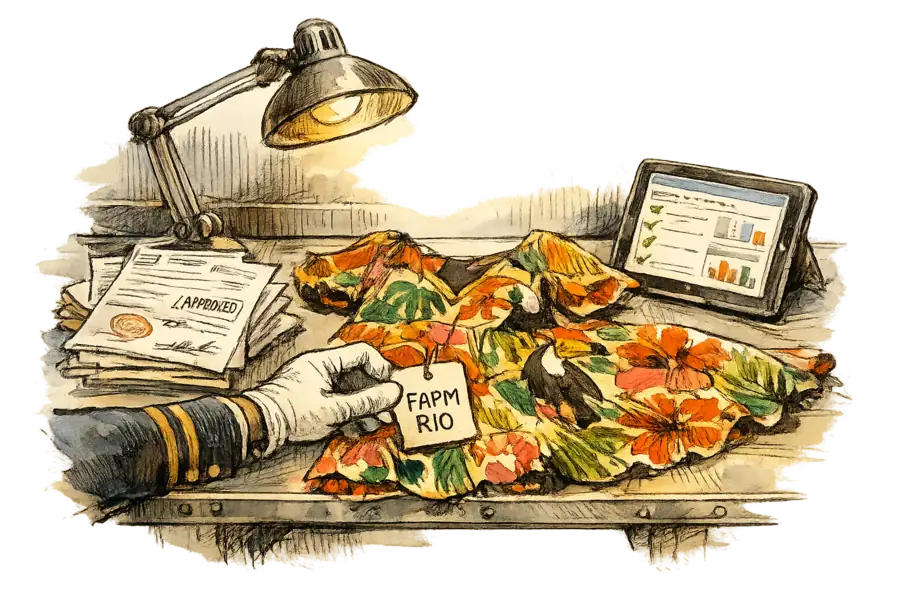
Farm Rio has moved its inspections, laboratory tests and supplier paperwork onto software owned by a company in Minneapolis. Sourcing Journal filed it under digitising operations. What the brand bought is admissibility: the right to land goods in six markets, issued as a file.
The rollout covers France, Italy, Mexico, the United Arab Emirates, the UK and the US, in three modules: inspection scheduling, lab results kept in audit-ready form, and document collection with automatic translation. Farm Rio has seventeen boutiques outside Brazil, more than 2,000 wholesale accounts including Bloomingdale’s and Selfridges, and about 40 percent of sales abroad. The Brazilian business, by this reading, needs none of it.
Farm Rio’s owner, Azzas 2154, hired Morgan Stanley in June to weigh strategic alternatives, including a possible US listing. A clean compliance file helps a sale as much as it helps a customs officer.
European due diligence is the obvious culprit, and it no longer reaches this brand directly. The Omnibus directive, published in the Official Journal in February, cut the Corporate Sustainability Due Diligence Directive back to companies above 5,000 employees and €1.5 billion in turnover, with non-EU firms caught only above €1.5 billion of turnover inside the Union; a value-chain safeguard still lets those larger companies demand the same standards from smaller partners like Farm Rio. Farm Rio’s entire international estate is seventeen shops. Brussels let it off in February; it signed in July.
What still reaches it carries no threshold at all. The EU’s ban on goods made with forced labour applies from 14 December 2027 to every product and any origin, with no exemption for size or sector. It is an obligation of result. Due diligence asks what a company did; this one asks what the goods are.
The American version already has four years of numbers behind it. Customs flagged more than 13,000 apparel, footwear and textile shipments under the Uyghur Forced Labor Prevention Act and denied about 62 percent of them, as FashionUnited reported from CBP’s own enforcement data. The presumption runs against the importer. Evidence has to exist before the container does.
Those 2,000 wholesale accounts enforce the same standard earlier and more quietly. A department store’s compliance desk asks for the test report long before a border does, and it can place the order elsewhere when the file is late. Farm Rio’s head of quality says Inspectorio supplies the “platform and regulatory expertise” the brand does not hold in-house. Law is now sold by subscription.
The cost curve explains the shape of the purchase. Inspectorio’s own 2026 survey found 52 percent of retail supply chain leaders rating recent regulatory change at four or five out of five for impact, while the share reporting a larger compliance budget fell from 75 percent to 50. Obligation rose. The headcount did not. Software is what a brand buys when the paperwork grows faster than the payroll.
Nobody buys an inspection platform in order to be good.
The money reads it the same way. Apax Digital took a growth stake in Inspectorio on 16 July, twelve days before this deal was announced, in a platform the company says more than 40,000 organisations use. Growth equity does not underwrite good intentions. It underwrites tolls.
The next requirement is already scheduled. The Commission’s 2025–2030 ecodesign working plan puts apparel among the first product groups in line for further requirements, ahead of a digital product passport that would bind whatever is sold in the Union, whoever made it.
The mandatory data points for that passport were published in May, though yarns, fabrics, fibres and smart or medical textiles aren’t covered yet. Farm Rio is early. Late is where this gets expensive.
By December 2027 the brand will be able to prove where its cotton was grown, translated, on demand. Whether it cared is a different file, and no border has asked for that one.