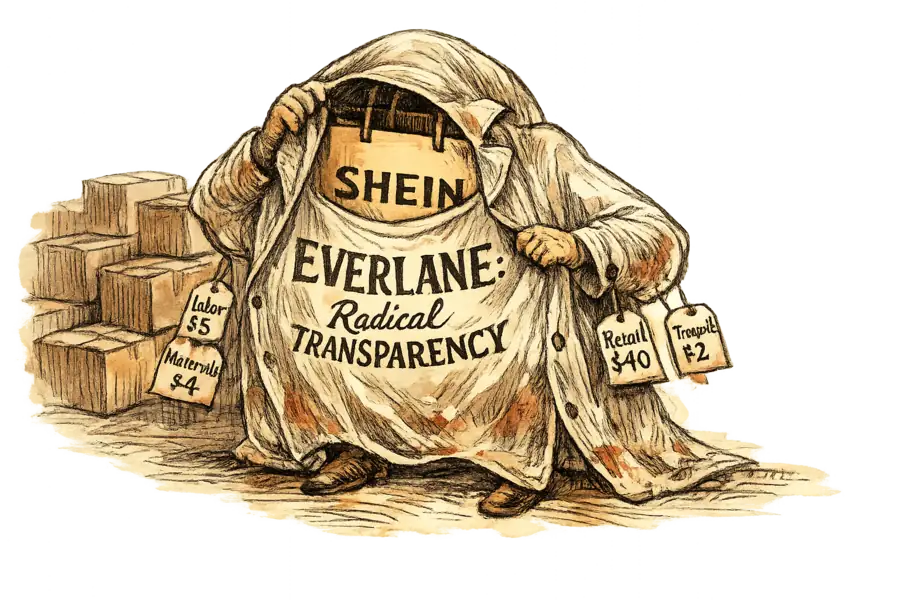
Everlane Made Transparency the Product. Shein Bought It as a Skin.
Shein has bought Everlane, the brand built on radical transparency, for a fraction of its old worth. The deal shows disclosure was never a moat: the most opaque operator in apparel can buy the most transparent one and keep its cost pages running, because transparency was always a detachable asset.
Sir John Crabstone
Shein has bought Everlane, the brand that taught a generation to read a cost breakdown before buying a sweater. The most opaque operator in apparel now owns the most disclosed one, and the deal reads as irony only if you believed the disclosure was a defense. It was never a defense — it was the feature that made Everlane worth buying.
Consider the price Shein paid. Reports put it near $100 million, a fraction of the roughly $250 million it commanded at its peak when L Catterton took a minority stake in 2020. A label can lose most of its value in five years and keep every syllable of its transparency intact. Those pages itemized the sweater to the cent. They were silent on the sale.
The disclosure did not protect the balance sheet either. Everlane carried roughly $90 million in liabilities, including a $25 million loan and a $65 million credit line, and its common shareholders left with nothing. Set that beside a price near $100 million and the deal resolves into something plainer: Shein bought the name for about what it cost to clear the debt. A company that published its margins to the dollar could not publish its way out of debt.
The factory pages stay up; only the beneficiary changes.
Shein means to keep them up. Everlane will run as an “independent brand, staying true to our longstanding brand values, sustainability commitments, and exceptional quality,” its chief executive Alfred Chang said in a statement. Read that as a business plan, not a reassurance. The buyer is paying to keep the transparency running under its own ownership, which is the plainest proof that disclosure and opacity were never opposites.
The certification trade understood this within days. Eco-Stylist stripped Everlane’s Gold rating almost at once, its founder noting that “the moment Shein became Everlane’s owner, that signal became meaningless.” Notice what did not move: the facts. The cost breakdowns are still accurate and the factory addresses are still real. What collapsed was the trust, which tells you the trust was never in the facts.
Most of the coverage has mourned. The sale gets cast as a betrayal, and the recurring question is whether Everlane’s mission can survive its new owner. That question assumes the mission was load-bearing. It never was. It was a label, and labels survive owners; they are built to.
None of this began with Shein. Everlane trademarked “radical transparency,” and by 2020 a New York Times investigation, covered by Fashionista, had former staff accusing it of union-busting and racially insensitive treatment while it published its suppliers’ costs. The disclosure was always partial. A firm can tell you the price of its cotton and decline to tell you how it treats the hands that cut it.
The founder was not told. Michael Preysman, who trademarked the phrase and ran the company for more than a decade, learned of the sale from the news, like everyone else. He is starting over with a venture he calls Still Radical, built without the private equity that decided his last one’s fate. The man who sold the world his costs could not see his own company change hands. Everlane disclosed everything except the fact that turned out to matter.