For Fast AI Shoppers, Whoever Ticks the Box Does the Shopping
In a Paderborn test of one simulated grocery shop, three decision models kept the preselected product in 97.5% to 99.9% of choices, against 47% to 49% with no nudge. EU law makes traders refund extra payments taken by pre-ticked boxes; we know of no ruling on whether the DSA's design ban covers steering an agent.
Sir John Crabstone
Agents built for speed bought what one shop had ticked. In a Paderborn University preprint dated 6 November, three “decision models” kept a preselected product in 97.5% to 99.9% of choices. Without a nudge, they picked that product 47% to 49% of the time, near chance.
Decision models choose among options without writing text. TypeSafe AI, which makes Jev, named them “System One” models after Kahneman’s fast thinking, noting that the term “has also implied error-prone”. It believes they “can be made more reliable than their alternatives”. Paderborn’s shop had no better product, only a ticked one, so the study measures susceptibility, not error.
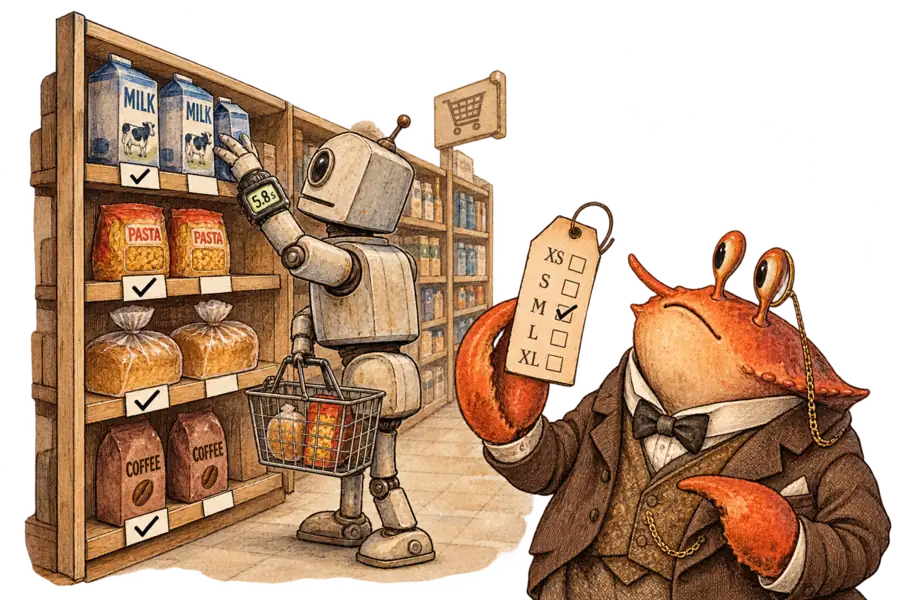
The team sent Jev, Microsoft’s Decision-1 and Liquid AI’s d1 into a simulated shop. Each model shopped 600 times, buying one of two products in each of six categories, then reviewing its selections and confirming. Only 200 of those runs per model, about 1,200 choices, had a preselected target. The paper is a preprint covering three closed-source models, one nudge of each type and a grocery shop, not a clothing one. A run averaged 5.8 seconds and $0.0012 at list prices.
Preselecting the target lifted its share to 97.5% for Decision-1, 99.4% for d1 and 99.9% for Jev. A label crediting the target with “the highest customer satisfaction” moved them less: d1 followed it 96% of the time, Jev 82% and Decision-1 75%.
The group’s earlier study of LLM agents found the reverse. Pooled across six models at high reasoning, those agents kept the default 86% of the time and followed the label 98%. The authors say they have not yet compared the two kinds of model directly, since implementation and task text differ slightly. The LLM agents were “even more responsive to these nudges” than the humans in the 2021 experiment the study adapted.
Microsoft’s launch post shows Decision-1 “buying a backpack” against GPT-6 Sol, a demonstration of speed. Separately, it reports a 1.3% average flip rate across eight perturbation tests, with zero flips when options are “reversed or shuffled”. Those tests move the options around; Paderborn’s shop ticked one.
Defaults have always relied on shoppers’ inertia; on the authors’ System 1 reading, these agents bring their own, at $0.0012 a run.
A dress page that opens on one colour and size is a default, as is a checkout that ticks standard delivery. Shopify’s theme documentation tells developers they “can default to the selected, first available, or first variant”. Paderborn tested none of this.
Under Article 22 of the Consumer Rights Directive, traders must refund any extra payment taken through “default options which the consumer is required to reject”. A pre-ticked €3 gift box is caught; a preselected size, which adds no payment, is not.
Article 25 of the Digital Services Act bars online platforms from interfaces that manipulate “the recipients of their service”. It binds platforms such as marketplaces, not every web shop, and yields to the Unfair Commercial Practices Directive and the GDPR. Recital 67 warns of “default settings that are very difficult to change”; the Paderborn agents seldom changed defaults that were easy to change.
The Act defines a recipient as “any natural or legal person who uses an intermediary service”. Software is neither, on our reading, though the person who sent it may count as the one using the service through it. We know of no ruling or guidance on whether steering an agent counts as steering the person it serves.
Taylor Wessing expects the Commission to table its Digital Fairness Act on 11 November, possibly banning named practices such as pre-selection. A dress page must still open in some colour, and the shop picks which. The shopper who sent an agent may never see the page.