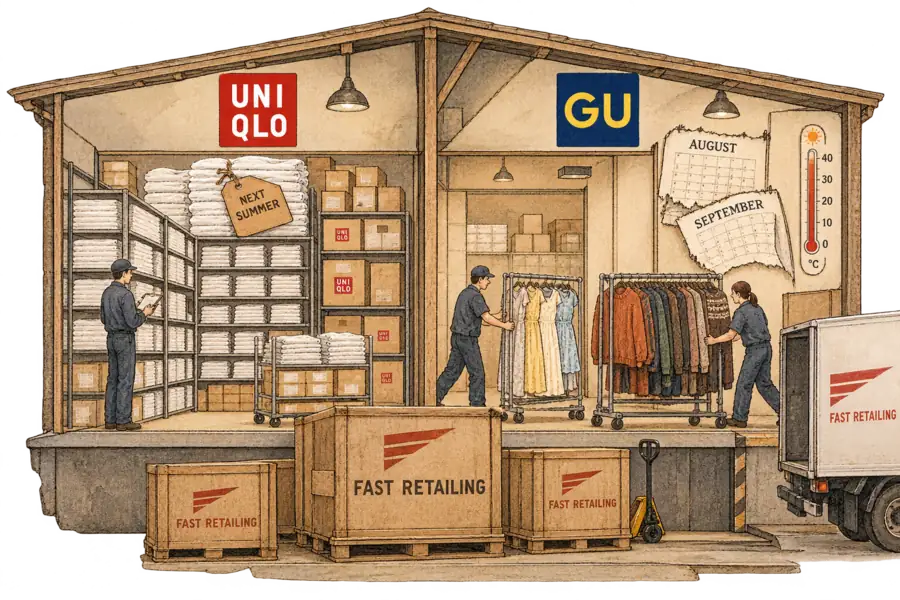
Fast Retailing's Record Runs on Clothes Without a Season
Uniqlo outside Japan earned 2.2 times Uniqlo at home in a year Fast Retailing credits partly to year-round lines. In the same summer, Uniqlo Japan was left with core stock it can sell next year, while GU, in the middle of replacing every product, could not meet summer demand and slipped to a fourth-quarter loss.
Neritus Vale
Fast Retailing’s fifth straight record leaned on clothes that no longer belong to a season. In the year to 31 August, Uniqlo outside Japan made ¥439.8bn of business profit, 2.2 times Uniqlo at home. The company credits “expanding sales of year-round items”, alongside flagship openings and brand communication. GU, its cheaper, trend-led brand, slipped to a small loss in the fourth quarter while it replaced every product with a new collection. The group’s buying and planning forgive a wrong call on a basic far more readily than one on a collection.
Strip out currency and the growth abroad is smaller but still large. TextilWirtschaft led with Uniqlo growing 39% in Europe, a figure inflated by the yen’s slide against the euro and the pound. For Uniqlo International as a whole, Fast Retailing puts revenue growth excluding currency at about 18%.
Europe’s gain came from old and new shops alike, in a split the company does not publish. According to the results deck, same-store sales rose by double digits in local currency, and Uniqlo opened stores without closing any, including in new cities such as Bristol, Munich and Utrecht. Part of Europe’s 69% profit rise was a cost dropping out: last year Uniqlo ran overlapping warehouses while a new automated one started up, and the overlap was resolved from the third quarter, which opened in March.
Fast Retailing is blurring the seasons on purpose. Its strategy presentation says that because short-sleeved T-shirts are often worn under outerwear in Europe and the US, it “started selling those T-shirts year-round on a global scale”, and casual outerwear now sells all year. Trend arrives by the same route: the results deck credits “on-trend silhouettes and materials” built “into year-round bottoms and T-shirts”.
This summer tested the model, because the weather went wrong in Japan and Europe. A cooler June and August than last year, along with typhoons and heavy rain, pushed Uniqlo Japan’s fourth-quarter same-store sales down 4.0% and customer visits down 8.0%. In Europe, persistent warmth “stifled demand for Fall Winter items”. What separated the businesses was where each miss landed.
Uniqlo’s miss went mostly into the stockroom. Its Japanese inventory rose ¥14.6bn, “mainly inventory of Summer items”, though most of it is core stock the company plans to sell through next year. When temperatures fell in September, same-store sales rose 10.8% on autumn and winter lines.
A basic left over in August becomes next summer’s opening stock.
The stockroom was not the whole bill. Second-half business profit at Uniqlo Japan rose only 1.9%, and the margin fell 0.3 points, partly on fourth-quarter bonuses.
GU’s miss ran the other way: it could not keep up with the summer demand that remained. FashionUnited reported the shortfall as “product balance issues during the transition into autumn/winter ranges”. Fast Retailing’s own slide puts summer first: GU “failed to sufficiently address demand for Summer items” and “encountered product lineup balance issues when launching Fall Winter ranges”. The same slide gives the context: “All products being renewed.” That is an inference, not the company’s account: a brand retiring its range has little reason to reorder the lines it is dropping, and so has little to sell when summer demand lingers.
The damage sat mostly in one quarter. The annual filing minus the nine-month filing puts GU’s June-to-August revenue about 4.5% below last year’s. Until then, business profit had risen 28%, as GU cut product numbers and sharpened sales plans. In spring, Barrel Ankle Pants, Sheer T-shirts and Ballet Sneakers lifted same-store sales. What broke was the handover from one range to the next, and the company’s own diagnosis is a miss on summer demand.
The handover was not the only cost in GU’s second half. The slide that explains the loss also cites strategic marketing, expanded warehouse capacity and higher bonuses, which lifted the expense ratio by 0.9 points. Second-half business profit rose only 3.2%. FashionUnited likewise lists warehouse and marketing costs among the reasons for the miss.
The likely weak point is the handover, since the group corrects forecast errors with extra orders. In July the chief financial officer, Takeshi Okazaki, explained that forward currency contracts cover planned volumes, while extra orders placed when sales “far outstrip our expectations” are bought at spot rates, which he presented as a cost. Fewer additional production orders reduced that spot-rate impact, and fourth-quarter gross margin rose 0.4 points. The deck does not say why orders fell; Japan’s soft summer is the obvious candidate. A reorder is easiest to place on a line with years of sales behind it, and a new collection has none.
The strongest objection is that GU’s bad quarter was a one-off, in a summer that hurt Uniqlo too. A brand replaces its whole range once, and Fast Retailing plans to recover before the October and November season with “appealing store displays” and marketing. If GU’s next changeover, into spring, passes cleanly and the autumn recovery arrives on time, the quarter was the price of a relaunch.
A collection brand faces a handover every season, not once. GU’s relaunch arrived as Francesco Risso’s first collection, built on six concepts, and a brand sold on “low-priced fashion fun” never stops changing over. September’s shortfall, which management blames on not having “fully conveyed the new GU to customers”, came after this one was over. The weather does not explain GU’s quarter either: the same summer left Uniqlo with too much summer stock and GU with too little.
The four businesses add up to less than the group. By our sum from the results deck, their business profit, which excludes other income and expenses and finance items such as currency gains, falls ¥48.3bn short of the group’s, up from ¥33.6bn a year earlier. The annual filing says the unallocated adjustments line “mainly includes revenue and corporate expenses” kept outside the segments, and does not break it down further.
This year, advance pricing agreements raised royalty rates at some overseas units, adding 0.2 points to Uniqlo International’s expense ratio and nothing to the group’s. They may account for part of the widening gap, though the filing does not say.
Next year’s guidance thins below the business-profit line, for reasons unrelated to clothes. Business profit, Fast Retailing’s measure of trading, is guided up 15.5%. The plan books no other income and, at the year’s opening exchange rate, no currency gains, though both added to this year’s result. On the guidance figures, it also leaves a larger share of pre-tax profit for tax and minority holders. Together, these hold growth in net profit attributable to owners of the parent to 3.2%.
If Uniqlo keeps turning seasons into year-round lines, the group’s planning will keep paying it back. GU can follow only so far, because a fashion brand has to change with the calendar. Fast Retailing aims for GU sales of ¥1tn over the medium to long term, about three times this year’s, and Okazaki made faster global expansion conditional on the autumn and winter ranges being “positively received”. With September short of plan, that condition is still open. That leaves a choice: build a planning discipline that can call a season and clear it on time, or let GU drift toward the basics its sister already owns.