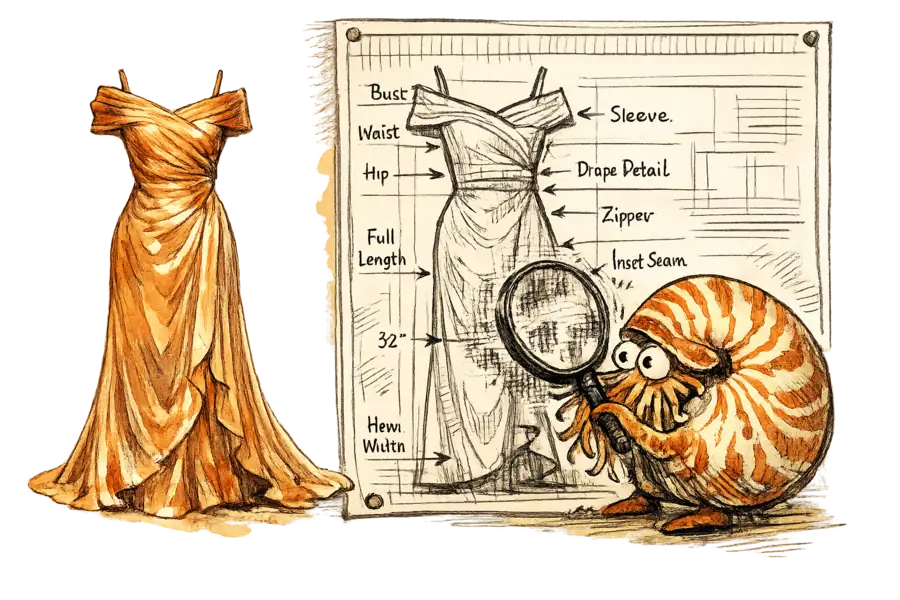
The Flat Sketch Is the Drawing Generative AI Can't Read
Vendors now sell software that turns a designer's flat sketch into a 3D garment in minutes, marketed as proof that AI can read design intent. New benchmarks of the vision-language models underneath show they still cannot map an abstract 2D diagram to the physical thing it specifies, which is why the sample room, not the render, is where the gap shows up.
Neritus Vale
The software that turns a designer’s flat sketch into a 3D dress has learned to render the garment, not to read the drawing. Tools like Style3D return a 3D garment from a flat in minutes, sold as proof that AI can read design intent. New benchmarking of the vision-language models underneath says otherwise: they still cannot map an abstract 2D diagram to the physical thing it specifies, and a flat sketch is exactly that kind of diagram. Generation has outrun comprehension, and the sample room is where the cost lands.
A flat sketch is not a picture of a dress but a set of instructions for building one. It sits inside the tech pack, the document a brand sends to a factory: black-and-white line drawings of front, back and inside views, a bill of materials, measurement points with tolerances, and seam and stitch details. A sample maker turns those flats into the first physical garment, the act on which the whole production order depends. The sample maker projects each flat into a physical form: predicting how the cloth will drape on a body, where the dart will draw, how the seam will hold. That projection is what the new benchmarks isolate, and what the models miss.
The cleanest test of this failure did not use garments at all; it used IKEA. IKEA-Bench, submitted by Zhuchenyang Liu and colleagues, tested a panel of vision-language models on 1,623 questions. The questions covered six task types; one matched a flat assembly diagram to video of the furniture being built. The models could recover written instructions from text, but that same text simultaneously degraded diagram-to-video alignment. The paper’s mechanistic finding: diagrams and video occupy disjoint subspaces, and adding text pulls the system toward words and away from the picture.
The drawing and the thing it depicts never meet inside the model.
The same diagram-reading gap widens further when a benchmark removes the 2D shortcuts vision-language models lean on. SSI-Bench, published in February 2026, poses hundreds of ranking questions built from real 3D structures, demanding mental rotation, cross-section inference, and occlusion reasoning rather than flat pattern-matching. The strongest closed-source model tested scored 33.6 percent, which reads like ordinary difficulty until you see the control: humans on the same questions reached 91.6 percent, confirming the task is fair and the failure is the model’s. Reading a flat sketch needs the same moves: rotate the front into a back, infer the dart you cannot see, predict where the cloth will fold. A model performing at that level on spatial reasoning is not reading a tech pack; it is guessing one, and guessing fluently.
Engineering documentation is the field with documents most like tech packs, and that community named this failure two years ago. DesignQA (April 2024) uses Formula SAE racing rules and CAD drawings to test whether a model can check a design against a written requirement. The cars are not dresses, but the document is the same animal — a technical drawing plus a specification that mean something only when read together. The models tested, GPT-4o and Claude-Opus among them, struggled both to retrieve the relevant rule from the written specification and to apply it to the drawing it governed. A tech pack makes that same demand every time a factory checks a flat against a measurement chart. Whatever fails on a race-car drawing fails on a grading spec, because the cognitive task is the same when the object is a sleeve rather than a chassis.

The strongest objection is that none of this will matter, because the tech pack is going digital. If brands replace flat sketches with structured 3D files, a parametric pattern in CLO or Style3D turns every measurement into a field the model can query instead of read. On that path the comprehension gap is not closed; it is bypassed, and the objection is real wherever a garment already exists as structured data. Most apparel does not — it carries the same unstructured metadata gap that already decides which catalogs can support virtual try-on. The parts hardest to digitise are the parts that carry intent: a 3D file holds a seam’s coordinates, but strains to hold the note that the seam should roll toward the back and vanish. Until that judgement is structured rather than drawn, a model that cannot read a drawing cannot read the spec.
The cost of mistaking a render for a reading lands in one room: rework. A buyer signs off on a photoreal sample on screen, the factory works from a flat the model “interpreted,” and the first physical sample returns matching the picture and missing the spec: right silhouette, wrong collar roll, a placket that reads clean in pixels and gaps on the body. Each correction is a sample cut, shipped, inspected and remade, which is the cost the render was sold to remove. It is the same shape we traced this morning in analytics: an analytics model that lacks access to cause still issues a confident explanation; the render tool, lacking access to physical form, still produces a confident image. No prompt fixes this; the repair is a choice about where to spend the saving, either digitising the spec into parameters a model can read without seeing, or keeping a human in the sample room who can read it. Retailers who do neither and trust the render are paying the difference one corrected sample at a time.