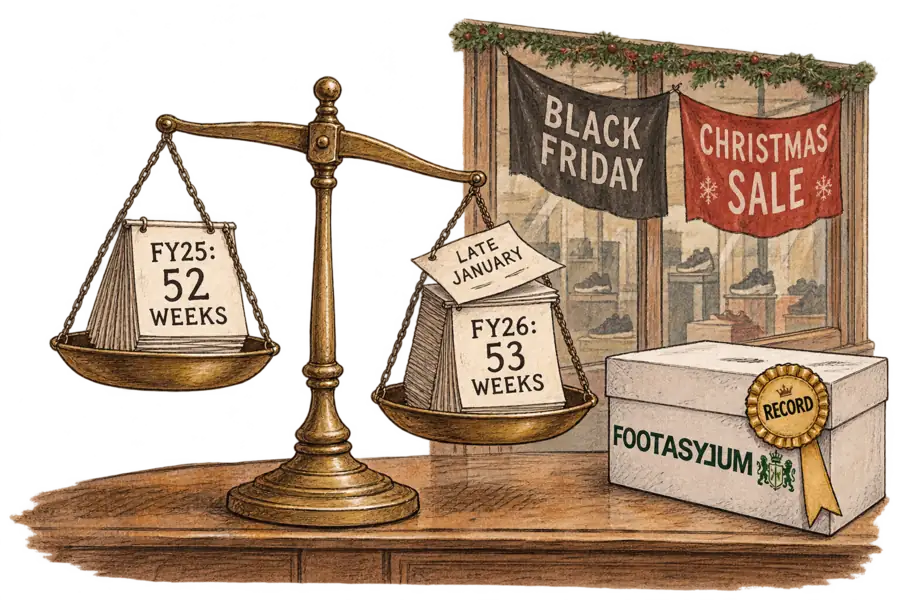
Footasylum's Record Year Had an Extra Week
Footasylum's 'record' £352.5m covered 53 weeks against 52, and its own July 2025 update implies the 32 weeks from late June sold less than the same stretch a year earlier. The profit measure changed too: last July's headline EBITDA was the management figure after lease costs, this year's follows IFRS 16.
Neritus Vale
Footasylum’s “record” revenue of £352.5m took 53 weeks to earn, and the year it beat had 52. Unless the extra week sold less than £3.0m, the growth disappears once the calendar is held still. The company’s own July 2025 trading update shows that its last 32 weeks, Black Friday and Christmas included, went backwards. What it has added since is capacity: an undrawn bank facility and an automated warehouse. Neither touches the discounting the company names as one cause of lower profit.
The growth Footasylum reported is smaller than the week it added. Drapers reported revenue up 0.9% “for the 53 weeks to 31 January 2026”. The year before ran 52 weeks to 25 January 2025 and brought in £349.5m, its filed accounts show. Howard Tattersall, the chief marketing officer, told Drapers the record was “achieved despite a challenging consumer environment”.
For the comparable 52 weeks to have grown at all, the extra late-January week must have sold less than £3.0m, under half an average week. Drapers’ report gives no 52-week figure, and the FY26 accounts are not due at Companies House until 31 October.
The July 2025 update puts the decline in the back of the year. Sales for the first 21 weeks were up 10.5%, FashionUnited reported from the company’s results announcement. Growth of that size on a normal base would by itself exceed the whole year’s gain, so the 32 weeks that followed sold less than the 31 they replaced. The inference fails only if those 21 weeks sold under £29m a year earlier, a share of the year’s sales well below their share of its calendar.
The size of the back-half shortfall depends on two assumptions. Suppose the first 21 weeks carried between a third and two-fifths of FY25’s sales, and the extra week sold between £3.0m and an average week’s £6.65m. The 31 comparable weeks from late June to January then sold between 5.2% and 8.8% less than a year earlier. Footasylum publishes no seasonal split, so both assumptions are ours.
The profit comparison changed measure between the two announcements. Footasylum’s FY25 accounts carry underlying EBITDA on the IFRS 16 basis, and a management EBITDA that deducts an IFRS 16 adjustment of £21.5m. The standard moves lease costs below the EBITDA line; the management figure puts them back.
Last July’s announcement gave the management figure, £28.2m, as FashionUnited reported it. Drapers’ prior-year comparison of £49.7m equals the accounts’ underlying EBITDA of £49,736k, which suggests this year’s £38.5m is on the IFRS 16 measure. Read side by side, the two announcements show profit up 36.5%.
On the IFRS 16 measure, Footasylum handed back the whole of the previous year’s profit growth. EBITDA fell 22.5%, Drapers reported, to a level a shade below the £38.6m the FY25 accounts show for FY24. Footasylum blames a “more subdued” economy, higher UK employment costs and “industry-wide” increases in promotional activity. The same accounts said the National Insurance changes would take effect from April 2025, so that cost fell on all of FY26, not only its back half.
On the measure Footasylum used last July, the fall is steeper. If lease costs held at their FY25 level, management EBITDA came to about £17.0m, a fall of 39.7%. Four more stores than a year earlier and an extra week of rent make a flat lease bill the generous assumption.
Footasylum’s market explanation is right about the direction. JD Sports said in its September interim results that UK online sales had fallen in “an aggressive promotional trading environment”, and in December Frasers’ chief executive, Michael Murray, said excess stock was “leading to increased promotional activity”. Footasylum is exposed there: online carried 41% of its FY25 revenue, the accounts show. JD’s UK like-for-like sales rose 0.4% in the quarter to early May, a trend it said was “helped in part by good weather”, then fell in the summer, the autumn and the peak weeks. Footasylum’s year has the same shape.
The strongest objection is that, over the whole year, Footasylum beat JD Sports, which the competition regulator forced to sell it to Aurelius in 2022. JD’s year ended on the same Saturday but ran 52 weeks, and its UK organic sales fell 2.5%, its results show. Scaled pro rata to 52 weeks, which treats the extra week as an average one, Footasylum’s fall was about 1%, so it would have taken share in a shrinking market. That reading needs the gain to have been spread through the year, and the July update shows it was banked by June. JD does not publish UK sales for the same window, but on a first-21-weeks share of 30% or more, Footasylum’s back-half fall exceeded JD’s full-year figure. That is the business Hannah Mercer, hired from Gymshark, took over as chief executive in May.
Footasylum has spent the months around the year end adding capacity. HSBC lifted its revolving credit facility to £60m, and none of it was drawn at the year end, Drapers reported. Operating cash flow climbed 15% over the same year. In March, Drapers said the money would also go towards upgrading the warehouse in Middleton.
Tattersall calls the automation of the distribution centre “the largest capital project in Footasylum’s history”. AutoStore’s announcement quotes Tom Killeen of THG Ingenuity saying the Robotics-as-a-Service model gives Footasylum “access to enterprise-grade infrastructure without the capital commitment”. It also quotes Mercer calling the project “one of the most significant investments we have made in the business in recent times”. The announcement does not say who owns the grid and bins.
Automation answers one of the three causes Footasylum gave for the profit fall, and only part of it. It cuts the labour of picking stock, but the FY25 accounts put the warehouse at 245 of 2,566 average employees. It does nothing for the price at which a trainer sells. Tattersall dates the response on price to after the year end. Describing the months since, he says: “We have also sharpened our focus on full-price trading and maintaining cost discipline.”
If Footasylum keeps its calendar, FY27’s 52 weeks will be set against FY26’s 53.
Footasylum’s full-price line is now a choice with a visible cost. After a weak peak, JD said it responded in its final weeks “by choosing to make targeted price investments”; holding prices against that protects margin and gives up volume. If FY27’s comparable sales merely match FY26’s, the reported figure will still fall by between 0.9% and 1.9%, depending on how much the extra week sold. Either way, the cost lands in a year with no extra week to absorb it.