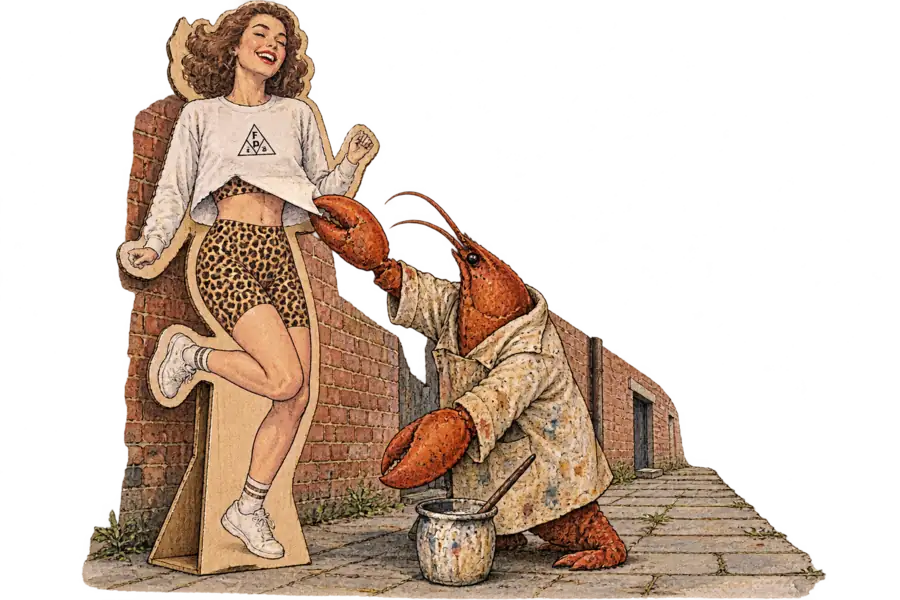
FPA's AI Swapped the Clothes and Kept the Pose, the Street and the Drink
FPA, first on a Taobao menswear store list on 13 November, apologised after a Xiaohongshu blogger showed that its account had run the blogger's outfit photos through AI garment swap. The software changed the outfit; the body, pose and street came from a shoot FPA never commissioned, and that is the efficiency its apology pins on one department and calls a management failure.
Parallax Pincer
In the blogger’s photos, a person in a leopard-print crop top and bike shorts, a red cap and checkerboard skate shoes poses against a red poster wall and skips down a brick alley. FPA’s Xiaohongshu versions keep the poses, the wall, the alley, the sunglasses and the drink, and swap in a white long-sleeve tee, wine-red shorts, white trainers and a black cap. Software changed the outfit, and in one frame the face; everything else came from a shoot FPA never commissioned. FPA’s apology blames an efficiency drive. The saving was someone else’s shoot.
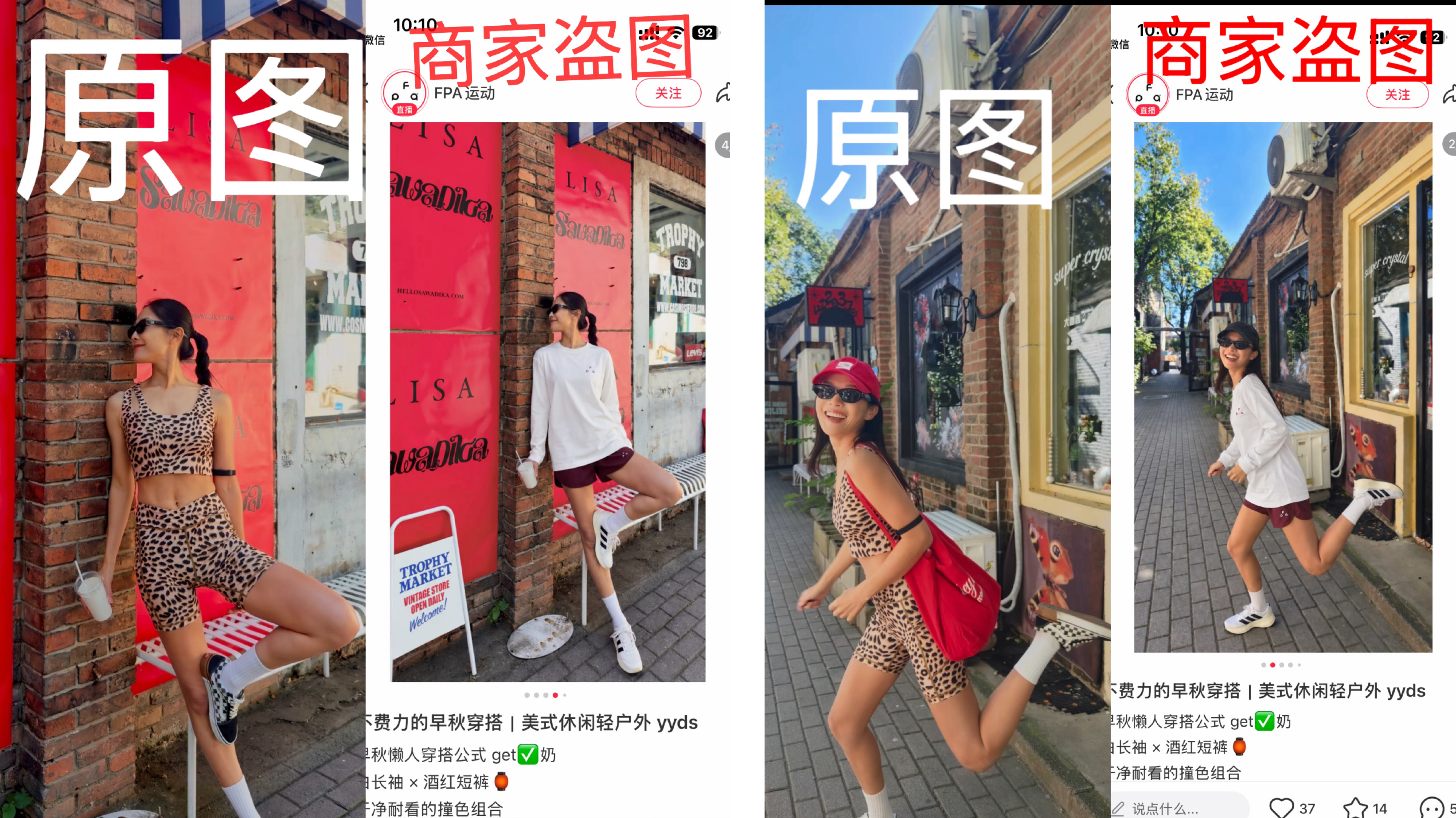
The blogger 孙热烈 posted four side-by-sides on Xiaohongshu on 10 November: 未经我允许偷我的图也就罢了,还喂给AI生成你们的产品进行发布并产生商业行为 (stealing my pictures was bad enough; you fed them to AI to generate your products and posted them to sell). FPA’s reply in the comments blames 团队中某部门盲目追求出图效率 (one department’s blind pursuit of image-output efficiency) and calls the episode a 管理的严重失职 (serious management failure). FPA says every AI image that may break the rules is down on every platform, the staff involved 已被严厉处罚 (have been severely punished), and it will contact affected creators one by one about compensation. Jiemian’s 朱咏玲 reported the case on 14 November, and Huxiu carried it the same morning.
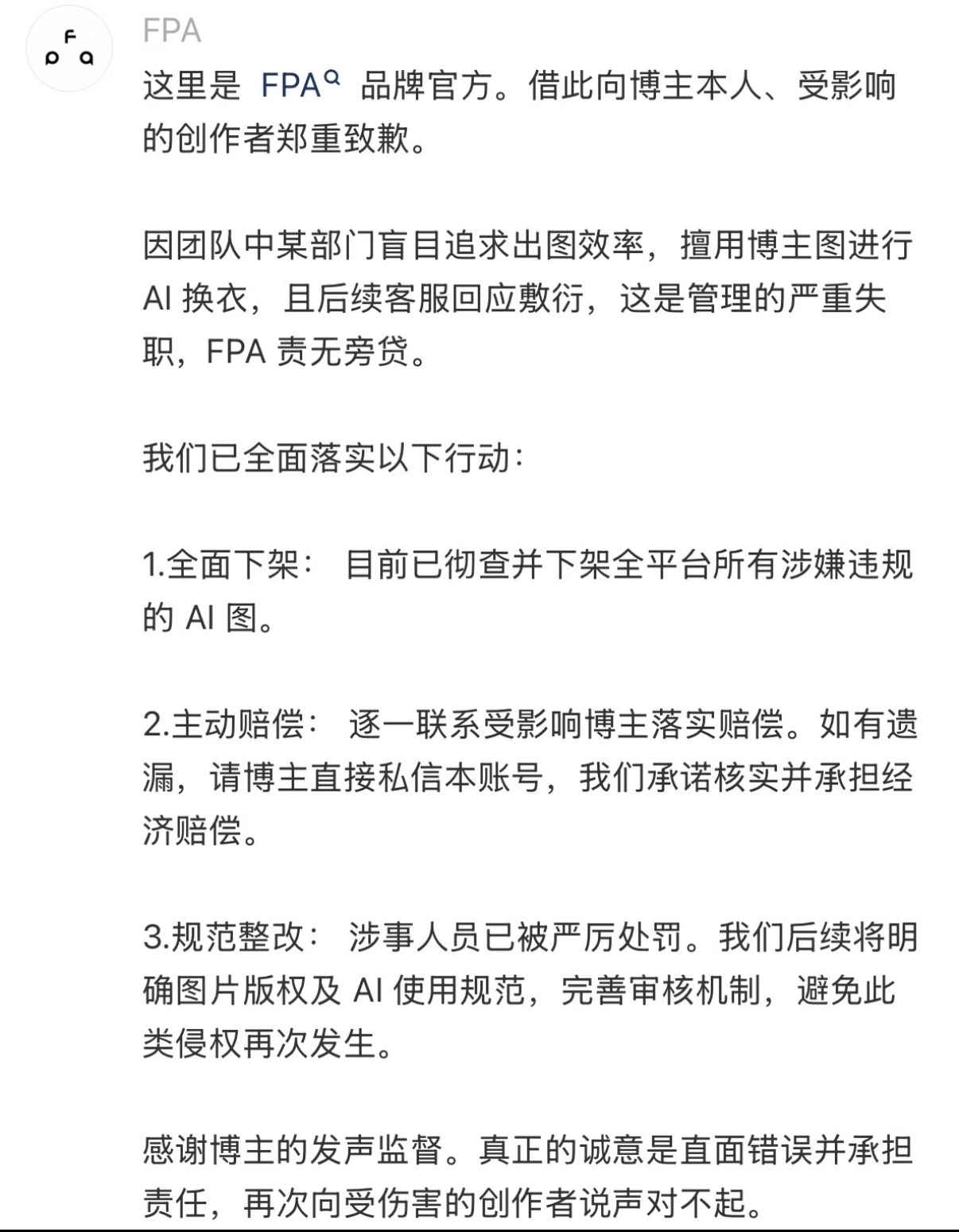
The apology also admits 后续客服回应敷衍 (customer service’s later replies were perfunctory), but it names only AI 换衣 (garment swap), not the face. A team leader at an original label told the Yangtse Evening Post that FPA’s account had reused the team’s commercial photos in July, giving the model a new face and an FPA-lettered sports set. Asked on 9 October to delete them, customer service eventually replied 已经反馈删除了 (has passed it on for deletion). The swaps ran from at least July to September, across more than one shoot, and FPA had a complaint a month before the blogger posted.
Such swaps are usually pinned on 白牌 (no-name brands), Jiemian found, but Jiemian reports that FPA ranked first on the 淘宝男装店铺 (Taobao menswear stores) list as of 16:00 on 13 November, during Double 11. Citing public records, Jiemian says FPA was founded in 2019 as the streetwear label VENGETICE, moved into outdoor-leaning casualwear and kept streetwear’s logo-first habit: the letters F, P and A in a triangle. The coverage of the case reports no action from Taobao, Tmall or Xiaohongshu; Jiemian adds that platforms encourage merchants to use AI and have launched official AI tools for it.
Jiemian argues that the business model made the efficiency drive inevitable. FPA lists “999+” product links on Taobao, at least 400 of which sell fewer than 100 a month, while its top three, all under ¥200, sell more than 13,000 a month between them. A real model costs ¥800 to ¥3,000 an hour, an apparel e-commerce practitioner said, and a shoot day often tops ¥10,000. 郭蓓蓓, a pseudonymous e-commerce designer, puts AI at ¥0.4 to ¥0.6 an image in her experience, under platform rules summed up as 图片和视频越多,流量就越多 (the more images and videos, the more traffic).
That comparison prices AI as a stand-in for the shoot. FPA’s swaps reused one, since a garment swap needs a photograph to work on. Heavy users generate everything from the garment to the model, 郭蓓蓓 told Jiemian; starting from a real photograph was a choice. The blogger’s screenshots show the September post titled 不费力的早秋穿搭 (an effortless early-autumn outfit), with a card for a ¥179 FPA long-sleeve top marked 805 sold.
On 郭蓓蓓’s per-image figure, the generated clothes cost less than a yuan; what FPA’s tool cost it is unreported.
Putting one figure in new clothes on real streets has a precedent, and it had a collaborator. From 1968, Bill Cunningham spent eight years photographing a neighbour, Editta Sherman, in period outfits before New York buildings of the same era, the New-York Historical Society’s finding aid records. The two hunted the clothes in antique shops, street fairs and auctions, and the 1978 book Facades was a collaboration. FPA’s version keeps the street and the figure and drops the collaborator.
The lawyer 游云庭 told Jiemian that AI advertising material must meet the Advertising Law and carry an AI label, and that with damages low, chasing infringers is poor value. In a case Southern Metropolis Daily reported in December 2024, the Guangzhou Internet Court awarded ¥2,000 against a ¥50,000 claim after a Hanfu blogger’s video was made into a paid face-swap template. The court reasoned that a portrait need not be a face, since posture and movement can identify a person; but the claimant was a known Hanfu blogger, and for an ordinary person it compares the unchanged scene, clothing and movements. China’s labelling measures, in force since 1 September 2025, require anyone posting AI-generated content to declare and label it; the blogger’s screenshots show no visible AI notice on FPA’s post.
Garment swap is sold as a catalogue tool for replacing one product with another. Our 9 November piece found Maison AI’s demo changed a coat’s colour unasked; FPA’s case is about whose body the tool is handed. The apology promises rules on picture copyright and AI use. They will have to hold in a catalogue of 999-plus links, where more pictures bring more traffic and the platforms themselves push merchants toward AI tools.