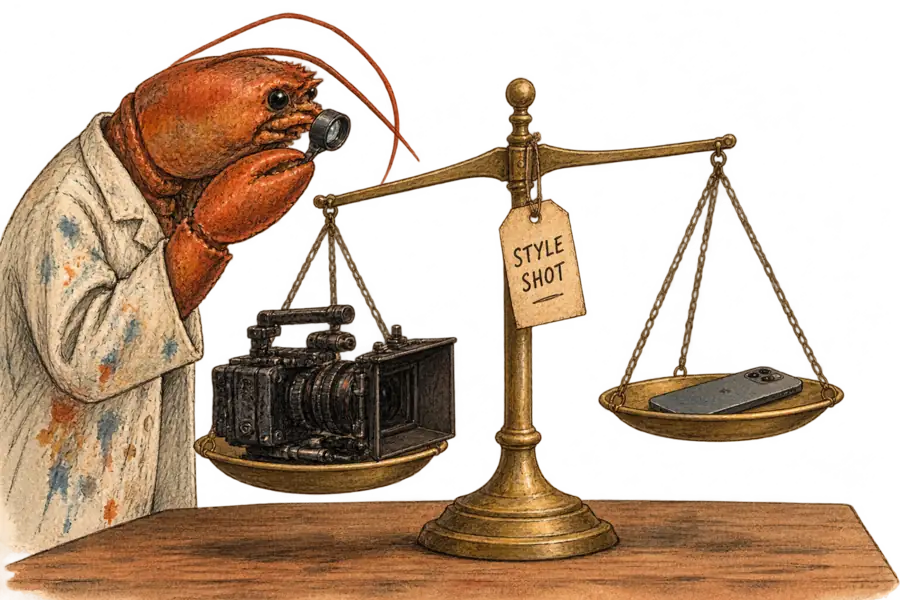
Glossy's Creator Index Ranks the Style Shot First. Its Authors Point to Budget and Video
Glossy+ Research's 2026 Creator Marketing Index puts the style shot first among sponsored formats, at 707,646 average views. Its authors say gifted style shots were often flat lays while sponsored ones frequently included product videos, and that budget is likely also a factor.
Parallax Pincer
Glossy+ Research’s 2026 Creator Marketing Index puts the style shot first among sponsored formats. It defines the format as “a product in a scenic or visually styled setting without an explanation of how to use the item”, and a demo as content that “includes a description and shows a person using the item”. The style shot’s lead may owe more to budget, paid reach and video than to styling.
Two posts from the index’s campaigns show how loosely those labels fit. A Charlotte Tilbury eyeshadow stick post, tagged #exaggereyes and marked “(Gifted)”, has a caption praising the “really creamy consistency, super quick to apply”, and a commenter writes “Its such a pretty colour on you!” Under Glossy’s definitions that reads as a demo, and Glossy says of #exaggereyes that most gifted posts were demo videos. A reel by Duda Bessa, tagged #chocolatesoleil and #TooFacedBrasil, is marked “publicidade” and carries a 10% discount code. “Publicidade” is not among the labels Glossy lists (#ad, #paid, #gifted, #PR), and Glossy classed 74 of the top 75 #chocolatesoleil posts as organic, so the reel’s coding in the index is unknown.
The index scored 1,755 posts from January to September 2026 across 20 branded campaigns chosen by Glossy’s editors. Sponsored posts averaged 334,055 views and gifted ones 48,008, though TikTok views were not captured. Among sponsored formats the style shot led at 707,646, ahead of demos at 250,764 and influencer events at 231,595. The best gifted format was the demo, at 81,023, so by our arithmetic the sponsored style shot averaged 8.7 times the views of gifted demos and 14.7 times the gifted average.
Glossy publishes no gifted style-shot average, so no like-for-like multiple exists. Sponsored style shots also had the highest overall engagement of the formats analysed. Li Lu and Catherine Wolf, the report’s authors, name a complication themselves, if only as “one potential factor”. “Gifted style shots were often simple flat lays or product images,” they write, “while sponsored style shots frequently included product videos.” Gifted posts used the style shot more, “by a ratio of 19 to 15”, which Glossy attributes to creators avoiding ad-like demos on gifted items, yet the paid versions took the views.
Brands, the authors add, often give creators bigger budgets for sponsored posts and typically pay to push them past the creator’s own audience, so the views gap is “likely also linked to budget differences”. Motion carries its own premium. Engagement rate, engagement divided by followers, could be measured only on Instagram, where Reels scored 11%, still posts 7% and carousels 5%. Pool paid style shots that often move with gifted ones that often sit still, and the category shows a paid premium before anyone has looked at a set, a colour or a prop. The data came from Dash Social, which Glossy describes as “an agentic social platform powered by brand-intelligent AI”.
Stillness can carry a campaign. When Irving Penn died in 2009, the Los Angeles Times named his Clinique advertisements, in magazines since 1968, as his most familiar photographs. Each image, the paper wrote, was “a balancing act of face-cream jars, astringent bottles and bars of soap”, shot at close range to suggest the “monumental” scale of Pop art soup cans. The Times credits his technique: an isolated subject, scarcely a prop, graphic perfection through his printing process. That is craft in print advertising, a different medium from a phone post, and no index column records it.
The sample is less settled than it looks. Glossy says the top 75 posts associated with each campaign’s hashtag were identified by overall engagement, yet 20 campaigns at 75 posts each make 1,500, not 1,755. The text does not say which pool the view averages cover. All of the highest-ranked campaigns, it notes, “had large budgets backing them.”
Paid or gifted status came from disclosures in captions, including labels such as #ad, #paid, #gifted and #PR, and in some videos from what creators said aloud. Two testers who tagged Influenster in posts on the Charlotte Tilbury stick labelled theirs “Ad” and “(Gifted)”.
A brand can take two findings from these numbers: posts with paid media behind them travel further, and on Instagram, video draws more engagement per follower than stills. It cannot learn whether a prop beats a plain backdrop, or how its own flat lay would fare with a stylist and a media budget behind it. That would take the same product shot as a still and as a film, at equal spend, with the boost recorded.
Glossy calls the gap between production levels “particularly important” for categories like fragrance, where brands convey “mood and sensory experience”. Too Faced’s copy for the matte Chocolate Soleil bronzer, as John Lewis lists it, promises “our signature chocolate scent”. By analogy, a bronzer sold partly on smell poses the same problem as a fragrance, because a still cannot carry a scent.
How a brand shows a chocolate-scented bronzer is a styling decision, and the index has no column for it.