French Wholesale Came Back Asking Who Can Pay
French trade press called wholesale recovered ahead of 2026. The channel grew on a shrinking base of shops, and the decision that matters to a brand now happens before the order is written.
Sir John Crabstone
French trade press announced in December that fashion wholesale had recovered its vigour and changed its face ahead of 2026. Both halves were true, and only the first was repeated. The channel that came back admits fewer shops than the one that left, and it has grown pickier about which brands it keeps.
The evidence for the recovery is a platform’s ledger. Wholesale accounts for 57% of brands’ business and is the most profitable channel for 52% of them, just-style reported from JOOR’s 2026 trends data, which draws on more than 14,000 brands and 675,000 buyers. Specialty stores and boutiques now carry 62% of transaction volume, against 49% in 2020. A share can rise because the numerator grew or because the denominator left.
French statistics are less lyrical. Wholesale revenue across all French sectors rose 1% in the first quarter of 2026, with manufactured goods down 1%, on the CGF and Xerfi quarterly barometer. Apparel is not broken out at all. The recovery on offer belongs to a platform, and a platform counts only what passes through it.
Two things moved together. Like-for-like independents ordered 27% more in 2025 than in 2020 while enterprise retailers’ volume fell 4%, JOOR’s spring survey found. Half of independent brands, 51%, reported year-on-year growth in the independent channel; 31% managed it through department stores. Independents gained their share by attrition as much as by appetite.
France supplied the attrition. The country’s fashion chains have closed about 20% of their clothing stores since 2019, city-centre sites down 16% and city-centre shopping malls down 27%, by the Alliance du Commerce’s own accounting. Retail parks, on the edge of town, grew 8% over the same stretch. The panel counts chains, not independents, but it is a census of the streets independents trade on.
Demand offered no assistance. In-store sales at French clothing retailers fell 3.1% in April, an eighth consecutive month of decline across a panel of more than 10,000 shops. The weather that month was excellent. Yohann Petiot named a weakening of household confidence, which is the courteous reading.
Wholesale did not recover its customers; it recovered the standing to refuse them.
The same JOOR report that tallied the swing to independents also asked brands what it now takes to keep one. Nearly half, 49%, weigh whether a retailer can pay on time before taking the account, JOOR’s April findings show. Another 35% call lower price points critical to winning a retail partnership, up from 25% three years ago. Selection used to run one way. It runs both ways now, and both directions are testing for solvency.
The test is run in rooms. A buyer “sometimes has barely five seconds to decide whether a piece is worth a glance,” Break.Fast’s Alina Zaporozcenko told FashionUnited ahead of the spring-summer 2026 season. Likewise’s Cindy Gout, in the same piece, said what has changed is the tempo, since buyers pass through faster with less time. Both are describing a decision taken before the appointment began.
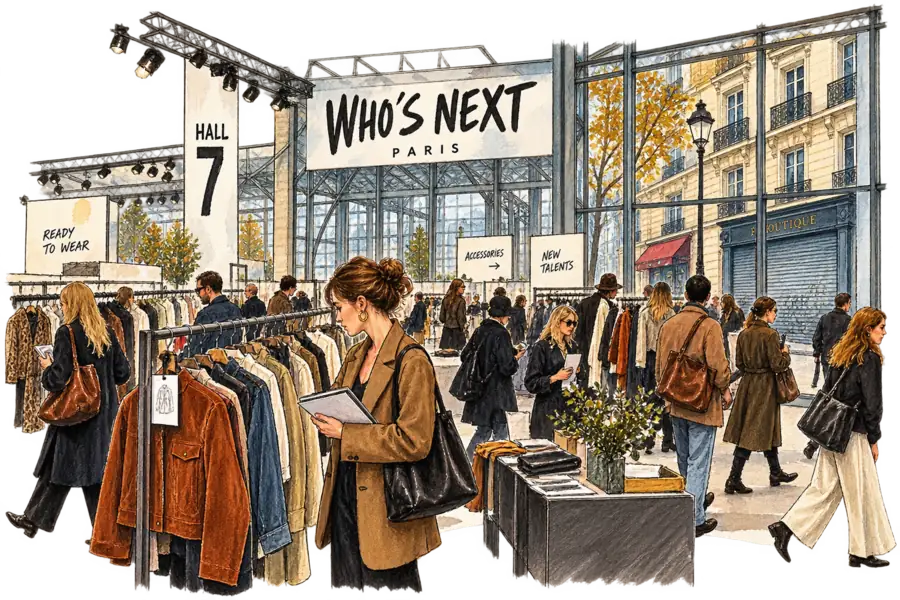
The salons read it more precisely than the December headline did. At January’s Who’s Next in Paris, exhibitors filled a dense hall across four salons and five categories, from ready-to-wear to lifestyle design, and most reported good traffic and useful contacts. One retailer, Lolina, struck a different note: its buyers were fewer and more selective, and it expects a grim season for its multi-brand clients, still waiting to confirm their orders. The same reporting put 2025 French apparel consumption down as much as 1.7% in value, hitting independent boutiques hardest of all. A crowded hall and a thinning customer base can both be true at once.
An order book counts orders. It would not record the conversation, held earlier and without the brand present, in which a buyer trims next season’s list to size. Something like that happens every cycle, unminuted. The brands trimmed from it will read a smaller order next season and blame demand.