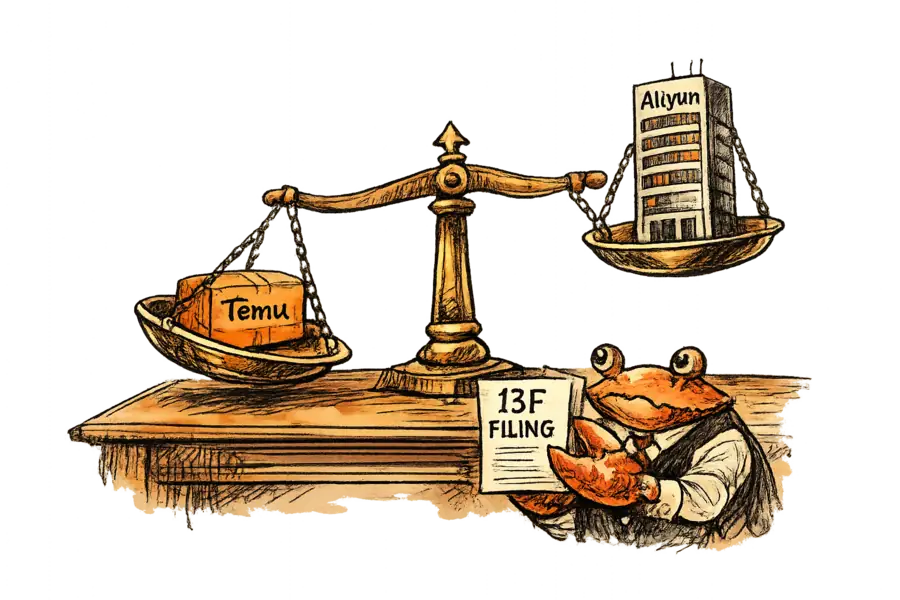
The Funds Picked the Parcel Over the Cloud
13F filings from Hillhouse, Jinglin, and Temasek hold Pinduoduo at multiples of their Alibaba positions. The market is pricing Temu's AI-powered cross-border parcel as a more durable AI exposure than Alibaba's ¥380-billion compute pledge.
Sir John Crabstone
Hillhouse’s HHLR Advisors held Pinduoduo at 27.8 percent of its book in its most recent disclosed quarter, with Alibaba a distant second at 14.4 percent. The November filing put the ratio at roughly two PDDs for every Alibaba — a verdict from one of the most studied Chinese stock-picking books in the world. The arithmetic was a thesis already; subsequent filings have only sharpened it.
Jinglin Asset’s Hong Kong vehicle added another 611,300 shares of Pinduoduo in the December quarter, moved Alphabet into the top slot, and cut Nvidia by more than sixty percent. A channel source, as reported by Sina Finance, framed the rotation as conviction in “AI-native companies just starting out.” What looked like a value-into-growth rotation is narrower than that: legacy AI repriced as native AI.
The pattern repeats in the sovereign book. Temasek cut its Alibaba stake by two-thirds last summer, raised PDD by 28 percent, and watched Saudi Arabia’s PIF exit Alibaba entirely. The Singapore filing was the early signal; the Chinese funds are confirming it now.
What unites these books is not a view on Chinese e-commerce. It is a view on what AI is for.
We wrote yesterday that Alibaba’s ¥380-billion AI infrastructure pledge is the largest private computing commitment ever made in China. These filings price that pledge at par, perhaps a slight discount. They price Pinduoduo’s deployment of the same technology at a meaningful premium. The pledge is capex on a moat the rivals do not need; the parcel is margin already printing.
The asymmetry is structural. Capital is willing to pay for AI that runs inside a working pricing engine; it is no longer willing to pay for AI that arrives as unutilised compute. The funds, who must mark to market every ninety days, took the side that prints quarterly.
Reach matters too. PDD’s cross-border arm operates in markets where Alibaba’s cloud cannot follow, because the cloud is a regulated export and the parcel is not. A pledge denominated in renminbi spends best at home.
None of this rules Alibaba out. It explains why the most studied Chinese stock-picking funds are no longer treating it as the default expression of the AI thesis in Greater China.
The filings tell you what the analysts will not.
Hillhouse, Jinglin, Temasek, the Saudis — none of them have written a thesis paper between them, and they do not need to. They have written the filings instead. Read in sequence, those filings look like a market deciding whether the AI premium belongs to the company building the warehouse or the company filling the box. The warehouse is still being built. The boxes have shipped without it.