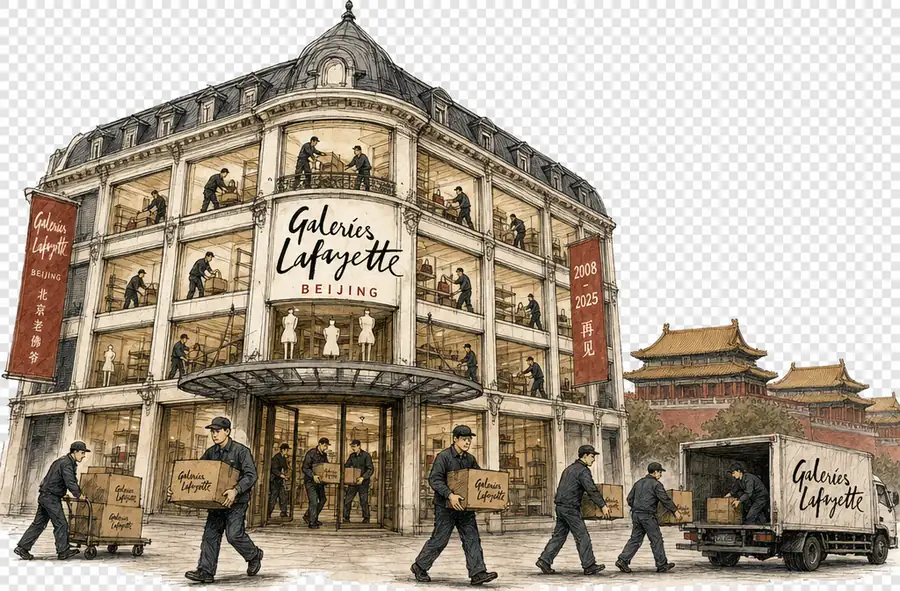
Galeries Lafayette Emptied Six Floors. Its Shoppers Had Already Moved to the App.
Galeries Lafayette closed its Beijing flagship on 27 May, but China's luxury money never left the city; it re-sorted toward value and verification. The AI price-comparison and resale-authentication tools Chinese shoppers now use by default are speeding a shift from status-signalling to smart-buying, and the department-store format is the casualty.
Neritus Vale
Galeries Lafayette spent thirteen years on six floors near the Forbidden City, and on 27 May it closed its Beijing flagship without losing the customer it came for. The convenient reading is a luxury slump that has finally reached the door of a 48,000-square-metre French emporium. The truer one is that Beijing’s luxury money never left the city; it re-sorted toward value and verification, and the price-comparison and resale tools now sitting in every shopper’s pocket are accelerating the move from signalling to smart-buying.
Read as a simple slump, the closure contradicts the very numbers a slump would predict. Mainland China’s personal-luxury market fell 3% to 5% in 2025, Bain reports, and a decline that shallow describes a market steadying rather than one in free fall. The same study logged early recovery in the third quarter, a significant moderation compared with the sharp decline seen in 2024. Falling demand cannot empty a flagship while the demand curve is flattening beneath it. What failed in May was a format and a postcode, not the city’s appetite for luxury.
The money that stayed has re-sorted by category, and the direction is easy to read. Beauty climbed back to growth of 4% to 7% in 2025 while leather goods kept sliding, by Bain’s count. That divergence describes a buyer trimming luxury’s most visible parts and keeping its most useful ones, the monogram cut before the moisturiser. The purchase that announces a price to a room is the one losing ground.
The re-sorting shows up in where the buying happens, not only in what sells. Bain estimates 65% of Chinese luxury spending now occurs inside the mainland, a swing back from the duty-free runs and overseas boutiques that once carried the status purchase. Narrower price gaps explain part of it, yet the habit underneath is the durable change: the shopper who once flew to Paris for the discount now expects to find it at home, and to confirm it before she pays. Proof and price travel with her; the trip abroad was the part that turned out to be optional.
Resale is the clearest evidence that Chinese taste turned toward proof. The country’s secondhand luxury market grew 15% to 20% in 2025 even as new-goods sales fell, Bain found, which is demand migrating rather than vanishing. The platform that wrote the template, Dewu, inspects every item for authenticity before it ships, so verification is the product it sells. China Daily, citing Business of Fashion, put Dewu’s share of Louis Vuitton’s estimated China sales at more than 14% in the first half. A channel built on checking the goods has become the part of the market that grows.
Trust was the department store’s quiet product, underwritten by its address and its lease, and an app that inspects a handbag in a week now holds the contract.
The value half of the shift runs on tools that barely existed when the store opened in 2013. On 11 May, Alibaba folded its Qwen model into Taobao and turned AI price comparison into a default step inside an app with more than 950 million monthly users. Checking a price once cost effort, which quietly protected full-margin retail; now it is ambient — a sentence typed before checkout. China’s 618 shopping festival has gone all-in on AI this year, mainstream enough to reset what buyers expect to pay. A six-floor emporium is the most expensive place in Beijing to learn that you overpaid, and when the cheapest way to audit a price already sits in the shopper’s hand, the showroom’s markup has to argue for itself.
The strongest case against calling this permanent is that the numbers have started to turn. If 2025’s milder fall and its third-quarter uptick are an ordinary cycle, then confidence returns, full-price demand follows, and Galeries Lafayette has merely mistimed an exit it could have waited out. That case has support: LVMH’s 2025 results showed a 5% full-year revenue decline while flagging brightening prospects in Asia-Pacific — the kind of directional signal that tends to precede a broader rebound. On this reading the department store is a casualty of timing, and the showroom comes back when the savings rate falls.
A rebound in spending and a rewiring of how people buy are not the same event, and only one of them reverses. The recovery now visible is concentrated in beauty and in the big houses’ own repatriated flagships, not in the multi-brand department-store format Galeries Lafayette ran. A shopper who has learned to check a price in seconds and have a resale Chanel authenticated does not forget the skill when sentiment improves; those are habits, not weather. If confidence fully returns, the likelier result is better-funded value-and-verification buying, not a pilgrimage back to the sixth floor. The tools do not uninstall.
Galeries Lafayette’s pledge to return with brands better aligned with Chinese expectations is an admission dressed as a goodbye. The expectation it now has to meet is unforgiving: that a building justify a markup the phone in the customer’s hand can already audit. Every retailer in China now sells to a shopper who arrives pre-priced and pre-verified, carrying the two functions the department store used to supply. Floor space has to earn what the app gives away, or it follows the six floors near the Forbidden City into the boxes. What a store is for has become a choice, and Beijing’s shoppers have already made theirs.