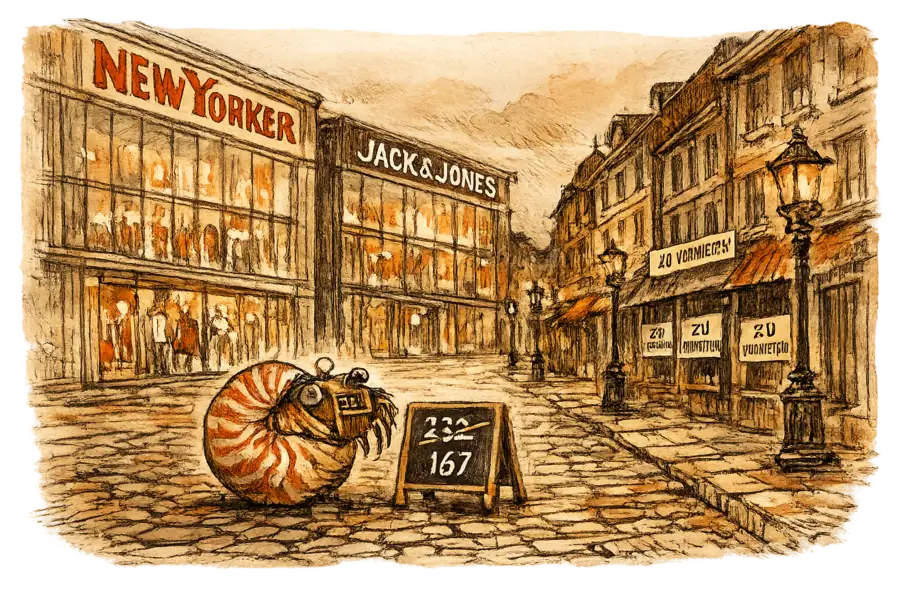
Germany Let More Shop Space Than Last Summer on 65 Fewer Leases
JLL counted slightly more German shop space let this summer than last, on 167 deals against 232 a year earlier. The rebound came from bigger units, mostly for international chains, while the number of signings has barely moved since last autumn.
Neritus Vale
Germany’s shop landlords let more space this summer than last, on far fewer leases. JLL counted 167 retail lettings in the third quarter, against 232 a year earlier. The space added since spring came from bigger units, and most of it went to international chains. JLL calls the quarter a revival, and TextilWirtschaft, counting from January, headlined a sharp fall. Both headlines rest on square metres, which do not show how many leases were signed.
JLL’s release leads with momentum that its own figures put down to larger units. The release of 14 October is titled “Retail letting market regains some momentum” (this and all other quotations from German sources are our translations). Third-quarter take-up of 123,000 m² beat a “weak” second quarter and edged past the 2021–25 quarterly average. The release also reports a flat deal count and an average letting about 31% larger than in the second quarter. It presents that as one detail among several, though with the count flat it is the whole of the gain.
TextilWirtschaft’s decline is a nine-month figure, set against an unusually strong year. Its headline on 15 October was “Markedly less shop space let”. The opening paragraph, citing JLL, puts nine-month take-up 19% below the same stretch of 2025. JLL concedes only that the year remains “below the previous year’s record level”. TW’s arithmetic is right.
Against last summer, this quarter’s lettings covered slightly more space in much larger pieces. Neither headline makes that comparison. JLL put the third quarter of 2025 at 117,700 m². Dividing each quarter’s space by its deal count, we find this summer’s average letting about 45% bigger than last summer’s.
International chains took most of the space added since the second quarter. Using the international shares JLL gave for the second quarter and the third, we put their share of the increase at more than four-fifths. Inside the flat total, the split shifted by about ten leases from domestic to international retailers.
International retailers lease bigger units than the market average. They took 67% of the third quarter’s space on 57% of its leases, JLL reports. Aniko Korsos, JLL’s head of retail leasing, gives the motive: “Global retailers are looking specifically for larger flagship units so they can present their brand experience to full effect.” A flagship programme adds square metres faster than it adds leases.
Clothing led the categories and took a bigger share over the summer. Textile retail took more than 28% of the year’s space after nine months, up from 26% at the half-year. Its slice of the third quarter must therefore have been larger than its slice of the first two. Over the nine months, JLL names Inditex, New Yorker and Jack & Jones among the most active, each with multiple lettings.
Clothing’s share has been shrinking for three years. In the first nine months of 2023 the category took 46% of take-up, by JLL’s count, and its share has fallen every year since. The summer’s rise is a blip in that decline.
Germany’s ten leading retail cities took more of the space without taking more of the deals. Their share of the third quarter’s space rose from 41% to 48%, JLL reports, while their share of deals slipped from 51% to 50%. More space on almost the same share of signings is what flagship leasing looks like in a broker’s totals.
Take-up records the leases signed and has no column for the retailers who leave.
Two days after JLL’s figures, TextilWirtschaft reported that a Berlin institution may be closing. Mientus, a premium and luxury retailer, traces its history to 1937 and runs three stores and a webshop. It has reportedly told suppliers that winter 2026/27 will be its last season, and TW’s headline carries a question mark. Berlin is still the largest market, though its nine-month take-up is 7% below last year’s.
JLL’s other gauge points to space that is empty or may soon be. Its availability rate for the nine major markets counts empty shops along with those under conversion, those whose leases end within 18 months and those whose current tenants are seeking a replacement. The rate rose slightly in the first half, and JLL’s half-year report puts Berlin, where Mientus trades, at 17.3% of floor space. Counted by shop rather than by area, the figure is 19.8%, nearly a fifth of units.
The strongest objection is that one lumpy quarter proves nothing, and it comes from JLL itself. Korsos notes that in cities like Leipzig “even individual large lettings” can lift a quarter’s result sharply, and she calls the spread between cities “the result of very targeted individual deals”. Both remarks concern city markets; carrying them over to the national square-metre total is our extension, not JLL’s. JLL’s first counts also get revised: the first quarter’s rose from 171 deals in April to 182 in July. For this reading to fail, the missing leases have to turn up, in revisions or in a rising count.
Four quarters of counts show no sign of the missing leases. Matching last summer would take 65 more, and the first quarter’s revision added 11. The count has barely moved since last autumn, from 174 to 168 in the second quarter and 167 in the third, while the average unit has swung from quarter to quarter. If large single lettings do drive results, as Korsos describes for individual cities, the square metres are the figure to doubt, and both headlines rest on them.
If the count stays flat while international chains take a growing share of the space, German landlords’ results will hang on a short list of flagship leases. Those leases depend on expansion budgets set at a handful of head offices. JLL says the fourth-quarter outlook makes it confident of a solid finish to the year, yet Korsos says it is “too early for euphoria” and that tenants still calculate “very price-sensitively”. When a retailer like Mientus leaves, the owner of the shop can wait for a flagship tenant that may never come, or price it for the tenants still signing.