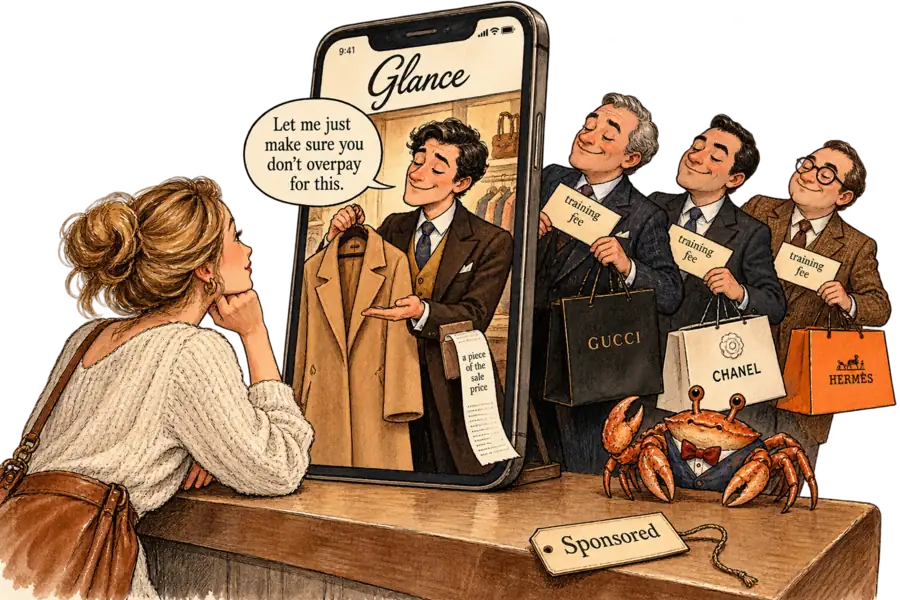
Glance Charges Brands to Be Studied. No Label Can Mark the Lesson.
Glance, the InMobi-owned shopping agent L Catterton has just backed, is paid a piece of the sale price, WWD reports, and offers brands paid 'deeper training'. A label can mark a paid result but not a paid lesson, and a 2023 FTC staff post asking AI output to separate organic from paid no longer resolves on the FTC's site.
Sir John Crabstone
Naveen Tewari, Glance’s founder, describes a shopping agent that tells its user: “Let me just make sure you don’t overpay for this.” WWD calls the model “similar to affiliate marketing”: Glance gets “a piece of the sale price”. For a fee it also does “deeper training” on brands; WWD does not say who pays.
Tewari told WWD that 10 million Americans use Glance monthly, almost 15 percent of whom “end up buying something”; Glance’s own brand page says 7 million.
A percentage commission rises with the price, so the agent earns less on every dollar it saves the shopper. Glance’s pages state no rates, so a shopper cannot tell whether the dearer shop also pays better.
Brands hear a different story. The brand page promises “No transaction cut, no middleman” and “You keep everything”, yet it also calls Glance “not a marketplace” that sends shoppers to “your site, your checkout”. The promise may concern the till alone; it does not mention the commission WWD describes.
Shoppers’ terms say less. The AI Looks app agreement names “affiliate brand partners” in its opening definition and discloses branded content, but nothing in it mentions commissions or brand-paid training.
The training fee is the subtler purchase. Tewari presents it as fidelity: “let the model learn the brand and its authenticity.” He names the return as reach: trained brands “get discovered for the right user at the right time.” If training raises a brand’s odds of being recommended, the payment works through what the agent knows, and a sponsored tag has nothing to hang on.
A label can mark a paid result; it cannot mark a paid lesson.
In 2023 an FTC staff attorney, Michael Atleson, wrote, in a passage on ads in AI output, that “any generative AI output should distinguish clearly between what is organic and what is paid”. The post no longer resolves on the FTC’s site; its address returns “Page not found”.
The FTC’s Endorsement Guides remain, as administrative interpretations rather than rules. They say an unexpected connection that “might materially affect the weight or credibility” of an endorsement must be disclosed, and online “the disclosure should be unavoidable”. Whether a shopping agent is an endorser is our analogy, not a ruling.
EU law comes closest, for search only. Point 11a of Annex I to the Unfair Commercial Practices Directive, added by Directive 2019/2161, bans search results that do not clearly disclose “payment specifically for achieving higher ranking”.
The Commission’s guidance counts an “increased commission per transaction” as such payment, and exempts fees for “general services” that are “not dedicated to achieving higher ranking”.
Pitched as fidelity, Glance’s training fee resembles a general service. Tewari sold it to WWD as discovery, and discovery is what ranking is for. Whether an agent that recommends before any query counts as search is open, as is Glance’s EU presence.
Glance plans to spend L Catterton’s money training its model faster. WWD does not report whose catalogues the model will study first.