Google Added a Parenthesis to Its Gmail Promise. Receipts Fit Inside.
Google has added an exception to its 2017 pledge to keep Gmail content out of ad personalisation, for users who connect Gmail to AI Mode and other Search services. Its help page says AI Mode might look into past purchases and tailor answers to preferred brands, and that such inferences may be used to show ads.
Sir John Crabstone
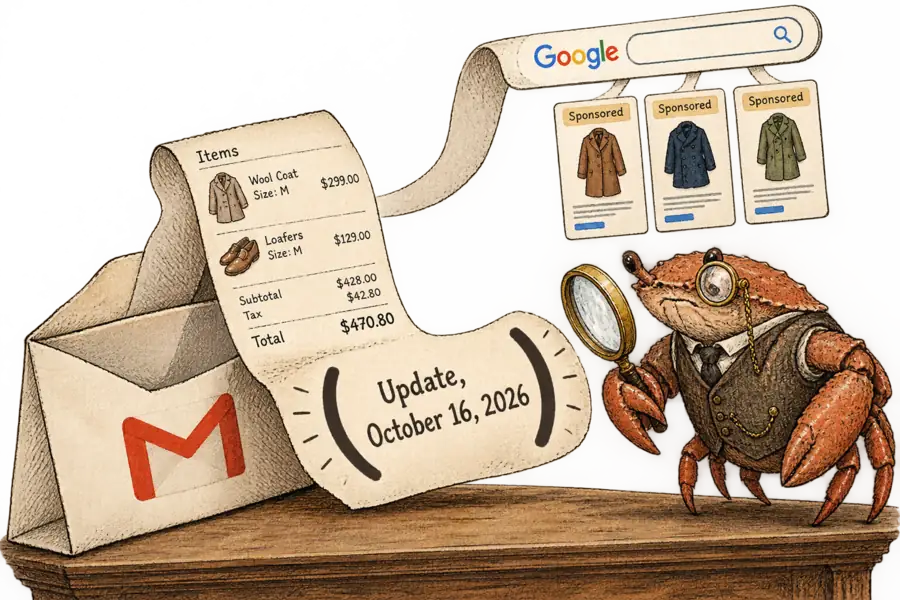
In June 2017 Google promised that consumer Gmail content “will not be used or scanned for any ads personalization”. On 16 October it added a parenthesis to the announcement by Diane Greene, then head of Google Cloud. Where users connect Workspace apps to other Google services, the update says, “depending on a user’s settings, that same subset of data can also be used to show ads.” For retailers, the likely subset is the order confirmation. Each retailer keeps a record of its own sales; the shopper’s inbox keeps them all.
In the example on Google’s help page, a shopper asks about “clothing options for your upcoming trip”. AI Mode “might look into past purchases” in Gmail and tailor the answer to the shopper’s “preferred brands”. The same page says such “summaries, excerpts and inferences” may be used “to show you ads”. Ads, it promises, “will not be based directly on your Gmail inbox”; they may rest on inferences drawn from it.
The privacy policy changed the same day. Its sentence refusing personalised ads based on Gmail content used to end with the word “Photos”. It now continues: “unless you choose to make data from these services available to other Google services that support personalized ads.” That choice is offered “to provide you with a more personalized experience”, and the policy says those services may use the data to personalise ads.
In March a Google spokesperson told Search Engine Land: “There are currently no ads for people who choose to connect their apps with AI Mode. That isn’t changing right now.” The assurance came on the day Google opened Personal Intelligence in AI Mode, as a beta, to anyone in the US. The spokesperson also anticipated that ads would one day “operate similarly” for those users.
“Right now” lasted just under seven months.
On 16 October Search Engine Land reported that Google had confirmed it is beginning to test ads for users who connect their apps. Advertisers “will not be able to access” those apps, and Google has announced no new advertiser controls or wider rollout.
Connecting, the help page says, lets “all Search services” into Gmail, Shopping among them. The option is open to adults in 191 countries and territories, by our count. None is in the European Economic Area, the UK or Switzerland, although the list includes overseas territories such as Bermuda. Google says it is “gradually rolling out to more users, languages, and regions”.
The Verge, reporting the change on 23 October, said it “could mean” targeted ads “based on your personal data”, and told readers how to disconnect. The data is the shopper’s, but on a shopping question much of it was probably written by retailers: order confirmations and shipping notices kept in case something goes back. Disconnecting leaves the past in place; Google’s help page says it does not delete data from Search Services History, which can still be used for product improvement, including training generative AI models. As far as Google’s pages show, the retailer whose receipts sit in the inbox has no setting to change.