Google Took Agent Checkout to Canada and Left the Basket in the US
Google's agent checkout reached Canada on 4 November with lululemon, Simons, Shoppers Drug Mart and select Shopify merchants, but it takes one item per order and does not yet apply loyalty rewards. Google's own developer guide described multi-item checkout by early June, and the launch partners' shipping and points rules show what the gap costs.
Neritus Vale
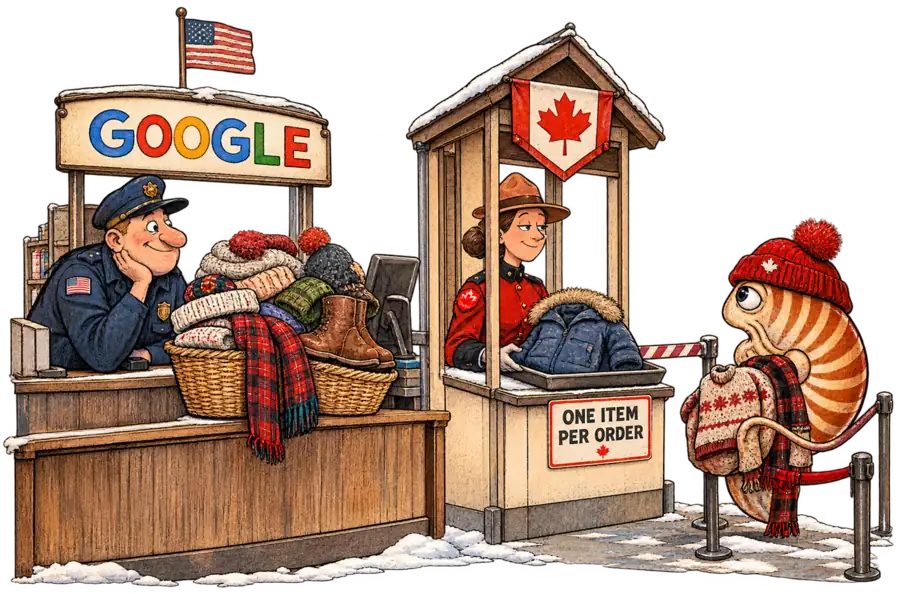
The checkout Google opened to Canadians on 4 November can sell a shopper a Simons coat inside Gemini, one item per order. Google’s US checkout already takes several, the Globe and Mail reported. For clothing, which shoppers buy as outfits and sometimes in two sizes, Canadians therefore enter the holiday season with a narrower checkout than Americans have.
Google supplies the payment details and leaves the retailer holding the order. Google Canada’s announcement names lululemon, Shoppers Drug Mart, Simons and select Shopify merchants. Buyers pay through Google Pay, using cards and addresses saved in Google Wallet. The retailer stays seller of record, CBC reported, “taking full legal responsibility for fulfilling the order.”
Google’s announcement does not mention the one-item limit; the Globe did. The Canadian checkout will initially allow “only one item at a time,” wrote the Globe’s Susan Krashinsky Robertson. Building a cart, “often a requirement to meet a retailer’s free-shipping threshold,” means clicking through to the store’s website. Google plans multi-item purchases for Canada too, she added, along with US features such as price alerts.
Parts of Canada’s launch post are Google’s January copy. The line that retailers “remain the seller of record, with the ability to customize the integration to their specific needs” appears word for word in Google’s 11 January post announcing the US checkout. That post promised that “in the coming months” Google would “expand globally” and add capabilities such as “applying loyalty rewards.” Canada is part of that expansion, and the loyalty promise came with it, in nearly the same words.
In November, Canada got the checkout Google described in January.
The basket already exists in Google’s own documentation. By early June, its developer guide announced: “We now support multiple distinct line items in a single checkout session.” The current version, updated the day before the Canadian launch, says the same, and adds that support for changing quantities is “coming soon.” The guide names no country, yet Canada launched with one item.
Retailers outside the launch group will reach Canada through a different door. Google’s Merchant Center help page describes a hub where merchants “select UCP capabilities such as cart transfer to merchant site, native checkout on Google, and identity linking.” It is rolling out in the US, “with Australia and Canada to follow next year.” Google’s loyalty guide makes identity linking a prerequisite for “member-only discounts and free shipping offers.”
CBC read the launch as the end of the cart. Its report opens by saying the tool in effect eliminates the role of the e-commerce checkout cart, and its photo caption credits the launch with “a new ‘universal’ checkout cart.” Universal Cart is a US product, launched on 15 October. In Canada, a shopper who wants two items in one order still ends up in the retailer’s own cart.
The strongest case for Google’s order of play is that one item is what an agent sells best. The Globe’s example, a coat in a stated style, colour and size, is the kind of considered purchase where an agent’s search saves time. For lululemon, whose standard shipping is “on us” with no minimum listed, a single item costs nothing extra to send. Sending basket-builders to the retailer’s site also returns them to its own cross-sell. The thesis fails if the Canadians who buy through Gemini this season want one thing at a time anyway.
ASOS, which sells only online, reported more than three units per basket in each of its two financial years to August 2020: 3.05 in the first and 3.18 in the second. That is one UK retailer’s figure. The same report credits changes to its delivery thresholds with “an increase in items per basket” in its rest-of-world markets. Take a shopper who brackets sizes, ordering one garment in two sizes and returning one. On the Canadian button that is two orders, each facing the threshold alone.
Simons and Shoppers Drug Mart charge for shipping below their free-delivery lines, so splitting a basket can cost the shopper. Simons ships free from Can$75 before tax for non-members and from Can$50 for members, and charges a flat Can$10 below that, its FAQ says. Members clear the lower line sooner, but only if Simons knows who they are. On simons.ca a second item can clear the line; in Gemini, if Simons applies the same rule, a lone shirt under it pays the fee. Shoppers Drug Mart’s line sits at Can$35 before tax.
Loyalty is the second thing a Canadian Gemini order cannot yet carry. Marketing News Canada reported that loyalty rewards “aren’t part of the experience yet.” The retailers’ schemes need the member identified when buying. Simons members must “log into their simons.ca account before making online purchases,” and lululemon’s membership page says the account “must be used at the time of purchase.” The same page excludes “purchases made on third party sites” from the yearly spend that sets a member’s level, without saying whether Gemini is one.
PC Optimum’s terms rule out adding points after the fact. Shoppers Drug Mart awards 15 points per dollar, but the programme’s terms say points “will not be granted on previously-completed purchases where a valid Card was not presented prior to payment.” The terms define a Card broadly, to include an app or any other device, and do not address agent checkout. On a plain reading, a Canadian Gemini order placed before loyalty support arrives would have no route to its points.
Agent checkout began with single items, and we have written about what that leaves out. The Canadian case is simpler. The basket exists, in Google’s documentation and its US product, and Google is releasing features country by country. What separates the two markets is a release schedule.
The one-item limit is Google’s launch configuration, but each retailer still prices the delivery. In UCP’s checkout the merchant computes “shipping options and totals” once the shopper’s address arrives, Google’s guide says. If Simons charges its flat fee on a lone Gemini shirt this December, it charges the very order the button was built to take. The alternative, waiving it, has Simons paying to fill a channel Google has not finished building. Unlike the limit, that choice belongs to Simons.