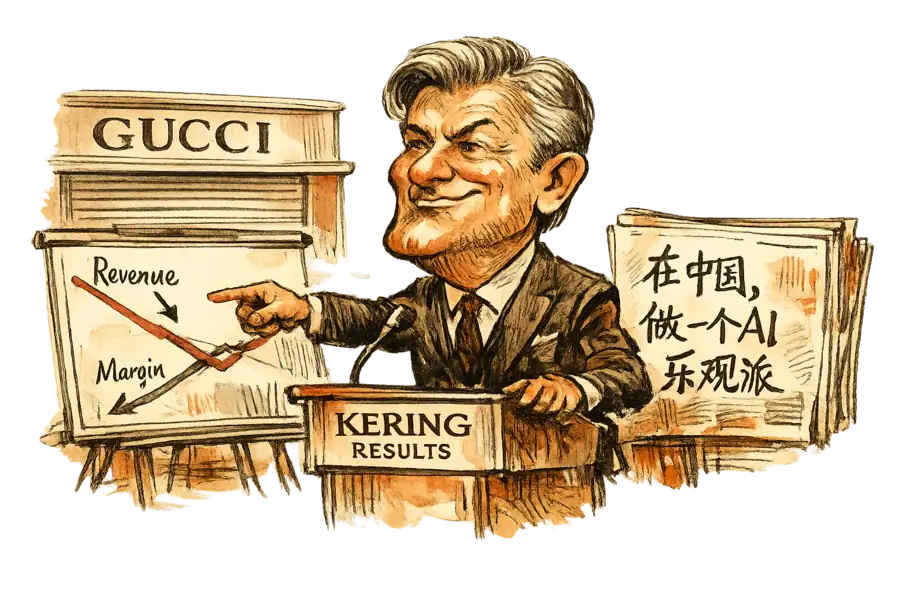
Gucci's Profit Fell While Its Margin Rose. In China, That Became an AI Story.
Gucci's recurring operating income fell 4% in the first half while its margin gained a point, which means Kering's first growth in three years came from spending less rather than selling more. Chinese-language coverage has filed the same result as an AI story, aimed at the market where the recovery has not yet arrived.
Neritus Vale
Gucci earned less money in the first half of 2026 than it did a year earlier, and reported a better margin doing it. Its recurring operating income fell 4% while the recurring operating margin rose a full point, which is the arithmetic of costs falling faster than sales. Kering’s first return to growth in three years is a subtraction result, and the framing of that result in Chinese-language coverage as a story about artificial intelligence is a positioning instrument rather than an account of what moved the numbers.
The margin improved because the revenue base shrank faster than the costs attached to it. Gucci’s half-year revenue came in at €2.76 billion, down 5% on a comparable basis, and the cost line came down harder than that. Kering’s own explanation is worth reading twice: the margin rose “thanks to continued discipline in cost management, without harming investments.” A company that appends the second clause knows precisely which question the first one invites. Holding profitability on a shrinking business is a real achievement, and a harder one to repeat than to perform once. Group net income fell 60%, to €189 million, pulled down largely by a disposal loss on the Monte Napoleone stake and restructuring costs sitting outside the recurring figures the margin measures.
What the market repriced was a decline that got smaller. Gucci’s second-quarter comparable revenue fell 2%, better than analysts had forecast, a beat measured against a shrinking base rather than a growing one. Kering shares closed 16.9% higher, the largest single-day gain in more than two decades for the stock. Reuters attributed the move to American demand for new handbags and to the group’s debt reduction. Neither of those is a demand recovery, and a beat measured in fractions of a contraction produced the kind of rerating normally reserved for the discovery of a new business.
Three months earlier the same stock had gone the other way on the same story. Kering fell 9.3% in April after a first quarter in which Gucci’s comparable revenue fell 8%, and Bernstein’s Luca Solca called that update a reality check: “it is easier and faster for the market to believe in a revival, than it is for management to produce it.” July did not refute him. It moved the date.
Cost discipline is a lever that shortens each time it is pulled.
The pricing half of the result works the same way, by removing weak revenue rather than adding strong revenue. Management has committed to taking €1 billion out of inventory within 12 months of its April capital markets day, shifting the mix toward full-price selling and away from off-price distribution, which lifts realised price per unit without changing a single ticket. The store network does the same job from the other end, working through a list of underperforming doors. The half brought 84 net closures. Management expects at least a hundred more before the year is out, a pace that leaves a finite list of doors still to close. Both moves flatter the ratio by shrinking what sits underneath it.
36Kr filed its read of the result on 31 July under the headline 开云的转折:在中国,做一个AI乐观派, which translates as Kering’s turn: being an AI optimist in China. The piece, by Xie Yunzi and Huang Yida, opens on the half-year numbers and then gives most of its length to Luca de Meo describing artificial intelligence as an enabling tool, including digital simulation that sharply cuts physical prototyping cycles in high jewellery. It is a careful article. De Meo says that AI can diagnose a situation but cannot convert the diagnosis into an executable plan, and that algorithms still cannot produce genuine creative inspiration. Nowhere does the piece claim that AI produced the quarter, and that restraint is what makes the framing work.
The headline does work the text never has to do. Placing a return to growth next to a technology thesis lets the reader supply the causal link unprompted, without the publication asserting anything it would have to defend. English-language coverage of the same release reached elsewhere entirely, crediting jewellery and eyewear for offsetting Gucci’s fall, which is a mix story told to readers who already own the stock. Both readings survive contact with the accounts. Only one of them is addressed to a market that still has to be persuaded.
Kering’s own release explains where the framing is pointed: “Mainland China remained challenging although trends improved during the quarter,” it says, while North America “continued to be the key growth driver.” The recovery being celebrated happened largely in the region that never left. Casting China as the group’s innovation centre and its richest testing ground, as de Meo does, converts an unresolved demand problem into a strategic role. That is a considerably better thing to be told about yourself than that you are the market which has not yet come back.
The strongest case against reading this as subtraction is that the trajectory matters more than the level. Gucci’s comparable decline narrowed by six points between the first quarter and the second, with every region improving, and if that curve holds, the cost base has already been reset and the operating leverage on the way up is unusual. For the argument here to fail, Gucci would need to post positive comparable growth while holding 17%, which would show the cuts came out of the parts of the business that were not generating demand. The test arrives soon, and the early reading is unhelpful: management has flagged a flattish third quarter against tougher comparisons, and the second-quarter improvement was led by North America while Mainland China stayed difficult. If Asia turns positive before the cost levers run out, the subtraction reading is wrong; if it does not, the next margin point has to come from somewhere the last one did not.
Kering has bought an interval, and it did not buy it cheaply. Net debt fell to €3.3 billion from €8.0 billion across the half, a repair driven substantially by disposals rather than by trading, which is what makes July’s rerating a line of credit extended against a smaller decline. How the interval gets spent decides which of the two stories turns out to have been the accurate one. Read in Chinese, the AI framing is at present a description of intent, and an unusually well-built one. It becomes a description of the business on the day the next point of margin arrives with revenue attached to it.