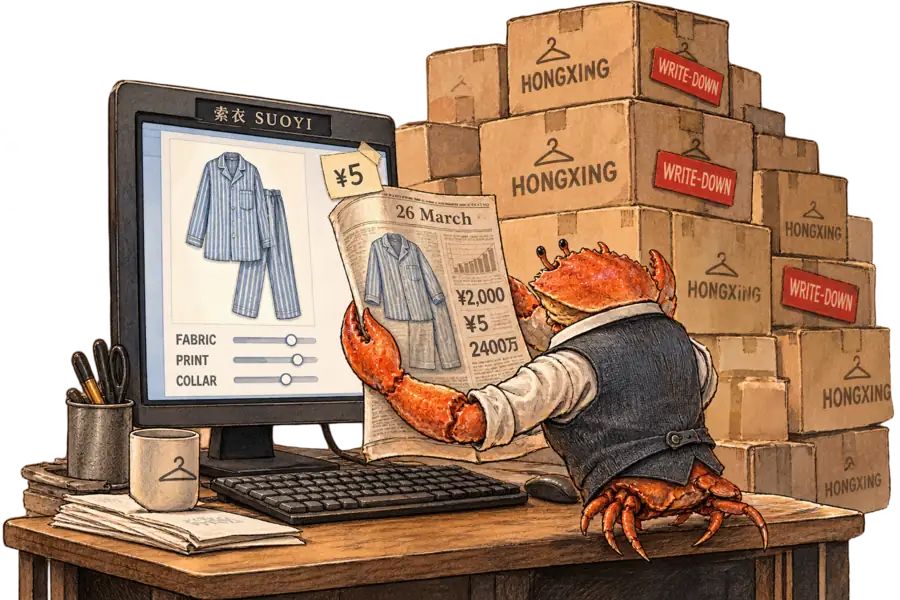
Hongxing's New AI Model Inherits a ¥24 Million Saving Claimed in March
A 6 November report credits Hongxing's unreleased Suoyi model with cutting a style's development cost to ¥5 and saving over ¥24 million a year. The same figures ran in March for earlier AI tools, and Hongxing's write-downs have yet to show the best-seller gain claimed beside them.
Sir John Crabstone
Hongxing’s new AI model has inherited its best numbers. A 6 November report on Chaonan, the Shantou district where the company is based, credits Suoyi (索衣) with cutting a style’s development cost from ¥2,000 to ¥5. It adds a saving of “over ¥24 million” a year (每年可节约成本超2400万元). Both figures appeared in March, attributed to tools Hongxing was already using.
Suoyi is still in internal testing (内测). Designers drag settings for fabric, print and collar, and a virtual sample appears in minutes, without cutting cloth or repeated sewing. After testing, says Guo Wuwen (郭梧文), chairman of the Shenzhen-listed homewear maker, the model will be rolled out nationwide (推广到全国) for garment businesses across China.
The figures were already in print on 26 March, in China Securities Journal (中国证券报), which had interviewed Guo. Suoyi is not mentioned. The ¥2,000-to-¥5 cut belongs to AI design tools, in a process that still ends with a small batch of physical samples (小批量打样).
Two more figures sit beside it in the March piece. AI photography took a style’s shoot from about ¥1,500 to under ¥100, and Hongxing makes 6,000 sample sets a year instead of 8,000 (8000套样衣套数减少至6000套). The paper does not itemise its ¥24 million; by our arithmetic, counted from the old 8,000, the development and photography savings alone clear it.
A 2 November feature by the business site 时代财经, carried by Stockstar (证券之星), keeps the order of events. The gains, it says, came before the model “officially went live” (在洪兴股份自研大模型正式上线之前), which then “further” lifted efficiency (进一步让企业核心研发环节提效). It drops the 8,000 yet keeps the ¥24 million; multiplied out, its remaining inputs reach about ¥20.4 million. As evidence that the gains are showing in the accounts (初步显现), it cites nine-month net profit up 21.99% and profit excluding one-offs up 50.16%.
The 6 November report, posted by the account 城市速递 on Phoenix’s self-media platform 大风号, drops the photography too. What remains is credited to the model (依托索衣模型). Its inputs, 6,000 sample styles at ¥1,995 saved apiece, multiply to about ¥12 million. The old 10% best-seller rate stays, with no new one beside it. The total survived every retelling; the arithmetic behind it did not.
At Hongxing, ¥24 million is a large sum. Its 2025 annual report, published in April, puts R&D spending at ¥29.3 million and net profit attributable to shareholders at ¥21.05 million. The claimed saving equals about four-fifths of the first and exceeds the second. The report describes AI as already deployed (已落地) in R&D and photography, but gives neither the ¥24 million nor a hit rate.
Guo ranked these numbers himself in March. Lower cost, he said, is only the first financial result, “and the easy one to measure” (也是容易衡量的财务成果). His larger claim was a best-seller rate up from the industry average of 10% to over 30%, which had “greatly reduced inventory risk” (大幅降低了库存风险). The paper gives no period for the 30%.
The accounts do not show it yet. In 2025 Hongxing wrote down ¥45.7 million of inventory, about a third more than in 2024 and more than twice its profit. That is where a better hit rate would show.
In the first nine months of 2026, asset write-downs, a wider line than inventory alone, came to ¥41.6 million, against ¥43.4 million a year earlier. Inventory stood at ¥665.2 million at the end of September, up 11% from ¥599.4 million at the start of the year. Gross margin rose to 34.2% from 31.4%, and the report does not say why. In our view, write-downs trail design by a season or more, so these figures cannot disprove the 30%; they simply fail to show it.
A sample is the cheapest part of a garment nobody buys.
Suoyi has not been released, and every saving above comes from Hongxing itself. Any buyer can price a ¥5 sample in an afternoon. A 30% hit rate takes a season to test, and Hongxing’s recent seasons are already in its accounts.