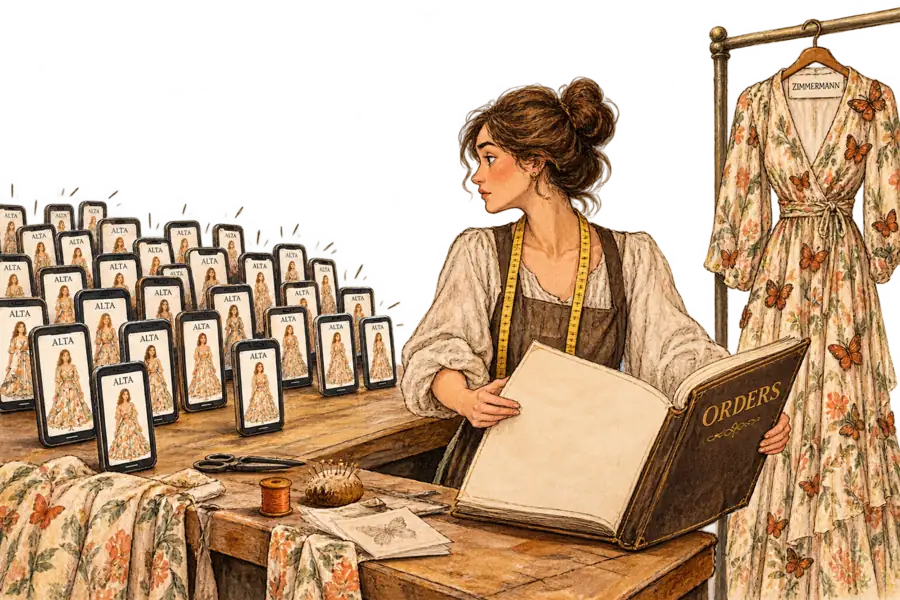
How Many Zimmermann Dresses Does an Avatar Try-On Sell?
Fortune says Alta's avatar try-ons helped Zimmermann judge how much of its Paris collection to make. For at least a week the same collection could also be pre-ordered at Moda Operandi, and nobody has published how the try-ons compared with the pre-orders.
Sir John Crabstone
The sentence that matters most in Fortune’s report on Alta’s $20m Series A concerns Zimmermann. Alta users, it says, tried the label’s Paris show looks on their avatars before they were available for purchase, helping Zimmermann “judge quantities to manufacture”. Fortune names no one at Alta or Zimmermann as the source. A try-on is a tap by a self-selected user; it can size a production run only if someone knows how often taps become purchases. Nobody involved has published that.
Fortune also reports that Forerunner’s Eurie Kim pre-empted the round and joins the board, with Menlo Ventures and the Arnault family’s Aglaé Ventures returning. Alta has 10 staff and 12 in-house models, and since earlier this year has powered all the AI in Rent the Runway’s app.
Alta’s own post on the Zimmermann shelf, published three days later, is more modest than Fortune. It says Kaleidoscope, the spring collection, appeared in the app minutes after the 5 October show, and that “thousands” try it on each day. “At this stage, the experience is simply about discovery, imagination and understanding whether a piece belongs in their world.” Manufacturing goes unmentioned.
Forerunner’s announcement mentions “campaigns to let Alta users try on new collections and limited fashion show items”, and omits production too. The only purchase figure comes from the author: Kim has bought “two or three things” from other users’ outfits and wishlists “just in the last month”.
The collection could be ordered, briefly. Moda Operandi’s page for it, archived five days after the show, described the collection as “Preorder the women’s Zimmermann Spring Summer 2027 collection” and carried the banner “TRUNKSHOW ENDING IN 8 DAYS”. A flounce maxi dress cost $4,600.
A try-on is a pre-order with the money taken out, and the money is what would have made it evidence.
For at least a week, the collection could be tried on in Alta and pre-ordered at Moda. Try-ons per pre-order, piece by piece, is the ratio that would turn avatars into a forecast. Moda’s window has since closed; Alta’s shelf was still open on 25 October.
Oui Speak Fashion repeated the announcement’s “35 percent increase in engagement” at Rent the Runway, then noted that it “does not specify the metric’s definition or measurement period”. That was the right objection.
Rent the Runway’s second-quarter release never names Alta. It says engagement with its outfit feature “is running approximately 35%”, which is a level, not a rise, and a feature launched in May has no pre-launch baseline in the release. The announcement’s “increase” and the release’s “running” may not measure the same thing.
The same release holds the nearest thing to a conversion figure. In the pilot, customers with the feature “added items to their bag approximately 12% more often than those without it”. A bag is not a rental. Avatars came in August, after the pilot.
Forerunner also backs Daydream, which started from shopping and takes a commission on sales it refers, so it has reason to count them. Alta’s product is styling, and every usage figure in its round counts a gesture.
Alta and Zimmermann could settle it by saying what they counted, try-ons or wishlists, and whether either changed an order. In January Kaleidoscope arrives in stores and online; that is when the avatars meet a price.