Hugo Boss's AI Charge Is for Software It Already Owns
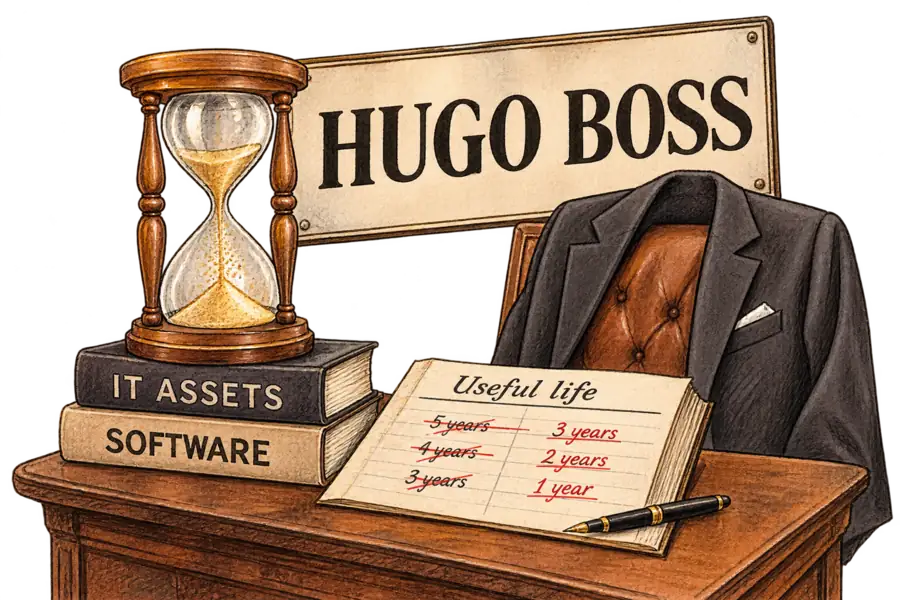
Hugo Boss blamed part of its 2026 profit cut on higher depreciation of IT assets 'given rapidly evolving AI and technology developments'. Its Q3 statement describes the mechanism as shorter useful lives for IT and software it already owns, not new AI spending, and puts no figure on the charge.
Sir John Crabstone
Hugo Boss has put AI into its profit warning as a cost of systems it already owns. On 2 November it cut its 2026 EBIT forecast to between €250m and €300m, from €300m to €350m. Its ad hoc announcement blamed softer consumer demand and “expected higher non-cash depreciation and amortization expenses for IT assets, given rapidly evolving AI and technology developments”.
Some of the coverage read that as spending. City AM wrote that the group blamed “softer demand” and the impact of its investment in new technology, including artificial intelligence. Hugo Boss’s sentence describes no investment.
TextilWirtschaft summed up the reasons as volatile demand and “hohe Kosten für KI”, high costs for AI. The costs are real; they are charges on old purchases, arriving early.
The quarterly statement of 3 November names the mechanism: “reductions in the useful lives of selected IT and software assets”. It describes no write-down. Shorter useful lives spread the same book value over fewer quarters.
The software costs what it always did; the bill simply arrives sooner.
In Hugo Boss’s 2025 annual report, chief executive Daniel Grieder set out the vision: “the leading premium, tech-driven, customer-centric fashion platform”. The letter called digitalization and AI “central to this vision”. The statement does not say which assets now have shorter lives, or whether they belong to that vision.
The same report lists what is on the books. At the end of 2025 Hugo Boss carried €188m of software, licences and other rights, mainly for its SAP-based ERP system. Last year’s €56m of additions went mostly into the move to SAP S/4HANA and software for the online business. The company has not said whether that ERP is among the selected assets.
Nor does it price the charge; the €50m cut is not split between software and demand. The statement’s tables show €175m of EBIT after nine months, leaving €75m to €125m for the fourth quarter. The same quarter of 2025 earned €154m: the year’s €391m less nine months’ €237m. Both reasons for the cut must now fit inside one quarter.
Analysts surveyed by Bloomberg had expected an 8% currency-adjusted sales decline and EBIT of slightly more than €300m, dpa-AFX reported. Their sales figure sits inside the new range; their profit figure sits above it. The surprise, such as it was, lies in the profit line, where depreciation is booked.
Frasers Group told Hugo Boss on 23 October that it had crossed 50% of the share capital, and it expects to consolidate the company. Its direct holding stood at 49.41% on 27 October, with a further 21.87% held through instruments. Ten days after that notice, Hugo Boss shortened the useful lives of some of its IT and software assets. Nothing in the statement links the two.
Asked about the takeover, Grieder would not go into detail; the company sees Frasers as a long-term shareholder and is in talks, dpa-AFX’s later roundup reported. The new useful lives are the figure that matters, and Hugo Boss has not given them. They decide how many more quarters are charged for software already paid for.