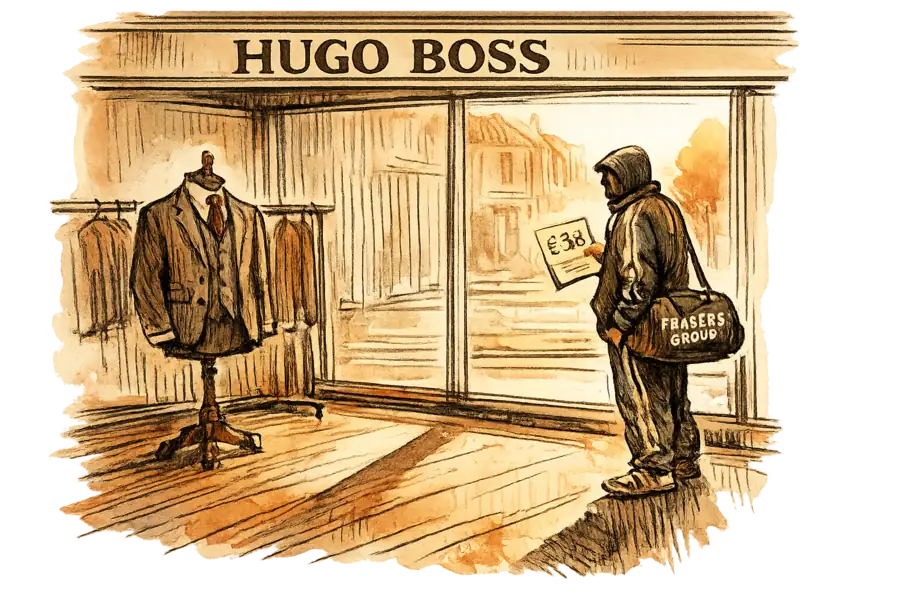
Hugo Boss Fell 10 Percent. Frasers Already Owns 38.
Hugo Boss published a 10 percent sales decline nine days before Frasers Group's takeover offer closes. The numbers are no longer a trading update; they are an exhibit, and the boards' own July statement explains who benefits from reading them.
Sir John Crabstone
Hugo Boss sold €905 million of clothing in the second quarter, down 10 percent, with operating profit down 28. It published the figure on 4 August. Frasers Group’s takeover offer closes on 13 August. A quarter published nine days before that deadline is no longer a trading update. It is evidence, and the people reading it most closely would like the company cheap.
Daniel Grieder wrote for that audience. “Gross margin improved significantly, inventories declined, and free cash flow generation remained strong,” the chief executive said of a quarter in which gross margin rose 200 basis points to 64.9 percent. Each of those clauses is a reason not to sell at €38. None of them is a sales figure.
The rest of the report says the opposite. EMEA fell 13 percent on a currency-adjusted basis, and the EBIT margin gave up 160 basis points to 6.5. Hugo fell 14; Boss fell 8. Premium menswear demand, the argument for holding the stock at all, is exactly what softened. The company asking its owners to be patient has published the best argument against patience.
It left full-year guidance unchanged all the same: sales down mid-to-high single digits, EBIT of €300 million to €350 million, as if the second quarter were an outlier rather than a trend.
Most of the coverage files this as an earnings story with a takeover attached. The boards’ own July statement suggests the reverse. They called €38 financially inadequate, backed by opinions from Bank of America and Goldman Sachs. The case rests on CLAIM 5 TOUCHDOWN, which promises an EBIT margin near 12 percent and roughly €300 million of average annual free cash flow through 2028. The same document conceded that the offer was “primarily designed to enable Frasers Group to increase its shareholding in HUGO BOSS beyond 30%.” Frasers was never trying to buy Hugo Boss. It was trying to cross a threshold.
Frasers Group’s chief executive, Michael Murray, already sits on Hugo Boss’s supervisory board. He was recused from the committee that reviewed the €38 offer, for conflict of interest, and Frasers has said it may install him as Hugo Boss’s next chief executive if the bid succeeds. The recusal admits what the appointment already implied: he was never a neutral director. That is not oversight of a deal. It is a seat at both sides of the table.
It asked its owners to wait for 2028 and gave them until 13 August to answer.
Most of them have refused. Only 7.3 percent of the stock was tendered in the first acceptance period, lifting Frasers from 30.28 percent to 37.58. The other 62 percent chose to keep the stock rather than bank the €38. A bidder the board defeated now holds more than a third of the register. Defeat has been unusually cheap.
The offer has already cleared Brussels and turned unconditional, and Frasers has said €38 is final and will not be increased. That settles the price of this offer. It settles nothing about the next one.