Jack's Sewing Robot Does More Work in the Share Price Than in the Accounts
Jack Technology priced its Aini sewing robot at ¥308,000 and collected 11 strategic agreements, while its exchange filings call the robot's share of revenue tiny. Robot-linked R&D explains about a third of the 62% fall in third-quarter pre-tax profit; the filings do not split the rest by project.
Neritus Vale
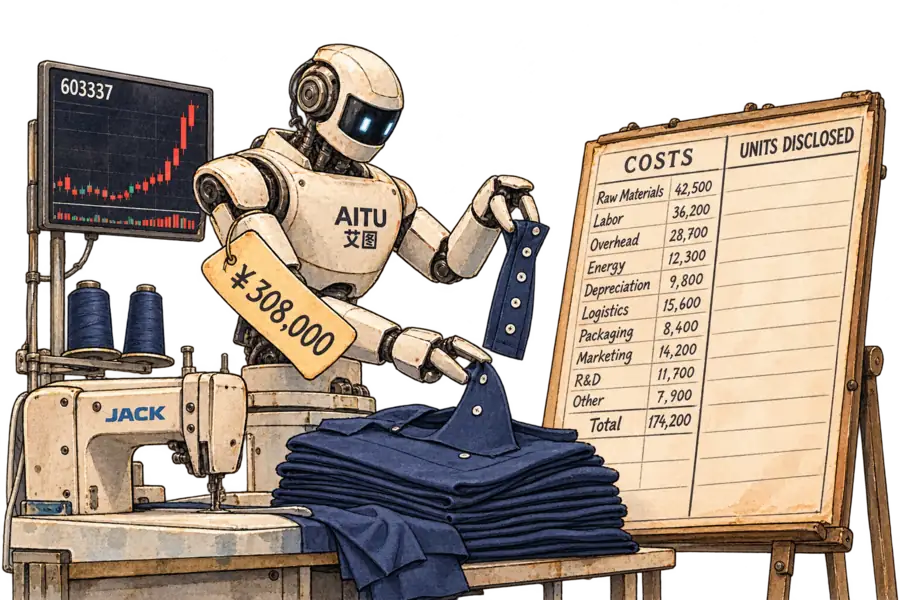
Jack Technology, the Chinese sewing-machine maker, priced its sewing robot, Aini (艾妮), at ¥308,000 when its Aitu subsidiary launched it in Hangzhou on 28 October (Jiaojiang District Media Centre). The robot now has to explain a share rally and a profit fall, yet Jack’s filings give it almost no sales and only part of the blame. Two days after the launch, the third-quarter report showed the quarter’s attributable profit down 58.94%.
Jack’s plainest statement about the robot went to the Shanghai exchange. A notice dated the launch day says Jack’s robot products are still at an early commercial stage, with a tiny share of revenue and profit (收入和利润占比极低). Robot R&D and marketing, it adds, will weigh on current profit.
The shares followed the robot story. They rose 36.82% in the four sessions to 28 October (risk notice). In the three sessions from 30 October they fell hard against the market (notice), then reached the daily limit intraday on 4 November alongside other humanoid stocks (Caiwen).
The launch’s evidence of demand was signatures. Aitu signed robot strategic agreements (战略协议) with 11 garment companies, including Korea’s SAE-A and Peacebird, plus separate deals for its production line (Jiaojiang).
The robot’s performance claims measure different tasks. On the launch stage Aini beat a skilled machinist in a timed race, making seven more pieces in 16 minutes (Jiaojiang). Xie Yunjiao, Jack’s vice-chair, had told China Business Journal, in an interview published on 2 September, that the robot’s pass rate could match human work and that on cut pieces it ran at over half a person’s efficiency (效率可达人工 50% 以上). The race covered full sewing steps; Xie’s figure covers handling cut pieces. Neither claim comes from a customer’s production records.
Xie was candid about the hardware and the price. The robot has two arms and grippers, Xie said, because dexterous hands are immature and costly (灵巧手的技术成熟度还没有那么高,成本也比较高). It starts with steps one person can do but would rather not (一个人就能干但不愿意干). Xie put the price at around ¥200,000 (定价20万元左右).
Xie’s payback estimate sets one robot against one Chinese worker costing ¥100,000 a year, her figure. Customers could earn the price back within two years, Xie said; she called that possible (有可能) and said she hoped to get customers there. At the ¥308,000 launch price, the magazine’s own arithmetic gives about three years, before power and maintenance. A robot working at half a person’s efficiency, as Xie also claimed, would take longer still.
The biggest number in the story, 2,000, counts robots Jack might buy. At Jack’s summit on 29 April, the Zhejiang Humanoid Robot Innovation Centre signed with Jack to supply that many garment humanoids over the long term (长期供货+稳定配套). A promotional article carried by ZOL on Sina Finance called it an order but named no price, value or delivery date. In the same interview, Xie spoke of fewer than 1,000 robots for now (现在先考虑1000台以内). The third-quarter report does not mention the deal.
The joint ventures in Jack’s half-year report are smaller than their partners’ names. It lists AgiBot, Zhejiang Humanoid and X Square as partners, wording China Post Securities copied into its results note. The report’s notes show three subsidiaries in which Aitu holds at least 85%, leaving each famous partner a minority stake.
The warmest praise came from Jack’s own brand consultant. In a post on Phoenix’s self-publishing platform, Ries’s chief executive, Zhang Yun, called sewing one of the very few humanoid uses with hard commercial value (极少数真正有刚性商业价值的场景). The post also names Ries as Jack’s long-term strategy adviser and co-creator of the Aitu brand.
None of these numbers is a count of orders at the launch price.
Some robots are already on factory floors. The launch article says Aini is in use at Chenfeng, on shirt collars and cuffs (Jiaojiang), and the quarterly report places the business between product validation and small-batch trial sales (产品验证、小批量试销阶段) and commercialisation. Xie’s target for this year is 5 to 10 core customers, not thousands of units (不追求几千台), as she told China Business Journal.
Jack does count the robot’s cost, listing it first among the reasons for the profit fall. The quarterly report blames the 62% drop in third-quarter pre-tax profit on more spending on AI digital full-set systems and humanoid robots (AI 数字成套、人形机器人领域投入增加), exchange rates and sales mix. Lin Meifang, the finance director, repeated that order at the 6 November results briefing (Cailian Press).
The quarter’s own arithmetic puts the robot’s development bill at about a third of the fall. Pre-tax profit dropped ¥139.5m, from ¥223.7m to ¥84.2m. Third-quarter R&D, the line the report ties most closely to the robot, rose ¥44m, on figures derived from the half-year and nine-month accounts.
The rest of the drop sits in lines the filings do not split by project. On the same derived basis, selling expenses rose ¥32m, administrative costs ¥26m and finance costs ¥18m. The 28 October notice names robot marketing as a drag on profit, and the quarterly report mentions talent hiring and joint-innovation spend, so some of those increases may belong to the robot. How much is not disclosed.
Two of the three stated reasons were already at work in the first half, when profit grew 3.01%. The half-year report blamed higher R&D on the same AI and humanoid projects and booked an exchange loss of ¥39.7m against a gain a year earlier. Lin said third-quarter gross margin of 32.54% held steady on the second quarter. It was 35.02% a year earlier, on figures derived from the accounts, and the first-half margin had already slipped to 32.42% from 34.07% (half-year report).
In the third quarter, sales stalled while costs sped up. Revenue growth slowed to 2.62%, in a quarter that included a newly bought company. Administrative costs fell 9.5% in the first half, then rose 33.9% in the third quarter, to ¥101.9m from ¥76.2m (derived from the accounts). The report does not say how much of that is the new company.
That company is Comelz, an Italian maker of leather-cutting machines for luxury footwear and clothing, consolidated from 23 July. Its unaudited 2025 sales were €52.3m, says Jack’s acquisition notice. At that pace, and at ¥8 to the euro (the magazine’s assumption), Comelz would pass the quarter’s whole revenue growth of about ¥41.8m within five weeks. If so, the rest of Jack shrank.
The strongest case for Jack is that honest launches look like this. A profitable incumbent prices the product, runs pilots, signs framework deals and tells the exchange the truth. For that case to hold, the robot agreements must turn into paid, counted orders near the launch price within a few quarters.
Cailian Press reported that Jack’s chairman has already played down the signings. Ruan Jixiang told the briefing that the robot business, piloting at several garment makers, is at an early commercial stage (尚处商业化早期), and that the signings are intentions (意向签约) still to be converted. In Cailian’s account, they will do little for 2026 results. Jack’s digital full-set business grew 39.4% in nine months, yet Lin cited long delivery and payment cycles. If robots reach the same factories, they may meet the same delays; that is inference, not something Jack has said.
Jack can settle the question with a line it has not yet printed: robots delivered to paying customers. A count in the next report would make the launch an early look at a business. Without it, the shares are pricing what Xie described before the launch: two arms with grippers, doing work people would rather not do.