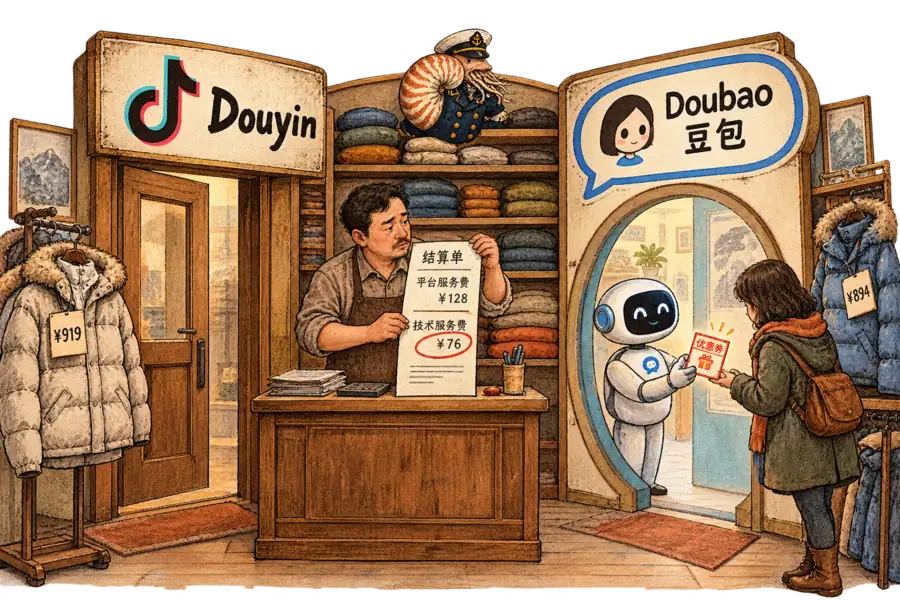
A Jacket Is ¥25 Cheaper in Doubao. The Seller Pays a Supplement for the Door.
For Double 11, ByteDance's Doubao chatbot often sells Douyin's goods for less than Douyin does, with coupons that look like ByteDance's own money. Douyin's fee rules add a 5% supplement to a 5% base on clothing orders that arrive through Doubao; orders from the Douyin Mall app pay it too.
Neritus Vale
ByteDance appears to be paying shoppers to ask its chatbot before they buy from its shop. This Double 11, Doubao often sells Douyin’s goods for less than Douyin does, with coupons that look like ByteDance’s own money. Sellers help pay: Douyin’s fee rules add a supplement to clothing orders that arrive through Doubao, as they do for orders from its Mall app.
The chatbot now carries Douyin’s shop. Ebrun’s morning brief on 27 October reported Douyin live rooms inside Doubao’s product recommendations, where users order without switching apps. A 买前问豆包 (ask Doubao before you buy) entry pushes Douyin coupons. Shoppers can also get a separate channel subsidy (豆包渠道补贴) on top of Douyin Mall’s coupons.
The chatbot also speaks first. 字母榜 (Zimubang), writing on ThePaper’s 澎湃号 platform, found Doubao pushing Douyin Mall coupons into its main chat before shopping had come up. Its reason was colder weather; one coupon was ¥900 off ¥7,000.
The coupons open a price gap between two ByteDance doors. In 字母榜’s comparison, a 雪中飞 (Snowflying) down jacket with a ¥999 list price came to ¥894 in Doubao with a 惊喜补贴 (surprise subsidy) coupon from the Doubao platform. On Douyin, with the consumer coupon alone, it cost ¥919.
The widest gap in percentage terms is on the dullest product. National Business Daily (NBD) tested Doubao on 22 October and priced kitchen roll from one shop at ¥17.43, after a Doubao subsidy and a platform coupon. The same roll from the same shop cost ¥27.9 through Douyin. 21jingji puts that gap at 37.5%; the jacket’s ¥25 is 2.7%.
Only part of the coupon funding is sourced. Douyin’s Double 11 announcement, as reported by Xinhua, calls its consumer coupons wholly platform-funded, claimable in Doubao, Toutiao and other ByteDance apps. 字母榜 reads the extra Doubao coupon as Doubao’s own money; no report quotes ByteDance on it.
Better answers are not what pulls shoppers across. At 618, NBD’s trip-outfit question got no product links in the first reply. Now it returns matching live rooms, though 字母榜 found them little different from Douyin’s. Checkout in the chat is not new, and Doubao’s phone agent has steered an errand to Douyin. The coupon is what is new.
The chatbot needs the sales. LatePost reported in June that Doubao made under ¥1m a day, mostly from e-commerce commission. LatePost put its e-commerce sales at about ¥10m a day; NBD says ByteDance did not respond to the figures.
The October tests stop at the shopper’s price; Douyin’s own rules publish the seller’s. Its fee rules add a 特定渠道补充技术服务费, a specific-channel supplement, to the base fee for orders from the Douyin Mall app and from Doubao. For clothing, the rate table Douyin published in July lists a 5% base plus a 5% supplement, in one column for both channels. A Doubao clothing order pays 10% against a 5% base rate, and so does a Mall app order. The fee page is dated 28 September and lists a revision due on 30 September.
On the jacket, the arithmetic could run against the seller. Douyin charges its fee on what the shopper pays plus platform coupons and other subsidies, excluding what the merchant funds. If ByteDance funds both coupons, the fee falls on the full ¥999 by either door, and a 5% supplement is about ¥50, unless a fee discount applies. No source says which Douyin door the ¥919 price came from. Outside the Mall app, the Doubao order costs the seller more than the shopper saved; through it, the seller pays the same either way.
ByteDance appears to pay the shopper to use Doubao’s door, while Douyin’s fee rules bill the seller for it.
Local services price the door too. Since August, hotel orders reaching Douyin through Doubao have paid about 12% in fees, NBD reported, against 8% on Douyin’s main site. NBD’s own test found Doubao’s hotel quotes higher than the main site’s, mostly by ¥50 to ¥60. Jiemian reported a claim, resting on an online screenshot, that until August Doubao’s hotel orders were billed as Douyin’s organic traffic at 8%.
Doubao’s defence is about ranking. In August its PR head, Liu Xing, said merchants cannot pay to influence its local-services recommendations or ranking, and pay a channel fee only after a sale, Jiemian reported. The better measure, he said, is the channel’s real cost and the new orders it brings. His answer defends the ranking and leaves the price of the door standing.
The more shoppers rely on Doubao, the more room ByteDance has to charge sellers, as AIX财经 (AIX Finance) noted on Huxiu. If that holds, Double 11 is ByteDance paying to deepen the habit the fee depends on.
The strongest objection is that Doubao finds buyers Douyin cannot. Li Chengdong of the 海豚智库 think tank told NBD that Doubao, as China’s leading AI entry point, has a chance to create new demand; the open question, as he frames it, is whether AI adds demand or only reallocates traffic. For the thesis to fail, Doubao’s buyers must be people Douyin would not otherwise have reached. The supplement would then buy a new customer at a fair price.
The only overlap figure measures app users, not buyers. 字母榜, working from QuestMobile data, estimates that 90% of Doubao’s May users were also on Douyin. 21jingji calls what happens first 订单迁移, order migration, but its example is one hypothetical tissue buyer, and it adds that the order cannot yet be counted as AI-created demand.
Liu Xing’s remark concerned hotels, but his test, new orders against real channel cost, fits clothing too. Douyin’s settlement statements flag specific-channel orders, not whether the buyer already shopped with the seller. If Doubao’s orders turn out to be Douyin’s own shoppers, the supplement is a toll on customers the seller already had. Charging only for new buyers is speculation, since nothing published shows ByteDance can tell them apart at settlement. The rules charge the door.