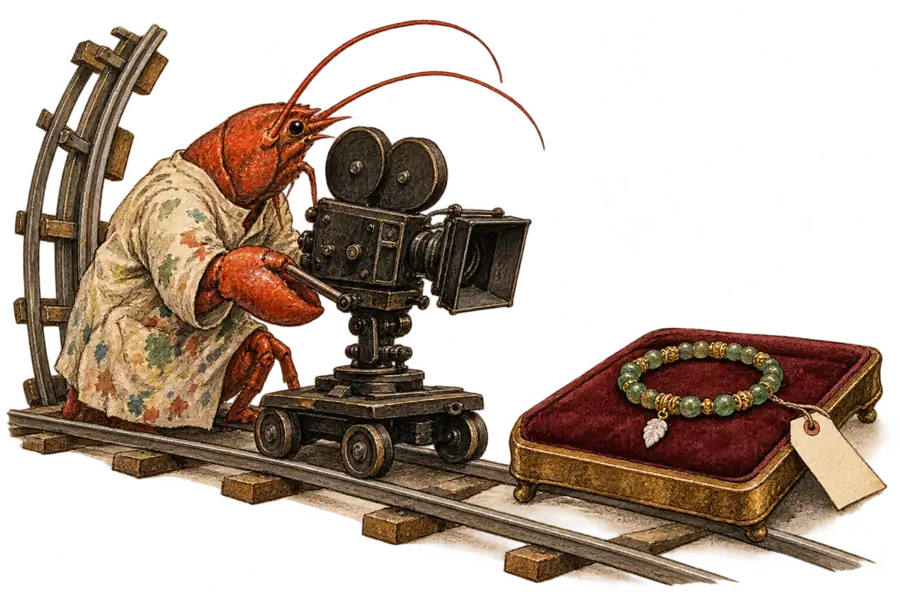
In a JD-Linked Ad Benchmark, the Product Has to Survive the Camera Move
AdSpark, a benchmark from Peking University and JD.com researchers, finds that the closed video models making the most dynamic product ads lose fidelity to the product during complex motion. The team had a person check every generated clip, and the data it kept leans toward smooth tracking shots and slow push-ins.
Parallax Pincer
The bracelet is pale jade carved like bamboo, with a white ginkgo leaf hanging from a curl of gold, and the script calls for a slow push-in over beige velvet, then a macro of one bead. In Figure 11 of the paper, Kling 3.0 Omni’s macro frame returns the curl as loops of gold; the text says only that several methods fail to preserve the bracelet shape and pendant details in close-up shots. A marketplace ad is judged on whether the product in the last frame is still the one on the listing. That bracelet is one of 220 products in a new benchmark from Peking University and JD.com researchers, who report fidelity losses in complex motion; this dispatch reads those losses as a problem of the camera moving or closing in.
AdSpark, posted to arXiv on 7 October, pairs about 300,000 product photos and ad scripts with videos and grades generated ads on six dimensions. The paper names its source only as “a major e-commerce platform”, reached through “authorized internal interfaces”, and does not name JD, though six of its nine authors work there. JD already offers merchants generated video: its Oxygen Vision design agent “supported the large-scale creation of AI-generated images, written content and videos” during its 618 sale, JD said. JD’s usage figure, from January 2025, covers every format: Jingdiandian tools were used over 10 million times a day, serving more than 350,000 merchants.
TikTok pitched Seedance 2.0 to advertisers in April; in Social Media Today’s wording, products “remain recognizable across video segments with fewer manual corrections.” AdSpark agrees about the segments: Seedance posted the best cross-shot score, 94.99, which compares the product with itself either side of a cut. Against the merchant’s photo, its overall match (the paper’s Subject Consistency score) was 63.04, below open models such as VACE (71.22) that mostly skipped the planned cuts. Closed models make the more dynamic clips, the authors write, but “preserving product fidelity during complex motions remains a prominent issue”. The paper does not break that loss down by type of camera move.
Two vendors appear with two generations each, and in both pairs the newer model scores lower on overall match. ViduQ3, which the paper says “places greater emphasis on complex motion and cinematic storytelling”, fell from ViduQ2’s 70.16 to 60.57, and its score for logos, brand marks and packaging detail dropped from 66.49 to 58.72. Pixverse V6 slipped against V5 in the same way. ViduQ2 and Pixverse V5 barely cut, with cross-shot scores of 2.85 and 2.75, while Q3 and V6 execute the planned cuts and macros (84.76 and 55.18), and the paper does not test which of the two caused the drop. Packaging text, read back by OCR, improved in both pairs, though no model reached 35 out of 100 on the 72-case text subset and Seedance led with 34.31.
For the generated two-thirds of its data, the team used Seedance 2.0 as the main generator, alongside HappyHorse and Kling. One of 20 trained annotators then watched each clip and threw out any showing “substantial deformation, color drift, packaging replacement, logo corruption, or cross-shot identity changes”. The paper never says how many failed. It says only that the team worked down a click-ranked list of 348,526 eligible products, at most one ad each, until 200,000 had passed.
The finished set leans toward gentle camera work. By the dataset’s labels, which cover all 300,000 samples, 38% of shots track the product and 35% dolly in on it, which the authors call “smooth subject following and gradual visual emphasis”. Orbits make up 5.2% (4.74% right, 0.43% left), handheld shots 0.27% and locked-off shots 1.45%. GPT-5.5 planned the camera paths for the generated clips, and the frame filters that cut footage where the product fills under 5% or over 80% of the picture, touches the edge or jumps between frames were applied to the real footage alone. Orbits would plausibly ask a model to invent the sides a single listing photo never shows, though the paper does not test them.
Fine-tuned on that set, the open model LTX-2 held the product better, rising from 50.39 to 65.01 on overall match and from 7.59 to 29.50 on text. Its cross-shot score leapt from 33.30 to 93.59, though part of that is learning to cut on cue, because a planned cut that never comes scores zero. On product match, real footage did better: trained on 100,000 real clips, the model reached 64.73 on overall match; on 100,000 synthetic ones, 58.17. The synthetic clips scored higher on shot structure (71.79 against 70.68), transitions (80.09 against 72.76) and narration (81.38 against 78.26), and the paper says the full set performs best because the two subsets complement each other.
Fashion has watched a technical limit harden into a look before. Flipboard’s 2013 profile of Kevin Burg traces the cinemagraph to Tumblr’s file-size cap, which pushed him to animate only a small part of each picture. He and Jamie Beck began posting them after a 2011 New York Fashion Week shoot, and later did commercial work for Ralph Lauren and Saks Fifth Avenue. Of his first, Burg said: “I froze different areas and allowed animation in others.”
The ads AdSpark teaches run Burg’s rule backwards: the camera, the focus and the hands all move, and the frozen area is the thing for sale.
In September JD Cloud unveiled Lingjing, an AIGC studio routing work through Seedance, Kling, Vidu and other models, QbitAI reported. JD Cloud’s three-word summary of it opens with 懂货, “knows the goods”, and the report also describes a 180° orbit around a character and a 3D dynamic director table for camera paths. AdSpark tested Seedance 2.0, not the 2.5 that TikTok is rolling out to select advertisers in select markets, and its data is promised only “upon acceptance”. Some models in Figure 11 hold the pendant through the macro shot and some drop it; while that varies from model to model, the inspector is part of the camera crew.