John Lewis Funded AI Shopping and TikTok Shop From the Same £800m
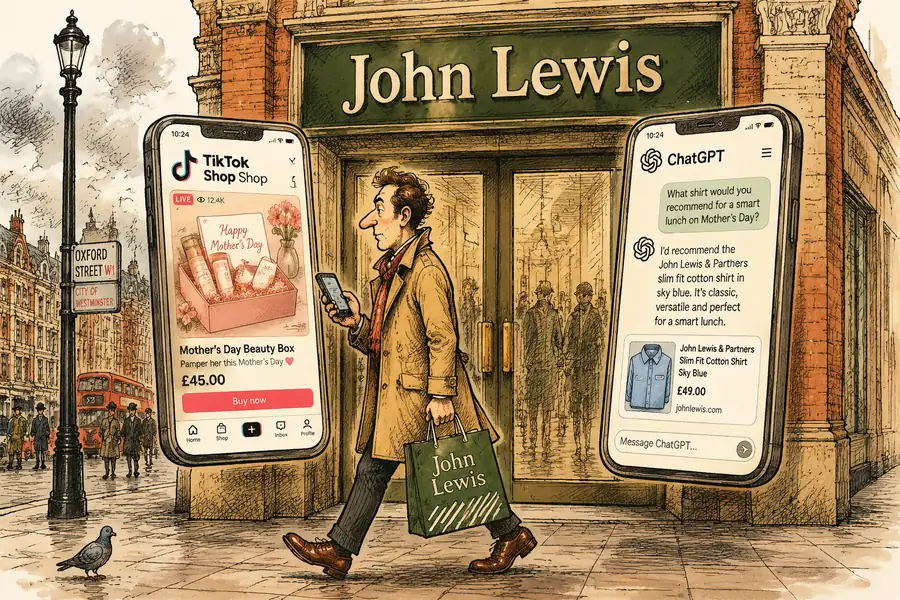
John Lewis is splitting part of its £800m transformation budget between AI shopping integrations on ChatGPT and Google Gemini and a 90-day TikTok Shop pilot. Funding both ends of the discovery spectrum from a single programme concedes that the department store no longer hosts the moment when its customer decides.
Sir John Crabstone
John Lewis announced on 9 March that it will route part of an £800m transformation programme into TikTok Shop and into appearing inside ChatGPT and Google Gemini. Both decisions arrive on the same day. They are not two products of the same plan; they are the same admission, twice.
The admission is that John Lewis can no longer host the moment when a customer decides what to want.
A department store earned its margin by being the place where the choice happened. The shop floor was the algorithm. John Lewis is funding ChatGPT visibility on one flank and a 90-day TikTok beauty pilot on the other. Both concede that discovery now happens in screens it does not own. AI search catches the customer who already has a question; TikTok catches the one who did not know they had one. The department store’s core asset was latent demand: the customer who was not yet shopping. Hedging both is not a strategy. It is a confession that the shop floor is no longer the room.
The ChatGPT and Gemini integrations are, for now, catalogue visibility: John Lewis products surfacing as recommendations when a shopper queries an AI assistant. The transaction still completes on John Lewis’s own domain. What John Lewis is conceding is the earlier moment — the one when the customer decided they wanted anything at all. A retailer that loses that moment consistently does not lose the sale today. It loses the habit that produces sales in three years. The AI assistant does not need to process the payment to displace the store; it only needs to be the thing the customer trusts first.
The retailer is shipping a Mother’s Day Beauty Box of Jo Malone, Augustinus Bader and Estée Lauder to a scroll feed, per the same 9 March release. That box is exactly the in-store curation John Lewis used to charge a footfall premium for. It is now a parcel a creator unboxes.
The Partnership tripled annual profit to £126m on £12.8bn of sales last year, against a plan that originally aimed for £400m profit by 2025, per its full-year results. The £800m is roughly six years of current profit. It is being spent so that someone else’s algorithm will mention the shirt, and so that someone else’s feed will show the unboxing.
Estée Lauder is leaving department-store counters for TikTok Shop and Amazon rather than AI assistants, as we reported earlier today. One destination is shared. The divergence is the point: Estée Lauder chose a direct sales channel on Amazon; John Lewis chose to surface inside AI conversations. What both reveal is that the department store is not on either list.
If a department store cannot tell you where its customer first sees the product, it has stopped being a department store and become a wholesaler with a postcode.