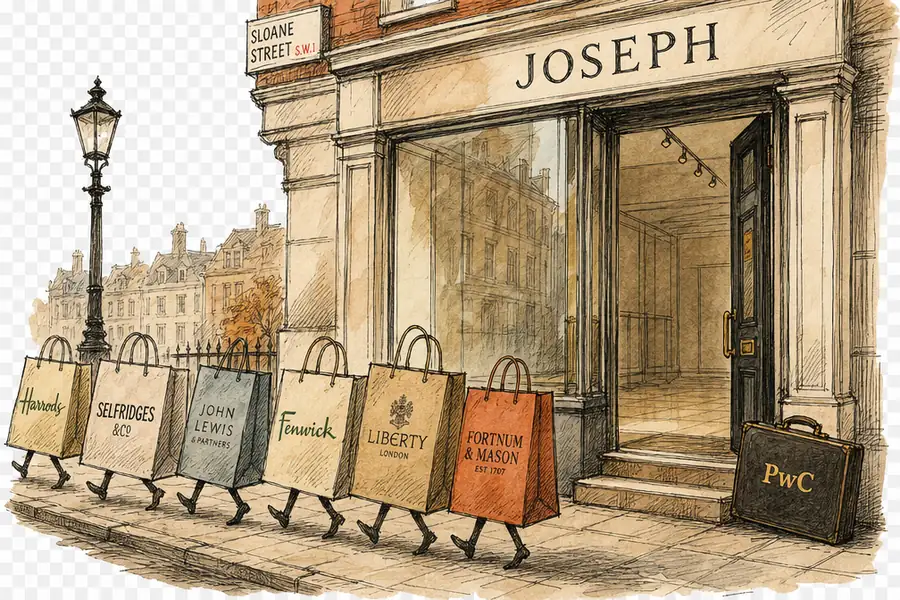
Joseph Has 400 Stockists and 24 Tills of Its Own
Onward Kashiyama has put PwC on a sale of Joseph, the London brand it bought for £140m in 2005. The price will show what a wholesale-built label is worth to buyers who now underwrite the customer file rather than the name above the door.
Sir John Crabstone
Onward Kashiyama has asked PwC to find a buyer for Joseph, the London brand it bought in 2005 for £140m. Sky News reported the mandate this month. The sale will test what wholesale-era brand equity is still worth. Buyers now underwrite the customer file, and Joseph sold most of its clothes across other people’s counters.
That 2005 price rested on a different arithmetic. Joseph then ran 63 stores and had lifted EBITDA 34% to £13.3m. Onward paid around ten times that for a company whose worth sat in its taste and its doors. Neither is what a data room examines now.
Joseph’s own account of itself explains the difficulty. In 2023 Barbara Campos told WWD she would double the business through 24 stores and more than 400 stockists. Four hundred doors is a triumph of distribution and a hole in the accounts. Each one rings the sale into somebody else’s till. The email address stays behind with the size history.
Joseph has spent sixty years introducing itself to women whose names it was never permitted to keep.
Campos named four of those accounts: Net-a-Porter, Matchesfashion, Mytheresa and Neiman Marcus. Seven months after that interview Matchesfashion was in administration, two months after Frasers bought it for £52m. Neiman Marcus went into Saks Global that December. Two of the four now answer to a different owner entirely — Frasers for Matchesfashion, Saks Global for Neiman Marcus — and a third, Net-a-Porter, answers to the fourth: Mytheresa bought its rival’s shelf space outright.
Net-a-Porter is the instructive case. Richemont did not sell it so much as pay to be rid of it, handing the business to Mytheresa with €555m of cash and no financial debt in return for a third of the buyer. A channel whose owner funds its own exit confers nothing on the brands inside it.
The buyer’s arithmetic starts from a shrinking pool. Bain and Altagamma count the luxury customer base down from 400 million in 2022 to about 340 million, with new customer acquisition falling 5% between 2024 and 2025. They measure personal luxury goods rather than premium tailoring, but Joseph’s buyer will model the same mechanism. When the pool shrinks, a list of women who buy twice a year stops being marketing. It becomes collateral.
The trade is reading this as a creative-director story. Mario Arena arrived from JW Anderson in late 2024, and Drapers reported that sources said his effect on trading has helped spark interest in a sale. The brand also returned to the London show schedule this year, staging a presentation at Tate Modern. That explains the timing. It does not explain the price.
The reviews have been better than the revenue line. The brand turned over £56.4m in the year to February 2024, against £60.6m in 2018, according to Vogue Business. The recovery is real and the business is smaller.
This would be Onward’s second European exit: its parent sold Jil Sander to OTB in 2021 for an undisclosed sum. PwC will show buyers a sixty-year archive and four hundred stockists. The first serious question in the room will be how many women bought twice.