Kamad's Vinted Receipts Sank Its Green Defence Against Louis Vuitton
A Paris court ordered upcycler Kamad Reworked to pay Louis Vuitton €920,000 and, as a further ground, used Kamad's own Vinted and auction receipts against its green defence: the goods it cut up could have been resold whole. Coach also deconstructs bags too damaged to repair, but it sorts by repairability and works on bags it owns.
Sir John Crabstone
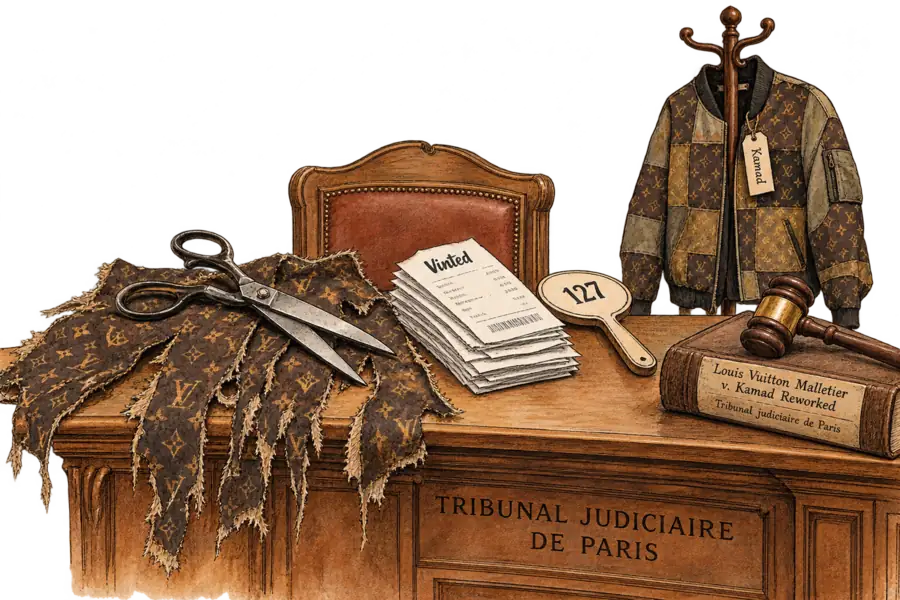
Kamad Reworked showed its Instagram followers a Louis Vuitton towel in shreds; the Paris court noted it had been in perfect condition. On 17 September the Tribunal judiciaire de Paris (RG 24/07925) ordered the upcycler to pay Louis Vuitton €920,000, The Fashion Law reported. The sum matters less than the extra ground the court added against Kamad’s green defence: the goods could have been sold whole.
Kamad kept its receipts. They were handed over during a 2024 seizure and showed purchases at French auctions and on Vinted between 2021 and 2024. Neither side relied on them; the court read them anyway and found Louis Vuitton had consented to the first sale. Against Chanel in May, Kamad could not prove its charms came from genuine Chanel goods. Here it could, and still lost on exhaustion: its jackets and T-shirts were new products the house never sold.
The receipts then did their damage to the green defence. The court had already held that no provision makes upcycling a ground for restricting intellectual property. “De surcroît”, it added, the goods “pouvaient être revendus en l’état”. Kamad, it said, “stimule la demande de produits neufs” where the consumer could have turned to the secondhand market.
Whoever buys a saleable bag to cut it up is that bag’s last consumer.
FashionUnited’s subheading on the case read “Environmental claims dismissed in commercial context”. Every upcycler works in a commercial context; the phrase does not distinguish Kamad from any of them. The judgment is narrower. It found that cutting the goods served “un but lucratif”, a profit motive, and not the environment, and the resale point came on top of that.
The exhaustion step never asked what state the goods were in. Elsewhere the judgment did, and it put the burden on Kamad: the company had not shown that the condition of the goods ruled out resale as they stood. Louis Vuitton told the court it had no quarrel with offcuts of its fabric, only with logo-bearing pieces it never supplies to outsiders. A damaged bag might buy an argument, though the court decided no such case, and nothing in the judgment suggests it buys a licence.
Seoul found a licence in ownership. In February, Korea’s Supreme Court held that reworking a bag for its owner’s personal use is not trademark use. It sent a Louis Vuitton win back to a lower court. Kamad, which bought bags and sold what it made, stands on the trader’s side.
Kamad has been in judicial liquidation since 25 June, the official gazette, BODACC, records. The judgment makes its three co-managers liable with it for the €920,000, which is under a third of the roughly €3.3m Louis Vuitton sought. It adds €120,000 in costs under Article 700. The house may wait for the money. It already has the reasoning, which needs no liquidator.
Coach also cuts up bags, but its own. Its (Re)Loved scheme restores bags for resale and deconstructs those “too damaged to be repaired” into pouches and dinosaur puzzles, so its dividing line is repairability. Paris used a blunter measure on bags Kamad bought from others, treating the prices Kamad paid as proof the goods were not damaged to the point of losing all appeal. By that measure, a bag is ruined only when nobody will pay for its monogram.