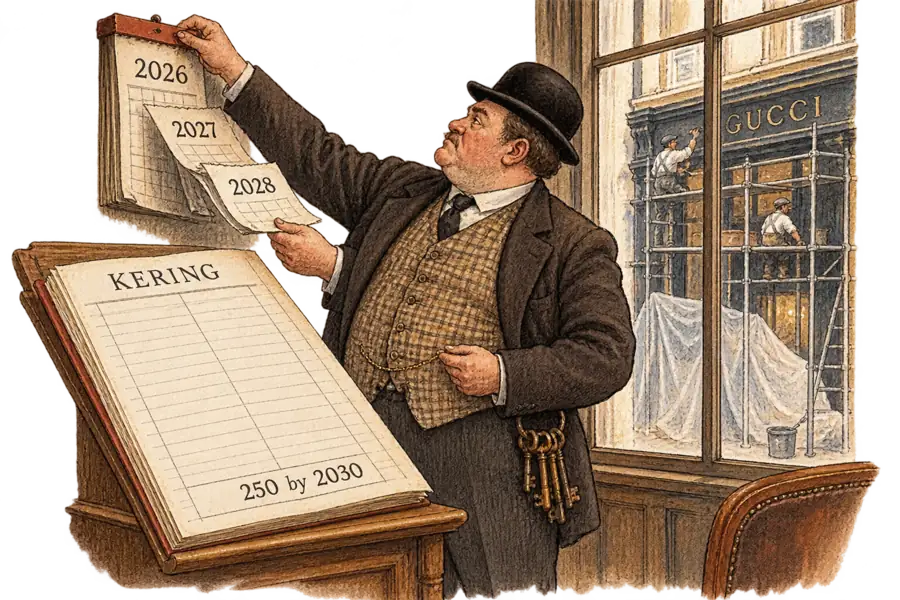
Kering Raised Its 2026 Store-Closure Target to at Least 125. The 2030 Total Is Still 250.
Kering now expects at least 125 net store closures in 2026, up from 100, but the 250 it promised by 2030 is unchanged. Its finance chief says lease negotiations went well, and the money goes into refitting the stores that remain.
Sir John Crabstone
On Thursday Kering raised its 2026 target from 100 net store closures to at least 125. Read quickly, that is a deeper retreat; it is an earlier one. By September Kering had shut 128 of its own stores and opened 23, a net 105. The total in its plan has not moved, and the finance chief says the lease negotiations “went well”.
On the call, Erwan Rambourg of Goldman Sachs asked whether Kering would “go deeper” or was “just quicker”. Armelle Poulou, the finance chief, chose quicker: “No, the plan is executed quicker, but the list is staying the same. We are not increasing the number of stores to be closed.”
Shareholders have totals, not street names. In April Kering promised a network 100 stores smaller by 2026, 200 by 2028 and 250 by 2030. Up to two-thirds of its stores are to be refurbished or relocated by then. Counted from the end of 2025, after 75 net closures last year, at least 125 puts half the cut into the first year. On her account no store has joined the list; the extra 25 are names already on it, closed sooner.
Kering decided which stores go; the lease negotiations are deciding when.
The original 100 was set with the negotiations in mind. Kering is leaving some stores “before the end of the lease”, Poulou explained, so the figure was “dependent on the negotiation”.
Most of the closing was done by June. Kering had shut 84 stores net in the first half, against an original target of 100 for the year. The third quarter added only 21. The target rose with the results for the quarter in which closing slowed.
Analysts, Reuters reported, say mere efficiency measures will not be enough to turn around a business whose brands have lost appeal. It is April’s plan, run early.
Glossy’s Luxury Briefing set Kering beside Prada, where the case for fewer stores is put more plainly. Andrea Guerra, the chief executive, doubts that some second- and third-tier Chinese cities need two or three stores. Prada wants to be “more prominent in those 10, 12 cities”.
The stores Kering keeps must do more for Gucci while Gucci sells less. Gucci still has 472 of the group’s 1,614 stores, but only 25 of the 105 net closures so far. Its third-quarter revenue fell 6% on a comparable basis, to €1.29bn, and sales in its directly operated network fell 9%. Only wholesale grew briskly, up 45% on a low comparison base and new-collection orders.
Poulou said that with fewer stores “we also can concentrate our CapEx on refurbishment”. The closing has a cost: she puts it at a 1-point drag on group sales in the first half and 2 points in the second, before sales recapture. Gucci unveils its new store concept on the Avenue Montaigne in November, and she says there is “a full program for next year”. In China, she conceded, some Gucci stores still have “a very old style coming from previous creativity”.