Kroger's Assistant Sold Its First Slot Before Its First Answer
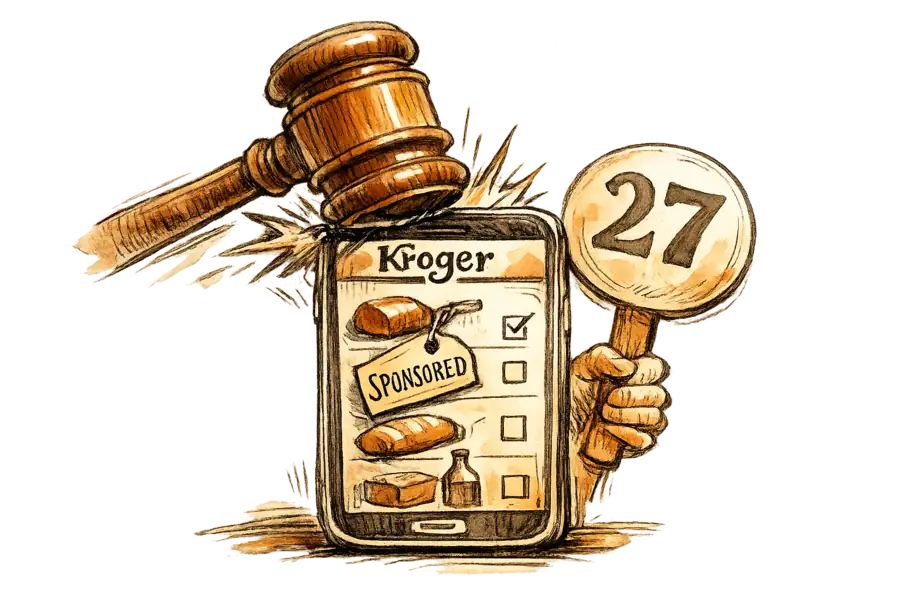
Kroger's AI Shopping Assistant launched with product listing ads already inside it, drawn automatically from existing search campaigns with no separate bid. The recommendation layer is the newer half of the product.
Sir John Crabstone
Kroger’s AI Shopping Assistant shipped with advertising inside it on day one. The launch announcement describes recipe cards and weeknight dinners, and never once uses the word advertising. What launched was a media placement that also gives cooking advice, with nothing in the copy to suggest an auction sits underneath it.
Product listing ads sat inside the assistant at launch, labelled sponsored and set beside the organic results. They appear as it assembles a cart for a shopper who asked about back-to-school snacks. Brian Spencer, marketing director at the grocer’s retail media arm, called it “a natural evolution to include product listing ads within the shopping assistant when it’s relevant” to shoppers. Evolution is a generous word for a thing present at birth.
The mechanism says more than the announcement did. Sponsored placements are drawn automatically from active Search and Browse campaigns, and Kroger asks advertisers for no extra setup and no separate bidding strategy. Any brand already buying Kroger search ads was enrolled the moment the assistant went live. Nobody bid for a place in an answer, because nobody was asked what an answer is worth.
Kroger did not add advertising to an assistant; it added an assistant to an advertising system.
The sponsored label is doing harder work than the work it was built for. On a results page it tells shoppers who paid to sit beside the thing they were already hunting. Inside a suggested menu it tells them who paid, and nothing about which unpaid product went unsuggested. Disclosure names the sponsor; it cannot name the absence. That asymmetry is the whole model, dressed as a courtesy.
Reach is what makes this worth arguing about, and the reach isn’t total. The assistant launched inside most of Kroger’s grocery banners, excluding Harris Teeter. A recommendation engine that size behaves like inventory: priced, allocated, sold by the slot.
Kroger’s product catalogue, not the assistant, is what travels onto DoorDash, Instacart and Uber Eats. The delivery apps carry groceries. They do not carry the conversation.
The number behind that inventory is smaller than it looks. Kroger Precision Marketing’s estimated annual revenue sits under $5 million, modest for a business now embedded in every recommendation the assistant makes. Scale and revenue are not the same argument, and the second one is still catching up to the first.
Walmart has the same idea and less haste. Ads inside Sparky are still a test, surfacing as sponsored prompts when shoppers ask for recommendations, after an initial trial last autumn. Kroger skipped that stage entirely. What Walmart is still testing, Kroger has already sold.
The reason sits in the quarterly. Kroger Precision Marketing profit grew over 20 percent last quarter while gross margin fell to 22.7 percent of sales from 23.0. A grocer earning less on food and more on position will keep finding new places to sell position.
The answering will get better. Kroger will see to that, because shoppers notice a bad answer and say so. The auction underneath it improves on a different schedule, and answers to somebody else. That is the split worth watching.