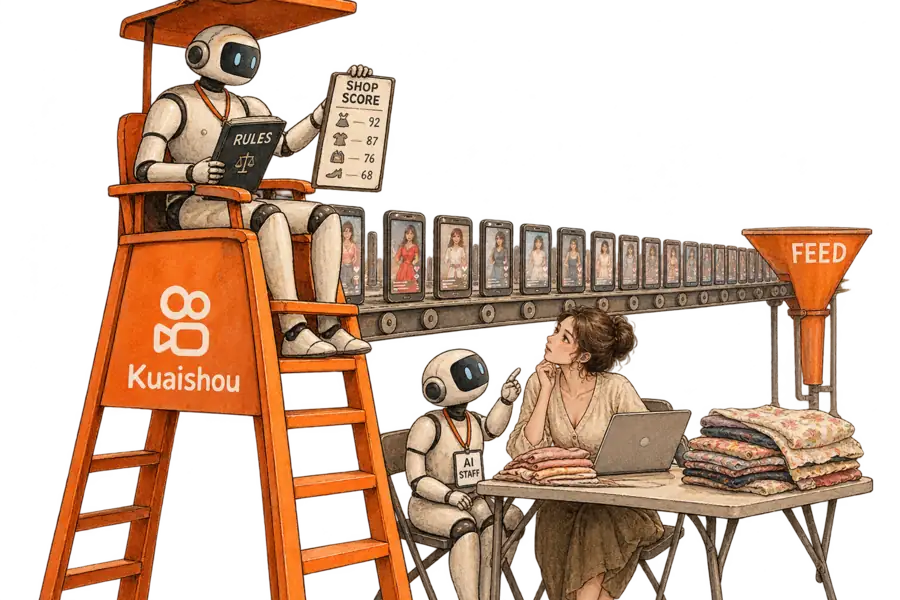
Kuaishou's AI Shop Staff Explain Kuaishou's Own Rulings
Kuaishou's merchant workbench now supplies AI 'digital staff' that diagnose a shop, post its videos and explain the platform's dispute rulings and score drops. Small sellers used to pay for an operator, an editor and an adviser. That help now comes from the party that writes the rules, scores the shop and rations the feed.
Neritus Vale
Each evening after her day job, a womenswear seller in Wuhan opens a chat with an agent in her Kuaishou Shop workbench. She checks the day’s exposure, clicks and refund rate against the day before; the agent suggests promotions to enter and, while she is at work, posts her videos. Sellers who wanted such help used to hire agencies and freelance editors; it now comes from the party that writes the rules, scores her shop and decides how many people see her videos.
The workbench now offers “AI智能数字员工”, 财中社 reported on Sina: digital staff on call around the clock in eight roles, from a virtual store manager to after-sales and risk-and-compliance (保障) specialists. Merchants ask in plain language, and an AI operations hub (AI经营中枢) routes each request using shop data, tools and 规则知识, knowledge of the rules. The loop runs from diagnosis to strategy to 托管执行, execution on the merchant’s behalf.
The after-sales and compliance specialists interpret Kuaishou for its sellers. The after-sales specialist helps a merchant “understand” (理解) cases the platform has taken over and its rulings in disputes, and adds refund diagnosis and suggestions. Its colleague in compliance identifies and explains violation risks, experience-score rules and why a score fell. Neither description mentions an appeal.
The score carries traffic with it. When Kuaishou rebuilt its shop scoring in 2023, 36Kr reported that high scorers get more natural traffic and platform incentives. Kuaishou’s latest quarterly release still promises “traffic support to high-quality merchants”. An agent that explains a lower score works from the scorer’s own rules and shop data, and the lower score may mean less traffic.
The digital-staff case studies run on a single text. 财中社’s article appears word for word on IT之家, where it ends with the line “快手内部文档请勿外传”: Kuaishou internal document, do not circulate. Pandaily’s English summary credits IT之家 and keeps the framing: agents that “diagnose a shop and act for the merchant”.
That framing treats the agents as staff and their output as the seller’s gain. Staff answer to their employer, and these sit inside Kuaishou’s workbench. Kuaishou says 850,000 merchants used its free AI tools in the first half, a list that includes business analysis and smart placement; the launch texts name no price for the digital staff. The sales and output figures on offer are tallied by a “digital-staff channel” (数字员工渠道), with no data source given.
The Wuhan seller buys stock at Hanzheng Street wholesale market and runs the shop largely alone. She paused livestreaming for lack of energy, and the agent’s videos keep traffic flowing to her hits (承接流量). Through that channel she publishes more than 62 short videos a month. Her hours no longer cap her output; the feed’s attention does.
阿娇娇, a general-merchandise seller, posts 190 videos a month through the same channel. At that rate the producer is the agent. The text credits those videos with 10.5% of the shop’s GMV, a figure that measures the channel and leaves open whether the shop as a whole sold more.
At 淳香阁, an Anxi tea supplier, the agent turns product photos into clips. “Since we’ve had AI, we basically haven’t been hiring editors,” it says. The text puts the supplier’s agent-channel share of GMV at 10.6%, on the same basis.
A second IT之家 piece the same evening is plainer about who posts. Once a merchant signs up for “AI video hosting”, the platform makes and publishes shoppable short videos every day from the shop’s listed products. It describes the kit as turning abilities that once depended on “teams, manpower, experience and time” into “platform supply” (平台供给). Supply there means capabilities merchants can call on; here the platform is also the one doing the posting.
When supply is that cheap, reach becomes the scarce input, and Kuaishou sets the rules for it. Its second-quarter release says that in e-commerce marketing services it “intervened at the supply level of marketing materials”, rewarding first-launch content and increasing recommendation diversity. That governs ad creatives, and the release says nothing about organic shop videos. Nothing suggests the agents’ videos are favoured, and the argument does not need them to be.
The house that governs reach also sells it, and its own agent now drafts the campaigns. In 2023 36Kr found livestream sellers with large followings in second-tier cities paying a dedicated buyer for 磁力金牛, Kuaishou’s ad platform, more than RMB13,000 a month; the job had not existed until 磁力金牛 arrived. Merchants now ask an assistant called 小牛 for a promotion plan and adjust budget and bid by chat, the IT之家 piece says. The release lists “smart placement” among the free tools but does not say whether that includes 小牛. Whatever the assistant costs, the budget it helps spend is the merchant’s.
Meituan has made the same move and named the trade it replaces. On 22 October it promised restaurants across China a free “AI store manager” that reads Meituan’s data with the merchant’s, 证券市场周刊 reported. Its showcase pizza shop in Rizhao had paid a delivery agency an extra RMB1,000 a month, struggled to get a response at weekend peaks and switched to Meituan’s agent.
The strongest objection is that the interests line up. Kuaishou makes money when its sellers sell, and merchants already ask its support staff (小二) for help with the rules. For a seller with a day job and no budget, a free operator is a plain gain. For the thesis to fail, Kuaishou’s interest and each seller’s would have to coincide on every decision the agent touches.
They coincide on total sales and diverge in three places. A merchant wants profit from each yuan of promotion, while the house that sells promotion books the spend. In a dispute Kuaishou is the judge, and its specialist helps the seller understand the verdict. Every seller also competes in one feed, where an agency hired by one is paid to beat the rest; Kuaishou’s agent serves them all, so it presumably takes no side.
An explanation from the party that made the ruling is a notice.
The arrangement is a design choice, and Kuaishou could make another. An after-sales specialist that drafted the seller’s appeal against the ruling it had just explained would be working for the shop. The launch text describes no such function. Until one exists, a seller who wants a second opinion must find it elsewhere, while the first comes from the party that ruled.