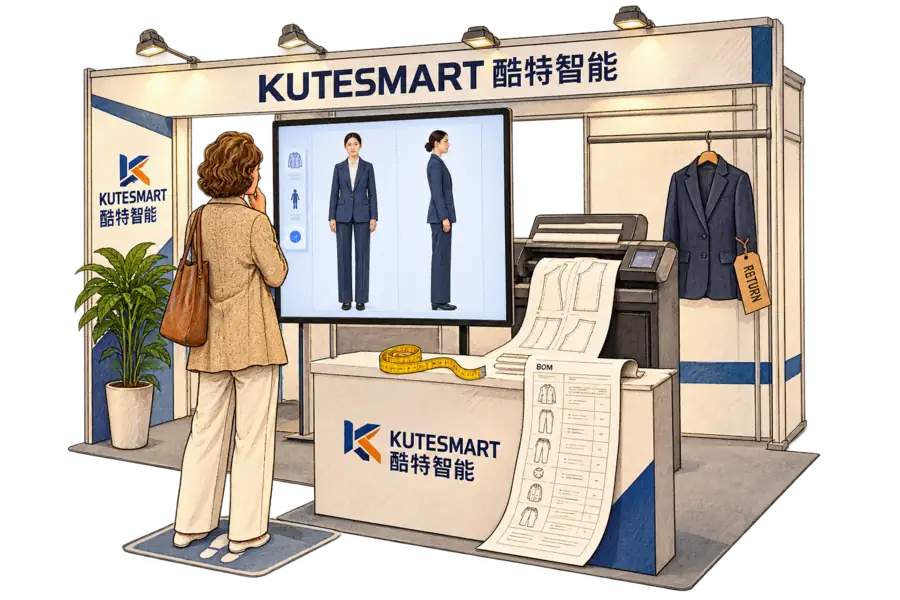
Kutesmart Has Described a Two-Photo Tape Measure Since 2021 Without Printing Its Margin of Error
Kutesmart's Qingdao stand measured customers from two photographs. Its filings have defined a two-photo method since 2021 without an accuracy figure, and its 2025 annual report prints no return rate.
Sir John Crabstone
Two photographs are now enough to have clothes made (拍两张照片就能做衣服), the financial site 瑞财经 reported from this week’s design festival in Qingdao, in a piece carried by 乐居财经 on Sohu. Customers at the stand of Kutesmart (300840.SZ), the made-to-measure maker that grew out of Red Collar, needed only two full-length shots to be measured. The report gives no margin of error, the number made-to-measure lives by.
The report does not name the system, but its wording matches a definition Kutesmart’s filings have carried for five years. The interim report of August 2021 defined an “Intelligent measurement system” that measures a body automatically from two photographs, front and side (正面和侧面两张照片). The 2025 annual report still carries the entry, with no count of customers measured and no accuracy figure.
The agent on show, 酷小匠, has its own entry in the same annual report. It turns a spoken or pictured wish into a pattern and a bill of materials in seconds; where the body’s numbers come from, the entry does not say. It was launched (推出) by December 2025, with deployment testing (落地测试) in fast fashion, e-commerce and the supply chain still to come.
Kutesmart once explained its tape-measure method. Its 2020 prospectus set out the Red Collar method: 22 measurements from 19 parts of the body, taken in five minutes. Software then drafted the pattern within two seconds, so pattern drafting in seconds is at least six years old. Even online orders needed a measurer at the door (上门量体), and custom clothing, it said, could not be sold online alone.
The prospectus printed return rates too: 0.41% at its own shops in 2019 and, historically, under 0.3% from franchisees. Online, the 2019 rate was 0.88% on 107 sales, which the prospectus puts down to weaker communication with the style adviser, not to measuring.
Franchise contracts allowed returns only for quality faults or Kutesmart’s own measuring (发行人量体原因). A rework database (返修数据库), one of six it kept, fed corrections back into the measuring method (量体方法).
Two photographs can measure a customer; the returned suits measure the photographs.
The 2025 annual report prints no return rate. Yet its glossary says a pattern’s quality directly decides how a garment wears and fits (其好坏直接决定了服装的穿着效果与合体性). Lower returns and exchanges (降低退换货率) appear among the aims of its AI shopping-assistant mini-program, with no starting figure.
Returned stock is named in this year’s interim report, as old stock. At the end of June, Kutesmart held 18,134 suits more than a year old, down 43.12% from a year earlier. The line also covers R&D and display samples; promotions, it says, were used to work through long-held customer returns (长期积压客退库存) and aged samples. It does not say how many came back.
3DLOOK, which measures bodies from two smartphone photos, calls “How accurate is it” one of the first questions enterprise teams ask. Its answer is a typical error of 1.5 to 2.0 cm per measurement, varying by body part, from internal tests against pattern-makers’ hand measurements. It concedes that no peer-reviewed study backs the figure, and it keeps its methodology and sample size under NDA. Kutesmart has given its photographs no figure to doubt.
The annual report names four databases, then “etc.” (版型数据库、款式数据库、工艺数据库、BOM 数据库等). Neither the measurement database nor the rework database is among those named. If the latter still runs, it holds the numbers the stand left out.