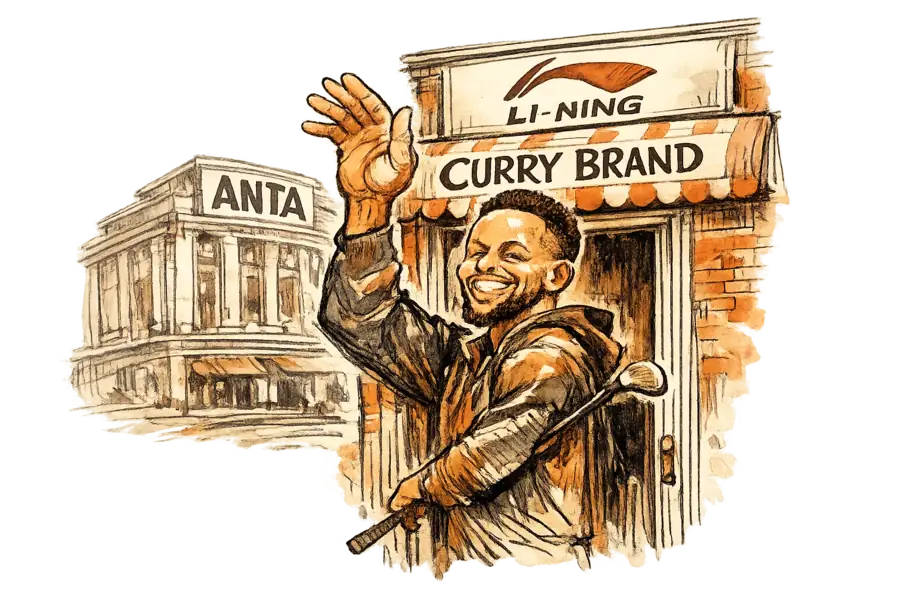
Anta Was Bigger. Li-Ning Handed Curry A Brand.
Stephen Curry signed a ten-year deal reported above $400 million with Li-Ning over the larger Anta, taking a sub-brand, athlete-signing rights and a golf line. The terms, not the money, are the story: marquee endorsement now means owning a house, not lending a face.
Sir John Crabstone
Stephen Curry has signed with Li-Ning and turned down Anta, the larger of China’s two leading sportswear makers, to do it. The ten-year deal, reported above $400 million, hands him a sub-brand, the right to sign his own athletes, and a full golf line. At the top of the market, an endorsement has stopped being the rent of a famous face. It is the deed to a house the athlete runs himself.
He did not take the biggest cheque. At least one rival offered more money; the brand he chose offered control instead.
He had already learned the cost of renting. Under Armour launched Curry Brand in 2020, but it lived on Under Armour’s balance sheet, not his. When the parent began to struggle, the brand had nowhere else to stand. He left the split owning the trademarks, a name in hand and a retail partner to find.
Money was not the question, because money was on every table. Anta booked, by 36Kr’s count, ¥80.22 billion in 2025 against Li-Ning’s ¥29.598 billion, and could have outbid the room without noticing. What it would not concede was control: the trademarks Curry carried out of Under Armour, a brand built around him rather than over him, the right to sign players under his name.
Even golf ran Anta’s way. It already sells the game through Fila and Descente, so a Curry line would have fought shelves Anta owns; for Li-Ning, the category sits close to empty. Li-Ning needed Curry more than Curry needed Li-Ning, and need is what writes generous terms.
Anta could afford Curry; it could not afford to house him.
The headlines called it a win for a Chinese shoe giant, and so it is: Curry sells in China, and Li-Ning gains a marquee name to carry into the United States. That reading is correct. It is also too small. The novelty is not the nationality — it is the clause that lets one athlete sign others.
Li-Ning has built this house before. Dwyane Wade left Jordan Brand for the company in 2012, and his Way of Wade line still ships more than a decade later. Nike wrote the template with Jordan: turn a player into a marque that outlasts his playing days and pays for decades. Curry intends to make it physical, with Curry Brand stores planned in both China and the United States. What is new is that the smaller brand, not the giant, proved willing to repeat the trick.
The face was always the cheap part of the deal. What Curry has bought, with another company’s capital, is the thing no endorsement could hand him before: a brand that does not revert to its sponsor when his playing days end. Anta will keep signing stars to shoes, and most will be glad of the cheque. The ones who matter now want the house. The biggest houses are the worst placed to offer it, for the plainest reason: they have too much of their own to lose.