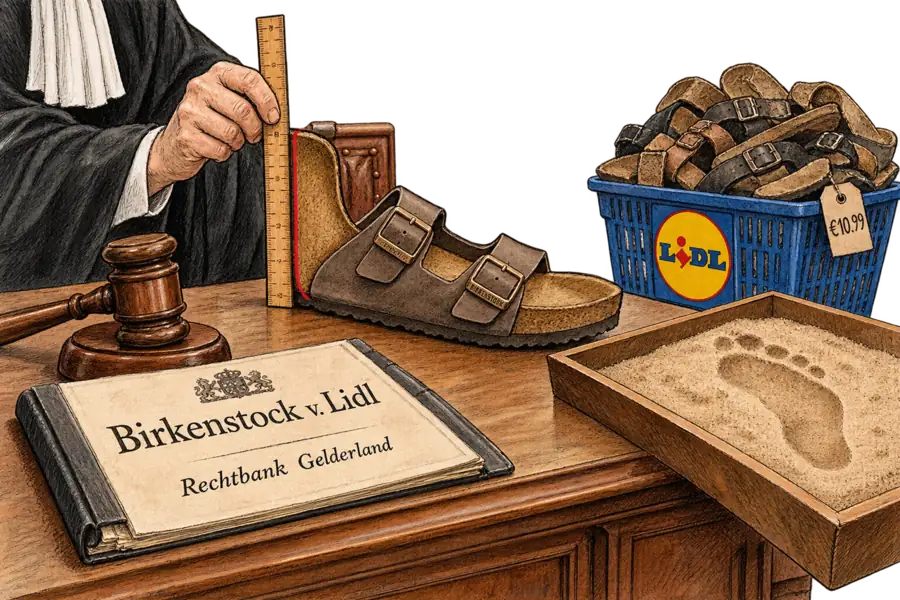
Lidl Copied the One Part of Birkenstock's Sole That a Dutch Court Protected
A Dutch court has barred Lidl from selling lookalikes of five Birkenstock sandals, but the copyright it upheld sits in the height-graded wall of the sole and one Madrid strap; the footbed's shape, it ruled, is dictated by the human body. Under the EU's new copying test the wall was enough, and the order stops at the Dutch border.
Sir John Crabstone
Lidl lost to Birkenstock in Arnhem over the wall of a sandal sole, the part that stands highest at the heel. On 23 September the Gelderland court ordered Lidl Nederland and its supplier, Rieg & Niedermayer, to stop selling lookalikes of five Birkenstock models. Each defendant pays €5,000 a day for breach, up to €250,000. The order stops at the Dutch border.
Birkenstock’s announcement said the sandals infringe “in particular, the copyright in the footbed design” and that costs would be set separately. The judgment had already fixed costs at just over €47,000. It is narrower on the footbed, whose concrete shape is “gedicteerd door het menselijk lichaam”, dictated by the human body (ECLI:NL:RBGEL:2026:7234, r.o. 6.22). Lidl had pointed to Birkenstock’s own website, which likens the footbed to a footprint in sand.
On the footbed, Lidl’s best witness was Birkenstock.
What the court did protect is the wall of the sole, its “wand”: a ridge that stands higher at the back and falls toward the front. The shaped rim at the toes it counted as part of the unprotected footbed. The uppers fared worse. The Madrid kept one feature, a strap of about 2 cm over a band of about 5 cm. The Arizona’s straps, 3 cm over 4.5 cm, differ too little, and the court called that choice “banaal en triviaal” (r.o. 6.33). Arnhem measured creativity in centimetres. No other upper survived: the Florida and Boston failed on creativity, and the Gizeh’s copyright lapsed in 1998 for want of a renewal declaration.
The wall sufficed under the EU’s new test. The Court of Justice’s Mio/konektra judgment of 4 December 2025, in joined cases C-580/23 and C-795/23, asks whether a protected creative element has been recognisably copied. Overall impression, Arnhem noted, is a design-law test and not decisive. One wall therefore condemned Lidl’s lookalikes of all five models, even the Boston-style clog, whose sole mostly hides under the upper.
Utrecht’s court, ruling against the shoe chain Scapino before Mio/konektra, protected the same wall as an image-defining element. It protected the footbed too: “is een voetafdruk nog geen schoen”, a footprint is not yet a shoe. Because it compared copies of the protected Madrid, Arizona and Florida by overall impression, a Scapino Madrid with a nearly level wall still infringed. The Boston failed there: its upper, which hides most of the sole, resembled a 1971 clog. Arnhem found infringement in that hidden sole.
Arnhem rejected the slavish-imitation claim. Birkenstock had not substantiated a distinctive “eigen gezicht” for its 2018 uppers (r.o. 6.66), and its market research did not prove one for 2025 (r.o. 6.67). Tolerance reinforced the point: Birkenstock had written to copyists since 2015 but “nimmer hebben doorgepakt”, never followed through, and any face of its own had already worn thin. The copyright claim succeeded regardless.
Germany answered earlier, and differently. Its Federal Court of Justice held on 20 February 2025 that Birkenstock’s sandals “do not qualify as copyright-protected works of applied art”, nearly ten months before Mio/konektra set the EU-wide test. Whether that ruling holds under Mio/konektra is for a German court to decide.
Three of the sandals before the Dutch court carried labels in Dutch, among other languages, and two named Rieg & Niedermayer as producer and importer. Lidl Stiftung, the ESMARA trademark owner, said its only Dutch site is a distribution centre handling food; Birkenstock did not dispute that, and the claims against it were dismissed. The order covers the Netherlands only and applies from service, appeal or not. Lidl.de lists a buckled ESMARA sandal at €10.99, but nothing on the page ties it to a model in the case or says whether its sole rises at the heel.