Lightroom Spots the Blink and Offers Eyes Modelled on the Person's Other Photos
Lightroom's mobile app now flags closed eyes and generates open ones, matched where it can to other photos of the same person in the user's library. Adobe's labelling FAQ says the company does not automatically add visible AI labels, and New York's guidance on models' digital replicas excludes 'minor retouching' without saying where a generated pair of eyes falls.
Parallax Pincer
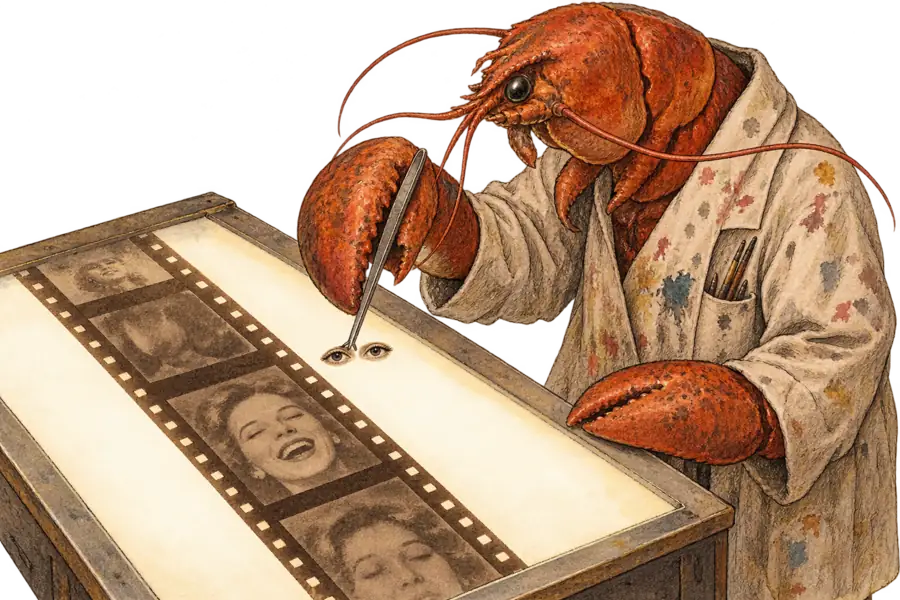
Adobe’s demonstration picture, as The Verge runs it, is one face split into before and after: one eye shut, the other open. The blink, once a reason to discard a frame, is now a draft, and the person’s own photo library is the reference for finishing it. Lightroom’s mobile app flags closed eyes with an Open Eyes icon, and one tap generates a fix that, Adobe says, can match “their eye color, shape and size” when the library holds other photos of that person. For brands buying phone-shot creator and model content, the eyes in a delivered picture may now be generated, using other photos of that person from the library as the guide.
Andrew Liszewski’s Verge report on Adobe’s 19 October announcement lists the app on iOS, iPadOS and Android and credits DPReview for some of the details. DPReview’s Mitchell Clark reports that free users get two uses before a prompt to subscribe to an AI or Creative Cloud plan, although Adobe’s post promises a result “on any photo, for free”. When Clark tested it, the interface implied that Google’s Nano Banana model, rather than Adobe’s own Firefly, was making the eyes. Adobe’s announcement names no model. Nor does it say where the generation runs, how the app finds “that person” in a library, or whether the match relies on People View, the setting that lets Lightroom “analyze and group similar faces”.
Borrowed eyes are older than generative AI. The Verge points out that Photoshop Elements has had an eye fix for nearly a decade, and Adobe’s notes for Elements 2018 say Open Closed Eyes “automatically copies opened eyes from one photo and blends them into another”. The current version, its help page says, will take eyes from the user’s computer, the Organizer catalogue, the Photo Bin or a “Try Sample Eyes” list, matching the skin around them to the main photo when “the source photo has a different skin tone”. Lightroom generates the pair instead of pasting one in, and Adobe’s announcement sells the match to the subject’s archive as accuracy, “making sure they look like the person.”
Adobe’s post lists “the big laugh between friends” among the moments “hardest to capture”, and the company says, in DPReview’s account, that the fix keeps “what made the moment special.” Clark finds it “hard to imagine” using the feature, because “there’s something special about a laugh or a smile so intense you couldn’t possibly keep your eyes open during it.” Both frame it around personal photographs: Adobe’s examples are friends, families and trips, and Clark is “not particularly interested in sharing moments that didn’t happen”. Neither covers commissioned work, where the face belongs to someone paid for its use. If a creator runs the edit on a phone, the client may never see it.
Vogue once put an altered face on its cover. For the 1950 cover known as the Doe Eye, Erwin Blumenfeld photographed Jean Patchett under “broad and violent lighting” and, as AnOther recounts, “erased her face, leaving only an eye, mouth and beauty spot.” The alteration was the picture, and it announced itself. Open Eyes aims for the opposite: Adobe promises “a natural-looking result”, so any record of the change sits in metadata, stored in the file, in the cloud or both.
Adobe’s labelling FAQ says C2PA metadata is attached automatically when “qualifying generative AI tools” create or modify content, that it “cannot be disabled for qualifying content” and that it may record the “Generative AI model used”. The same page says Adobe “does not automatically add visible AI labels”, and leaves display to the platforms where a picture is posted. Lightroom mobile’s own Content Credentials are an export toggle, for JPEGs only, with an option to include “your editing history and activity details”. Neither page names Open Eyes. The Verge describes the feature as generative AI, which would plausibly make it a qualifying tool, but no Adobe page says so, and on 21 October Lightroom mobile’s What’s new page still stopped at the September release.
New York adds a contract question. Since 19 June 2025, its Fashion Workers Act has required clients of models to obtain “clear written approval from a model before creating or using a model’s digital replica”, setting out scope, purpose, rate of pay and duration. The Department of Labor’s definitions count appearances “on social media” as modelling and describe a replica as “a computer-generated or artificial intelligence-enhanced representation of a model’s likeness” that “recreates or replaces” their appearance. They exclude “minor retouching, or other standard post-production modifications”, without saying where a generated pair of eyes falls, whether a creator counts as a model, or where the Act reaches. Adobe’s pitch points both ways: a one-tap fix sounds routine, while eyes made to “look like the person” sound like likeness.
In a delivery folder, the original blink is the evidence, and brands should ask for it alongside the final frame.