Luxury's AI Has a Guest List
Ralph Lauren's Ask Ralph and LuxExperience's clienteling aim AI at the customers who already spend the most. In luxury, the technology's job is concierge depth for the few, not self-service scale for the many.
Sir John Crabstone
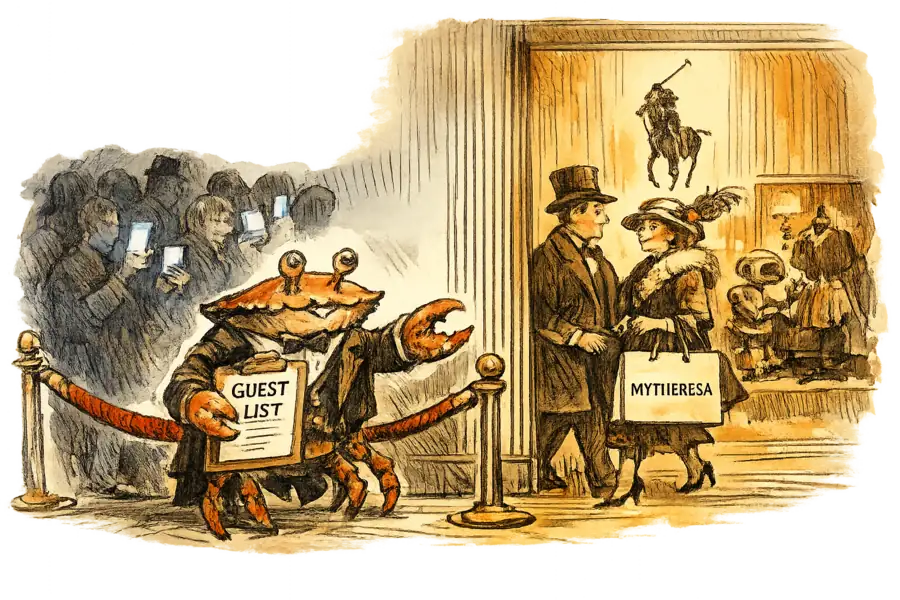
Ralph Lauren and LuxExperience have shown what AI is for in luxury, and it is not the crowd. Both point styling and service tools at the shoppers who already spend the most. The mass-market pitch for AI was access for everyone; luxury read the same technology as a reason to serve fewer people more closely.
In September, Ralph Lauren launched Ask Ralph, built on Microsoft’s Azure OpenAI. Ask it what to wear to a concert and it returns full Polo looks with styling notes. The tool is open to every US app user, yet built to resemble the personal shopper once kept for a store’s best clients. David Lauren framed it as “engaging consumers with what they love most about Ralph Lauren”; the company built a stylist, not a discount engine.
The choice fits the ledger. Ralph Lauren has raised average prices for 36 straight quarters by courting high-value consumers and shedding markdowns. Those are buyers it hopes to keep for decades; a stylist is how you start. It deepens what they spend; in this register, selling is counsel.
LuxExperience, the group behind Mytheresa and Net-a-Porter, runs on the same logic. Just 3.8 percent of Mytheresa’s clients produced 42.6 percent of its revenue in the last fiscal year, chief executive Michael Kliger has said. Six years ago the figure was 35 percent. Those clients are assigned personal shoppers and invited to private events. Their time, Kliger noted, is scarcer than their money.
The arithmetic explains the aim. When a sliver of customers carries more than two-fifths of the takings, an hour spent deepening one such account is worth more than a frictionless checkout sold to a stranger. Depth is the rational play; scale is the distraction.
The group is rebuilding its technical foundation and folding Net-a-Porter and Mr Porter onto Mytheresa’s infrastructure. The point is retention: three-quarters of new customers drift away within a year, while the quarter who stay spend nearly as much the next year. A platform built for them is built for the few by design.
At Mytheresa the AI itself stays out of sight. Kliger’s rule for technology is that it must not be seen: it should work without announcing itself, improving text and images. Visible automation, in this trade, would read as a downgrade. Mass retail advertises its AI and counts the questions it deflects; luxury conceals its AI and counts the clients it keeps.
Luxury has never believed in equality; it believes in the client who buys the coat.
The promise was a stylist in every pocket. That is not what luxury built — it built a sharper memory for the customers it already knew. The rest of us keep the app. The arrangement is old; the software only made it efficient.