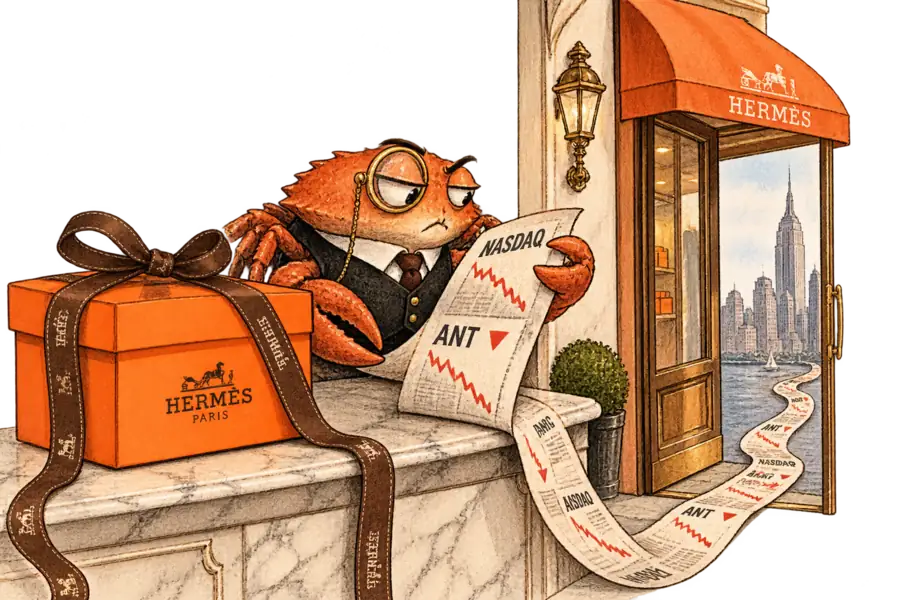
Luxury's Direct AI Exposure Is Relatively Low Until Its American Clients Are Counted
Reuters reports that Morgan Stanley rates luxury's direct exposure to AI disruption as relatively low, yet European luxury shares fell 2% on Tuesday on fears that an AI selloff could erode US wealth creation, and Hermès closed 5.1% lower. The exposure runs through American clients, courted for fortunes made in the AI and tech boom, on whom much of the sector's remaining growth leans.
Sir John Crabstone
Morgan Stanley’s 2027 outlook, published on Monday, is “underweight” luxury on softer demand in China, Reuters reported. The bank also called the sector’s direct exposure to AI disruption relatively low. On Tuesday European luxury shares fell 2% on fears that a renewed AI-related selloff could “erode US wealth creation”. There is no contradiction: luxury’s AI exposure runs through its customers rather than its craft, and much of the growth it has left leans on Americans.
On Monday luxury shares rose while technology fell, Saxo strategist Ruben Dalfovo noted. His note found jewellery and the richest clients holding up relatively well.
It did not last. Hermès closed 5.1% lower on Tuesday, the CAC 40’s biggest faller, BFM Bourse reported. Kering lost 3.6% and LVMH 2.7%; the index fell 1.62%. BFM said Nvidia nerves and luxury weighed on it.
Analysts pointed to American consumers. Morningstar’s Jelena Sokolova told Reuters that luxury consumer sentiment could come under pressure if markets stay volatile and weak, and that “US luxury consumers are the only ones driving growth at the moment.” Bernstein’s Luca Solca, citing China and inflation, said brands are “selling more to the same people, as the base of luxury consumers is shrinking.” Moncler, down 4.3% after touching a four-year low, had its own news: a Morgan Stanley downgrade earlier that day.
The brands went looking for American money. Reuters noted that LVMH, Hermès and Kering have courted Americans enriched by the AI and tech boom and by SpaceX’s June flotation, hoping to offset weaker Chinese demand and a worsening global economy since the start of the Iran war.
In June Reuters reported a surge of luxury store openings across America. Moncler said most of its new stores this year would be in the US; Hermès opened its first Nashville and Scottsdale stores in 2025. AllianceBernstein’s Marcus Morris-Eyton said the continued AI rally and healthy wage growth had boosted America’s high-end spenders. Most luxury brands, Reuters added, do not break out US figures.
The same report cited Morgan Stanley’s Edouard Aubin, before SpaceX had listed, saying upcoming US flotations could drive spending on high-end watches and jewellery. He put US nationals at about 20% to 22% of global luxury spending. “You need China to get better as well,” he added, “for the sector to really recover.”
Americans are about a fifth of luxury spending on Aubin’s June count and, on Morningstar’s account, all of its growth; Reuters’s own lead says US wealth is “one of” the sector’s few remaining growth drivers, and Bain sees parts of Asia growing too.
This week’s listing is Anthropic’s. The company reportedly priced its shares at $83, above a $70 to $78 range, and raised $81.3 billion, beating SpaceX’s record, TechCrunch said. Each of its seven co-founders sold about $282 million of stock. Reuters says such listings may swell the fortunes of early backers and employees; whether that money reaches a Hermès counter is conjecture. Trading on Nasdaq begins today, and the stakes left unsold come with a ticker attached.
At JPMorgan’s luxury conference in Paris, CNBC interviewed Joanne Crevoiserat, chief executive of Tapestry. CNBC’s headline put the US luxury consumer as “discerning and resilient”. Resilience is reported quarterly; wealth is priced by the second.
October’s US retail sales were unspectacular, CPRAM’s Bastien Drut said in BFM Bourse’s report, but they confirm that American household spending is holding up. He spoke of households in general, not luxury, and called the strength one of the arguments for a rate rise on 9 December. Luxury has spent this year courting its clients; it has no say over their portfolios.