LVMH's Leather Goods Were Stuck Below 2024 Before the Molly Tea Ruling
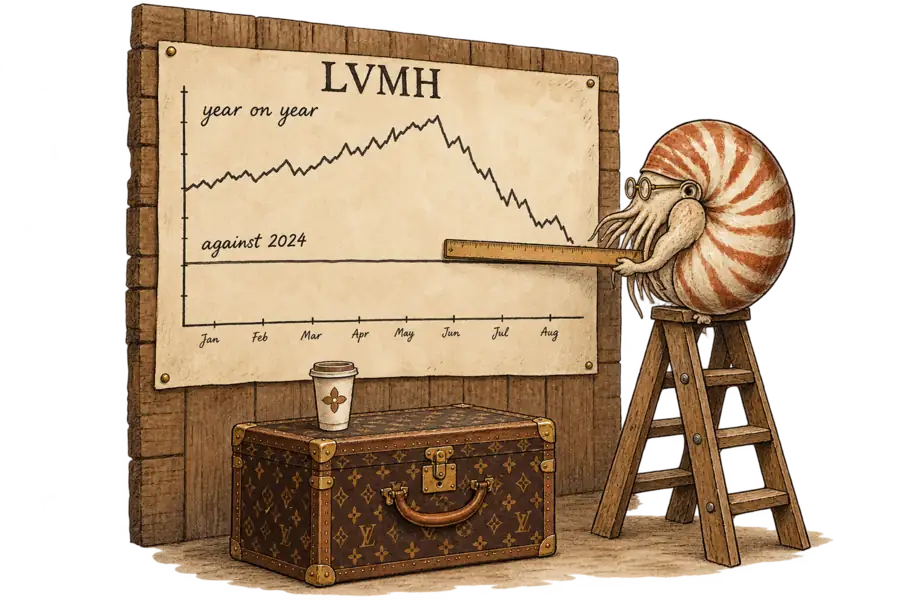
LVMH's leather goods fell 5% in the third quarter, and the blame went either to China's economy or to Louis Vuitton's Molly Tea backlash. Measured against 2024, the division sat 6 to 8% lower in every quarter of this year, before the ruling and after it, so most of the fall is last summer's recovery dropping out of the comparison.
Neritus Vale
LVMH’s fashion and leather goods division fell 5% in the third quarter, and both explanations on offer treat the fall as new. One is a Chinese slowdown; the other is a backlash over Louis Vuitton’s trademark fight with the tea chain Molly Tea. LVMH’s own figures, set against 2024 instead of last summer, put the division about as far below that year after the Molly Tea ruling as before it. Most of the third quarter’s drop is last summer’s recovery falling out of the comparison.
LVMH’s own account was macro. Cécile Cabanis, the chief financial officer, said Asia had been “penalised by a sharp macro-led deterioration in Chinese consumer sentiment”, in Reuters’ report, carried by Inside Retail. She put Chinese demand down by a mid-teens percentage, WWD reported. TextilWirtschaft put part of LVMH’s Chinese trouble down to the “Molly Tea-Shitstorm”, and Seoul Economic Daily, under the headline “China Backlash Builds”, had Cabanis citing the trademark dispute as a reason China was harder.
The split between leather goods and Watches & Jewelry is older than either story. Watches & Jewelry has outgrown leather goods by nine to eleven points in every quarter of 2026, as the release shows. A Suzhou court ruled on 29 June that Molly Tea’s four-petal logo infringed seven Louis Vuitton marks, FashionUnited reported. The research firm JL Warren Capital, quoted by Bloomberg, dates the backlash to July, so two of the three quarters were already on the books. A gap that was there first cannot measure what came after.
What moved in the third quarter was the comparison. Asia excluding Japan, the region that includes mainland China, swung nine points between the second quarter and the third, from growth to decline, LVMH’s presentation shows. That is the decline Cabanis put down to a sharp deterioration in sentiment. A year earlier the region had swung eight points the other way, into growth, and this summer was measured against that.
Leather goods follow the same pattern. Their growth rate fell six points between the second and third quarters, against a base that had improved by seven over the same months of 2025. The figures are organic, at constant currency and consolidation scope; the release puts the division’s nine-month perimeter effect at zero, so the 1 September sale of Marc Jacobs to WHP Global does not distort them.
Compound each quarter’s change over the two years and the line goes flat. By our calculation from the same presentation, leather goods sat 6 to 8% below 2024 in every quarter of 2026. Asia excluding Japan stayed between 2% and 5% below 2024, with the third quarter between the first two.
The band starts at 6 because of one remark. Cabanis said the third-quarter decline was “much closer to -4.5” than the rounded 5%, the error-ridden transcript on Investing.com shows, which puts that quarter 6.4% below 2024. Every input is rounded to a whole point, so a point either way is fair slack.
The division’s line did not break in the quarter after the ruling.
On the same arithmetic, the division that slowed in the third quarter was Watches & Jewelry. Its lead over 2024 narrowed from 11% to 8%. WWD’s report said the Chinese slowdown had reached the division, alongside a tougher comparison for Tiffany. Asked about leather goods brand by brand, Cabanis called the slowdown broad-based, the transcript shows. Breadth of that kind is hard to pin on a grudge against one brand.
Louis Vuitton finished slightly below its division’s average, and the only brand-specific cause LVMH quantified was a freight forwarder. Cabanis said a “one-off logistic and transportation disruption” cost the brand “a bit more than a point of growth”, in TheIndustry’s account. She added that it hit hardest among American clients, per the transcript. Dior, flat in the quarter, outperformed along with Loro Piana and Rimowa, WWD reported. Without the freight problem, on Cabanis’s account, Louis Vuitton ran close to the average.
LVMH conceded a Molly Tea effect only when asked, and only for the start of the quarter. An analyst raised the case after noting that Cabanis had not alluded to it, the transcript shows. The effect was hard to quantify, she said, but “it’s probably fair to say that it had a negative impact, at least at the beginning of the quarter”. Seoul Economic Daily’s line that she cited the dispute compresses that exchange.
The steepest numbers in circulation come from watching malls, not from tills. JL Warren, based in Greenwich, Connecticut, put Louis Vuitton’s July sales in China down about 30%, Bloomberg reported in September. The firm builds its estimates from “visuals” gathered by staff watching boutiques in Chinese malls, “rather than actual sales data”, Bloomberg noted. People familiar with the matter told Bloomberg that Louis Vuitton was the worst hit in July and August, though the broader downturn has slammed all luxury brands.
The same piece put Gucci’s China sales down 20% in July and Hermès down 5%, which makes Louis Vuitton’s fall the steepest of the three. Bloomberg added that The Louis, the ship-shaped Shanghai store Louis Vuitton opened in June 2025, made the brand’s comparisons harder.
JL Warren’s own estimates for Louis Vuitton then narrowed to 20 to 25% in August and about 13% in September, which fits a concession limited to the start of the quarter. Overall demand also improved later in the quarter, FashionNetwork reported.
The strongest objection is that compounding treats last summer as an ordinary base, when it was a recovery. If Chinese demand had turned in 2025, holding level with 2024 would mean the recovery stalled, which is LVMH’s macro story told in different units. Cabanis did not argue it that way: asked whether last summer had set a tough comparison, she called The Louis “one store” and treated it as a small base. For the objection to hold, the stall should appear this summer, after the ruling.
The stall was already there in the spring. The second quarter, which WWD and TheIndustry reported as the division’s first gain in two years, sat 8% below 2024, no closer than the third. The base in LVMH’s annex is a region and a division, not one store. The division line cannot isolate Louis Vuitton, the largest brand in it, so a Dior or Loro Piana gain could mask a Louis Vuitton loss; what the line rules out is a division-wide break after the ruling.
The fourth quarter offers a cleaner test. Leather goods fell 3% in the last quarter of 2025, Reuters reported in January, in a copy carried by The Standard. If the division holds its line, it will print a fall of about 4 to 5%. That would be a full year at the same distance below 2024, with the backlash a season old and the comparison barely changed.
LVMH has set aside the fastest fix. Cabanis argued against cutting prices, telling analysts, “We don’t believe this is something that is advisable”. Self-help, she said, is showing “progress across our brands”. On the two-year line, that progress has yet to reach leather goods. LVMH can wait for the Chinese mood to lift, or it can ask why a line that has not moved since January sits where it does.