Mac House Booked the AI Spend as Revenue
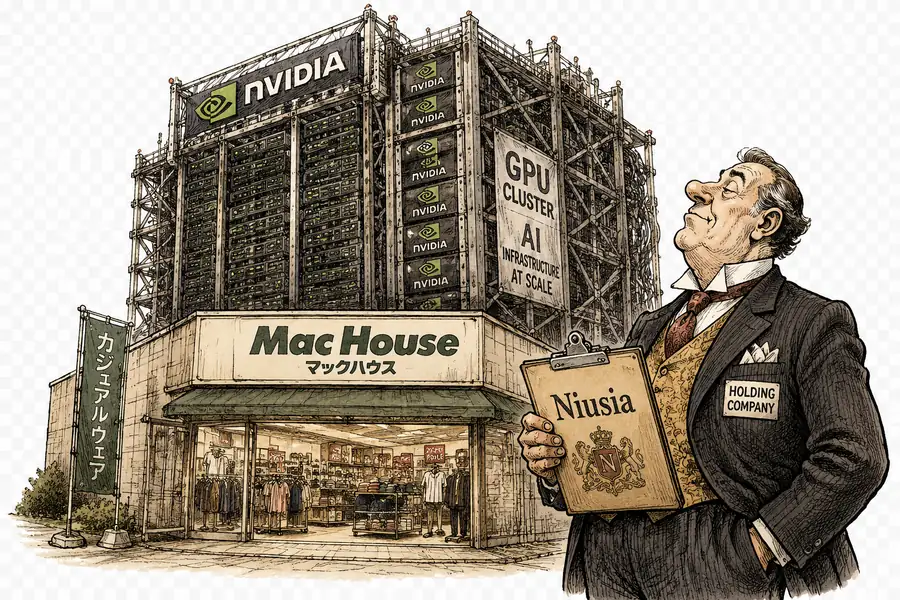
Mac House's August 1 agreement with Niusia is a generative AI business unit whose customers are listed as other apparel and retail companies. Operating under a capital alliance with GF Group, the chain isn't using AI to cut costs; it is entering the AI services market with its own stores as customer-zero.
Sir John Crabstone
On August 1, 2025, Mac House signed a basic agreement with the AI vendor Niusia to build a generative AI business unit. The document opens with Mac House’s own labour and cost problems; the six listed initiatives extend well past them, to image-generation BPO services for external customers, a joint venture to sell GenAI solutions to other apparel and retail companies, and a GPU cluster data centre. The internal uses sit on the same list as the outbound ones, not above them.
Western chains do not write announcements like this. Gap acquired CB4 in 2021 to apply predictive analytics inside its own merchandising; the implementation has lived inside Gap ever since. The customer in those documents is always Gap. Mac House’s announcement names the rest of the apparel sector instead.
The framing turns the cost question on its head. A retailer using AI to remove a photoshoot is paying down overhead; a retailer running other people’s photoshoots is booking revenue. The same model run lands in different rows on the income statement depending on whose products are on screen.
What makes the move legible is that Mac House is no longer Mac House.
Gyet, the rebrand we covered earlier this week, is the new identity of the chain now operating under a capital agreement with GF Group. The Niusia tie-up was filed under the old name, but the structure is the new one: a financial holding company that treats stores, EC, and product data the way a prior generation of buyers treated factories — as the captive demand that justifies building the supplier. The stores will use the AI. They are not the reason it is being built.
The supplier is being built out quickly. Mac House has agreed a parallel deal with ZeroField on a dual-revenue data centre running NVIDIA H100/H200/B200 capacity, with the stated aim of selling SaaS-style AI workloads onward. The mining revenue underwrites the AI buildout when AI demand is thin. That is not a retailer’s data centre. It is a holding company’s, written in a retailer’s filings.
Gap can buy a startup; it cannot, plausibly, become one. Its public market would not tolerate the income-statement geometry of outbound AI services billed at vendor multiples beside a denim P&L that trades at retail ones. A regional chain that answers to a holding company has no such constraint, because the holding company is the constituency. The cost-centre question only binds operators whose investors expect them to be operators.
The Niusia product line is exactly the toolkit an apparel BPO would resell: AI try-on, AI digital humans, video generation. The published list of initiatives reads less like a roadmap and more like a customer brief. The internal uses double as proof points; the proof points double as a reference deck. The clothing was always the lure.
There is one cleaner read of the announcement. Mac House is not pivoting to AI; GF Group is using Mac House to enter the AI services market with a built-in first customer, an apparel data set, and a pricing argument the customer cannot easily refute, because the customer wrote it. The retailer’s margin pressure is the vendor’s go-to-market.
The piece Western analysts keep missing is that the cost-centre debate is a debate about whose books these line items end up on. Mac House has answered for itself by changing whose books it is on.
The Niusia tie-up is small, the data centre is conceptual, and the joint venture is still in “deliberation.” The inversion is not. An apparel chain has filed a document in which it sells AI services to its competitors, and the competitors do not yet have a document that disagrees. They are about to need one.