Marangoni Shanghai Prices the Store at ¥140,000
Istituto Marangoni's Shanghai centre staged its graduate show as a retail environment and sells three of its four postgraduate certificates on the commercial side of the business. A school's catalogue is a hiring forecast it has to commit to years early, and this one names the luxury roles China still expects to fill with people.
Sir John Crabstone
A school cannot hedge. It prints the syllabus, takes the deposit, and finds out three years later whether the jobs were there. Istituto Marangoni’s Shanghai centre has now published its forecast. On 8 September its ten graduating designers showed their collections, staged as VIA NOMADIS, inside three linked rooms built to behave like shops, not along a runway.
The trade press filed this as pedagogy, and WWD’s headline called the result an immersive retail lab. The more useful reading is actuarial.
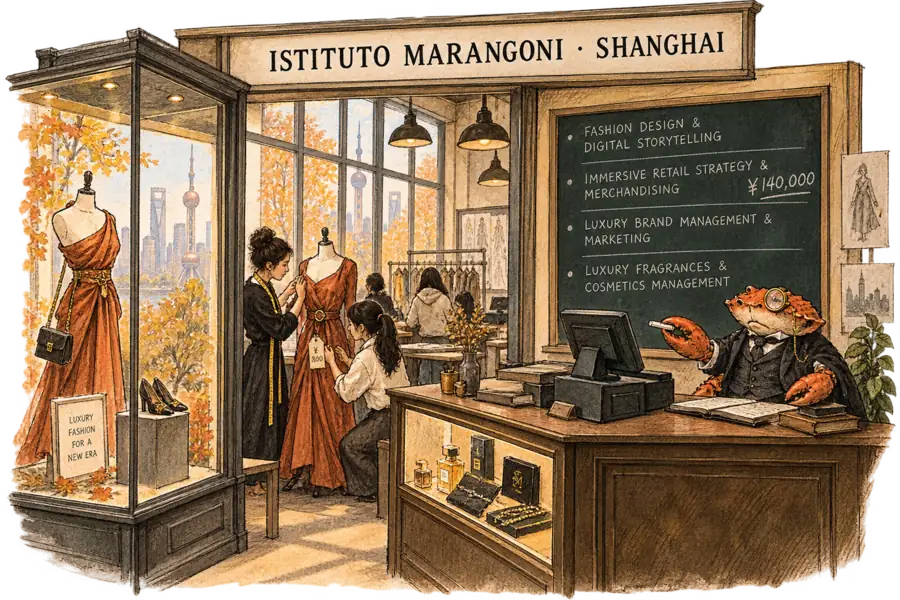
The catalogue is blunter than the show. Shanghai’s postgraduate offer runs to four certificates: Fashion Design & Digital Storytelling, Immersive Retail Strategy & Merchandising, Luxury Brand Management & Marketing, and Luxury Fragrances & Cosmetics Management. Three of the four teach the sale. Only the first carries storytelling in its title, which says plainly what the school expects a designer, as opposed to everyone else in the room, to be paid for.
The retail certificate arrives with a subtitle its marketing department should be congratulated for: “How to buy and sell the dream of fashion.” Tuition is ¥140,000, enrolment another ¥20,000, doors open on 11 October. Beneath the word immersive sit buying, merchandising, sourcing and negotiation. The exits it names are buyer, project manager, production director. Shanghai has renamed the buyer and kept the job.
Every prospectus is a wager on which humans a market will still pay for.
Ying Ting Cheng, chief operating officer for China and Asia-Pacific, explained the reasoning: stores “are becoming media, displays are becoming content.” On AI the boundary is drawn precisely. The tools generate images and alternatives at speed; what they cannot supply is “an individual’s lived experience, cultural memory, emotional sensitivity or personal point of view.” The school is selling the remainder and has set a price on it.
The division of labour at the show was that forecast in miniature: design students made the product, communication students the film and the narrative, management students the audience and the commercial logic. The group advertises a 91% graduate employment rate, which is the number a catalogue is written to protect. Nobody publishing a placement figure can afford to teach a closing job.
The market underneath is smaller than the prospectus sounds, though it is recovering, not simply shrinking. Mainland China’s personal luxury sales fell 3% to 5% last year, fashion by 5% to 8%, a moderation the report itself frames as far gentler than 2024’s sharper decline, with early signs of recovery already visible and modest growth forecast for 2026. Meanwhile 65% of all Chinese luxury buying happened inside the mainland, and beauty, the category you sample at a counter, grew 4% to 7%. The same report found consumers still favouring “emotional and sensory experiences over material goods.” The school is copying its forecast off the receipts, not off a downturn.
Brands are answering broken digital acquisition with leases, as we reported earlier today. Someone has to stand in those rooms and know what the room is doing. Shanghai has named that person, priced the training, and set the intake for autumn. The people who pay in October will be the first to learn whether the school read the market or flattered it.