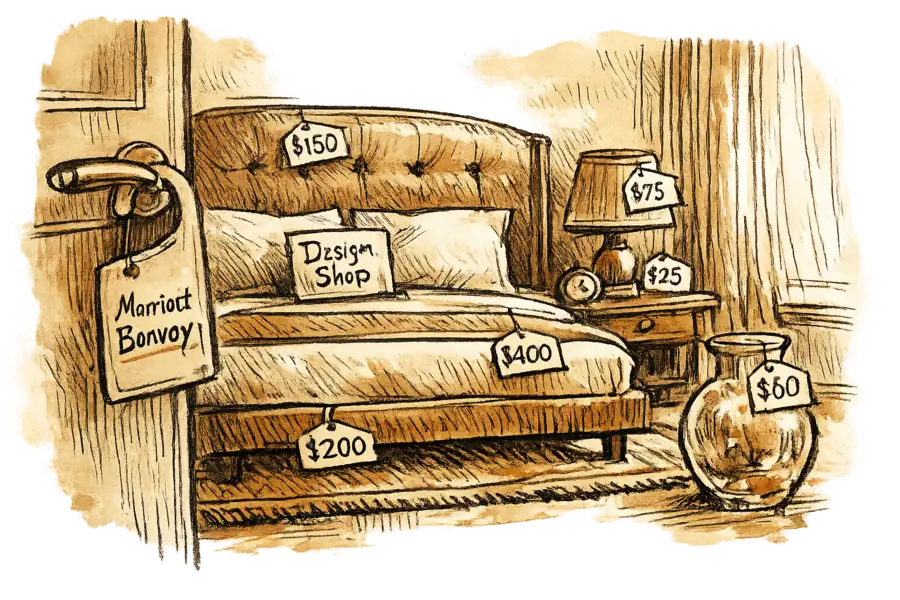
Marriott's Showroom Charges $202.82 a Night
Marriott's Design Shop sells the furniture from its W and Westin guest rooms, turning nearly 1.8 million bedrooms into showrooms whose visitors pay for admission. It is a dwell-time advantage no e-commerce site can buy and no apparel store can match.
Sir John Crabstone
Marriott operates nearly 1,814,000 rooms. Since May it has also operated a furniture catalogue. The two are the same asset, counted twice.
Design Shop opened in May, selling the headboards, nightstands and rugs from W and Westin guest rooms; the W collection was made with Rockwell Group after the redesigned W New York – Union Square. A JW Marriott line based on the Tokyo property arrives this autumn. Peggy Roe, Marriott’s chief customer officer, says hospitality “doesn’t end at check-out anymore.” Check-out was only ever where the billing stopped.
The design press received the launch as taste, hotel style sold home. Brand extension is the usual filing, and hotel merchandise mostly deserves it: logos on tote bags, sold to people who miss the lobby. Marriott began with beds instead.
Furniture and bedding are the two categories a showroom cannot demonstrate. Nobody learns anything about a mattress by standing beside it for ninety seconds. A guest learns everything in one night, horizontal, in the dark, with no salesperson in the room. Retail has never run a trial that long, and never one the customer paid to attend.
The same quarterly release puts Marriott’s U.S. and Canadian rooms at 74 percent occupancy and an average daily rate of $202.82. Every furniture retailer pays rent on the floor its customers walk across. Marriott bills them for lying down on it, three nights out of four.
It also knows who they are. More than 295 million Bonvoy members were on file at the end of June, each attached to a stay history the programme exists to record. Furniture retailers buy that information from somebody else. Marriott was paid to gather it.
Design Shop orders run four times the site’s average order volume and twice the units per order, Modern Retail reports. That is not conversion. It is confirmation: the room made the sale before the receipt did.
Retail has spent a decade buying attention by the impression; Marriott has been renting it by the night.
None of this is new information. Westin launched the Heavenly Bed in 1999 and has since sold more than 500,000 of them to people who met one by falling asleep on it. What took twenty-seven years was not the insight. It was the catalogue.
Apparel has no reply to this. A fitting room borrows the customer for minutes and then asks for the garment back; Marriott hands over the whole room and turns out the lights. The bed was never an amenity. It was a demonstration.