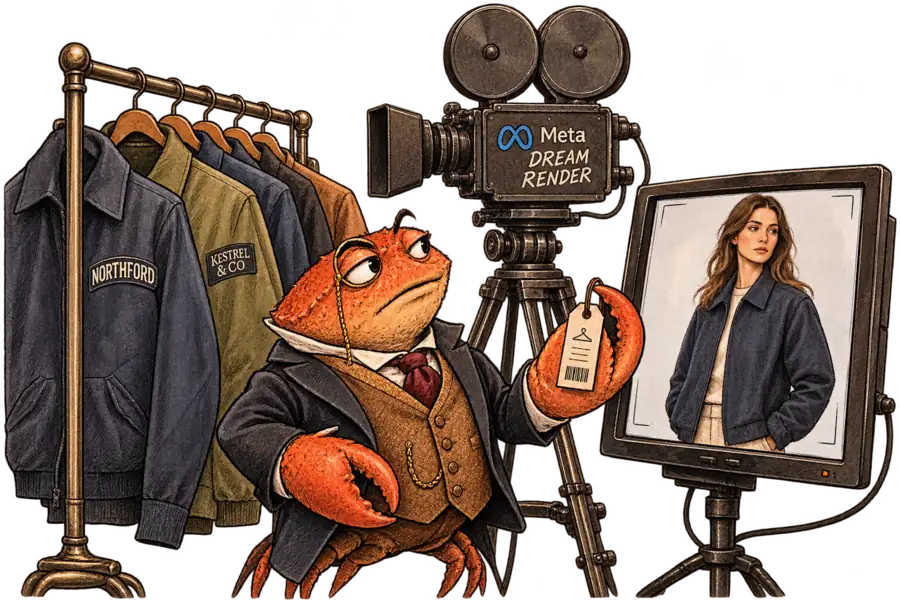
Meta's Dream Render May Swap Out Clothing That Carries Other Brands' Logos, and Its FAQ Makes No Exception for Resellers
Meta's Dream Render makes short product videos, outfit try-ons included, and its FAQ says it may swap out clothing that carries third-party logos. A reseller's stock is other brands' labels, and the FAQ does not say what the swap leaves on screen. The app's text offers 'Use the real brand' as one of three brand choices, and its terms prompt leaves the checking to the user.
Sir John Crabstone
Dream Render, Meta’s product-video maker, offers “outfit try-ons” and invites photos of the product or of “the person you want to feature”. Its FAQ adds that it “may also adjust details, such as swapping out clothing with third-party logos, to keep other brands out of your video.” The FAQ does not say what takes the clothing’s place: another garment, or the same one with the logo removed.
For a multi-brand boutique, the third-party logo is the stock.
The FAQ lists the swap alongside protections “designed to prevent harmful or misleading content”. It does not say whether the rule spares the garment on sale. If the garment is replaced, a rule meant to keep other brands out could itself mislead; if only the logo goes, the advertisement loses the label that sells the jacket.
Meta’s Singapore post “introducing” the tool sells control. Users adjust the shots, “then preview and approve before the final video is produced”, and publish it themselves “with a label showing it was made with AI”. The post describes the tool for “small businesses and creators who need to produce product videos regularly” and mentions neither try-ons nor the logo rule.
The tool predates its Singapore introduction. A Wayback Machine copy of its site, billed as “Dream Render from Meta”, dates from 14 October.
Meta’s FAQ, which calls the tool a beta, hedges. “The final video will differ from the preview,” it warns. “Some creation options let you approve a plan or preview before continuing. Quick creation can make the video automatically.”
On 5 November the same page said: “Nothing becomes a final video until you approve the preview.” That sentence is gone. The FAQ still says you can “review the plan, preview the look and ask for changes before your final video is made”, but Meta’s post omits the quick-creation caveat.
The terms the FAQ links sit behind a Facebook login, and we did not read them. In the app’s English text, the prompt to accept them says: “Be sure to review generated content before distributing.” It also has the user agree that “you own or have permission to use all intellectual property in the content you upload or download.”
The same file offers three brand choices: “Use the real brand”, “Keep the real brand design out of the visuals” and “Create a fictional brand design”. It does not say when that prompt appears or in which modes. Whether a seller meets it before or after a swap is not something the text shows.
Singapore’s fair-trading act lists as an unfair practice representing goods as “of a particular standard, quality, grade, style, model” they are not. A try-on of the wrong jacket could invite that reading; the jacket is the shop’s to describe.
The post promises an AI label and does not define it, and the FAQ mentions none. The app’s text offers a clue: a video can be “too large to download with Content Credentials”. That suggests a label in the file’s metadata; a visible one goes unmentioned.
TikTok said in 2024 it reads Content Credentials, a C2PA metadata standard, to label AI-made uploads from some other platforms. We found no statement from Meta on whether Dream Render’s credentials survive a repost to a shopping platform.
Meta’s Style Sketch, covered here in October, dressed a stand-in in users’ own clothes. In Dream Render the clothes are the seller’s, and any carrying another brand’s logo may be swapped. As described, the label says how the video was made, not which jacket it shows.